



- Home
- /
- Top Stories
- /
- Supreme Court Asks Union To...
Supreme Court Asks Union To Consider Rail Fare Concessions, Emergency Quota For Acid Attack Survivors
Debby Jain
16 July 2026 7:44 PM IST
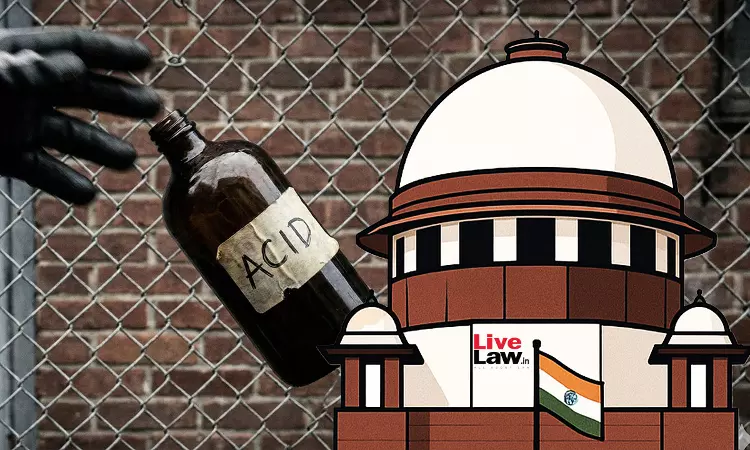
The Supreme Court today called on the Union of India to consider including acid-attack survivors in the category of Persons with Disability (PwD) who are granted concessions and/or emergency quotas by the Railways for treatment/periodical checkups.A bench of CJI Surya Kant, Justice Joymalya Bagchi and Justice V Mohana asked Additional Solicitor General Archana Pathak Dave to obtain...
This is a premium content
Available exclusively to
Our subscribers
Subscribe Premium 
INR 1099+GST
Your support helps us to bring you more content at
an affordable subscription scheme !!!
All payment options available
The Supreme Court today called on the Union of India to consider including acid-attack survivors in the category of Persons with Disability (PwD) who are granted concessions and/or emergency quotas by the Railways for treatment/periodical checkups.
A bench of CJI Surya Kant, Justice Joymalya Bagchi and Justice V Mohana asked Additional Solicitor General Archana Pathak Dave to obtain instructions, after hearing Advocate Anandh Venkataramani (for petitioner-Atijeevan Society).
The present public interest litigation was filed seeking concessional fares and emergency quota in the Railways for acid attack survivors. During today's hearing, ASG Dave informed that the government is already deliberating on provision of emergency quotas to all persons with disabilities (including acid attack survivors).
She further stated that out of 21, reservation and concessions in Railways are provided to 4 categories of PwDs - orthopedically handicapped/paraplegic patients, persons with intellectual disabilities, people who are visually impaired (travelling with or without escort), and persons with complete speech and hearing impairment. She highlighted that such travelers require full-time escorts.
On the other hand, Anandh Venkataramani informed that the government is in fact providing reservation to 9 categories of PwDs, including those suffering from thalassemia, hemophilia, sickle cell disease, and those who are deaf and dumb.
He further submitted that the coaching tariff, based on which reservations and concessions were traditionally being given to the PwDs, is in existence since 1902. It was revised in 1999 and 2015, that is, before the RPwD Act was enacted. "So the reservations that were given to these categories of PwDs were essentially a benevolent thing that the Railways was doing. It was not statutorily required to do so. But since 2016, Section 41(2) categorically requires them to do so. It's no longer a question of benevolence", he submitted.
Venkataramani further contended that acid attack survivors are predominantly women, who bear the brunt of the attack on their face. The law provides for compensation and immediate care at hospitals, but they have to undergo long treatments for their skin, eyes, etc. and sometimes, they are constrained to travel long distances for these treatments.
Hearing him, the bench asked the ASG to respond as to why acid attack survivors cannot be considered at par with cancer patients or persons with other chronic ailments for the purpose of concessional railways fares and emergency quotas to undertake periodic treatments/check-ups.
Some specialized treatments needed by such patients may only be available at multi-specialty hospitals in cities, Justice Bagchi noted.
In related news, the Supreme Court recently invoked its special powers to hold that persons forcibly made to consume acid, as well as those suffering internal injuries without visible external harm, also fall within the ambit of 'acid attack victims' under the Rights of Persons with Disabilities Act.
The clarification was issued since the Act defined 'acid attack victims' as only "a person disfigured due to violent assaults by throwing of acid or similar corrosive substance." The Court further directed that this clarification will have a retrospective effect from 2016.
Following the order, the Union recently notified necessary amendment in the law.
Case Title: ATIJEEVAN SOCIETY v. UNION OF INDIA AND ORS., W.P.(C) No. 30/2026
Tags

Debby Jain
Debby Jain is a Correspondent with LiveLaw, covering the Supreme Court of India

