



- Home
- /
- Top Stories
- /
- Supreme Court Upholds View That...
Supreme Court Upholds View That Eden Gardens Not A 'Public Place' For Levy Of Advertisement Tax
Debby Jain
14 Nov 2025 3:06 PM IST
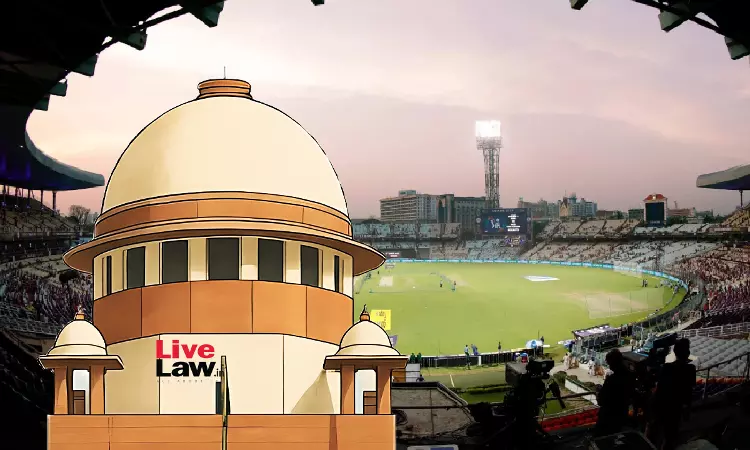
The Supreme Court today dismissed a challenge to the Calcutta High Court order which held that Eden Gardens stadium was not a "public place" for the purpose of levying advertisement tax under the Kolkata Municipal Corporation Act.A bench of Justices Vikram Nath and Sandeep Mehta heard the matter. Senior Advocate Jaideep Gupta appeared for petitioner-Kolkata Municipal Corporation. Senior...
This is a premium content
Available exclusively to
Our subscribers
Subscribe Premium 
INR 1099+GST
Your support helps us to bring you more content at
an affordable subscription scheme !!!
All payment options available
The Supreme Court today dismissed a challenge to the Calcutta High Court order which held that Eden Gardens stadium was not a "public place" for the purpose of levying advertisement tax under the Kolkata Municipal Corporation Act.
A bench of Justices Vikram Nath and Sandeep Mehta heard the matter. Senior Advocate Jaideep Gupta appeared for petitioner-Kolkata Municipal Corporation. Senior Advocate Rajiv Shakdher appeared for respondents.
Gupta argued that every bit of the Eden Gardens stadium can be seen from outside. Besides, the events are televised and most revenue generation happens because of that. Therefore, he contended, Eden Gardens stadium is a public place in public view.
Hearing him, the bench noted that it's the boundary wall of the stadium which can be seen from outside. "These days people can put up drones and see advertisements. That means it's public view? [Taking] too far", remarked Justice Mehta.
When the bench dismissed the petition, Gupta requested that the question of law may be left open, but it did not pass any such direction.
Background
Cricket Association of Bengal (CAB) organized the Wills World Cup 1996 inaugural ceremony and a semifinal match at Eden Gardens on February 11 and March 13, 1996. Following this, the Kolkata Municipal Corporation issued a demand notice on March 27, 1996, seeking ₹51,18,450 as advertisement tax under Section 204 of the KMC Act, 1980. CAB and its office bearers challenged the demand through a writ petition.
The demand notice was challenged for being outside the scope of Section 204 KMC Act, arbitrary and violative of natural justice, and barred by Article 285 of the Constitution. The Single Judge accepted these grounds and quashed the notice, prompting KMC's appeal.
Before a Division Bench, KMC submitted that when entry to Eden Gardens is thrown open to the public at large on purchase of ticket, the Eden Gardens ground/Stadium does not remain a private place but attains the status of a restricted public place. It was further submitted that advertisements at Eden Gardens were visible to the public attending the events and through broadcasts viewed from public places, making Section 204 of the KMC Act applicable.
In reply, the CAB submitted that the in-stadia advertisements were displayed entirely within the Eden Gardens Stadium and were not visible from outside. To view them, one had to enter the stadium and the interior of Eden Gardens did not qualify as a "public street" under Section 2(71) of the KMC Act, 1980.
It was further submitted that Access to Eden Gardens Stadium is neither absolute nor unrestricted. Entry is controlled by CAB and limited to specific match days, requiring valid tickets that permit access only to designated areas for a limited time. Since access is conditional and limited in scope and number, the stadium cannot be considered a "public place." Accordingly, no advertisement tax is payable for in-stadia advertisements under the KMC Act.
Going through the material, the High Court observed inter-alia that considering the restricted and conditional access to Eden Gardens Stadium, and the fact that entry is subject to CAB's discretion—even during events—the Stadium cannot be classified as a "public place." Mere capacity to hold a large audience does not equate to unrestricted public access. It held that even if advertisements are seen by thousands within a packed Eden Gardens Stadium, the venue remains a private space due to the absence of unrestricted public access. The critical test is not the number of spectators or the scale of the venue, but whether the general public has an absolute right of entry. Since entry is conditional and controlled by CAB, KMC cannot levy advertisement tax under the pretext that it is a public place.
Case Title: THE KOLKATA MUNICIPAL CORPORATION AND ANR. Versus THE CRICKET ASSOCIATION OF BENGAL AND ORS., SLP(C) No. 28566/2025
Click Here To Read/Download Order

Debby Jain
Debby Jain is a Correspondent with LiveLaw, covering the Supreme Court of India

