



- Home
- /
- Top Stories
- /
- 'When Law Enforcers Turn...
'When Law Enforcers Turn Extortionists' : Supreme Court Cancels Pre-Arrest Bail Of Policemen Accused Of Extortion
Gursimran Kaur Bakshi
3 Jun 2026 12:09 PM IST
The Supreme Court recently cancelled the anticipatory bail granted to three police officers accused of allegedly extorting money from a jeweller. It remarked that when law enforcers turn extortionists, the citizens are left in a dilemma as those who are meant to protect them become the ones against whom the citizens have to ask for protection: "When law enforcers turn extortionists, the...
This is a premium content
Available exclusively to
Our subscribers
Subscribe Premium 
INR 1099+GST
Your support helps us to bring you more content at
an affordable subscription scheme !!!
All payment options available
The Supreme Court recently cancelled the anticipatory bail granted to three police officers accused of allegedly extorting money from a jeweller.
It remarked that when law enforcers turn extortionists, the citizens are left in a dilemma as those who are meant to protect them become the ones against whom the citizens have to ask for protection: "When law enforcers turn extortionists, the citizen looks askance and is left in a dilemma. To confront, is to invite instant retaliation and the option is only to succumb meekly to the uniformed authority, even when there is patent abuse."
To briefly put it, a father and his minor daughter were travelling from Mumbai accompanied by his brother-in-law. They were detained by the police at the railway station. While searching their bags, a gold bar of 14 grams and cash of Rs. 31,900 were detected. They were then allegedly taken to a nearby room and were forced to give the cash in return for the gold bar. The father then lodged a first information report, following which the officers were denied anticipatory bail by the Sessions Court. However, the Bombay High Court allowed their plea after viewing the CCTV footage collected during the investigation. As per the High Court, the accused persons were wearing identity cards, and the father and her daughter showed no signs of distress, coupled with the delay in lodging the FIR.
This was challenged by the State of Maharashtra through a special leave petition before the Supreme Court. During the hearing, Advocate Bharat Bagla(for the State) submitted that as per the various guidelines, the search and seizure is conducted with proper video recording. However, the police men had taken the father and her daughter to a room where there were no cameras. He added that the State does not tolerate such uniformed excesses against citizens and informed the Court that the three officers were dismissed from service after a proper enquiry.
As for the accused persons, Senior Advocate Sudhanshu S. Choudhary emphasised the delay in lodging the FIR, the return of the gold bar and the alleged unnecessary vindication by the State against the officers who have more than 20 years of unblemished service.
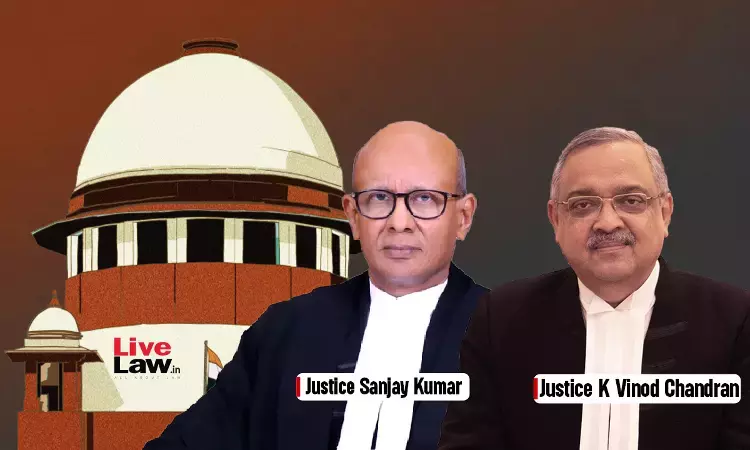
Terming the High Court's order as 'cryptic', a bench comprising Justice Sanjay Kumar and Justice K Vinod Chandran remarked that while the expressions of the persons are not clear in the CCTV footage, there are some clear signs of distress which the High Court surprisingly failed to notice.
"We are surprised that the High Court observed that there is no sign of distress on them, especially when their expressions are not clear in the footage. We also noticed that the two adults were moving ahead, one of them gesturing frantically with his hands while the child was trailing behind: a definite indication of distress. We also find that the time they spent inside the closed room was sufficient for the police men to carry out the complained of actions, which we hasten to observe have to be in any event proved in a criminal trial."
The Court also rejected the senior counsel's contention that the subsequent return of the gold bar by the accused police officers militated against the allegation of extortion, observing that the very act of returning the gold bar lent credence to the prosecution's case.
Referring to the Standard Operating Procedure (SoP) governing the handling of valuable items recovered during searches, the Court noted that police personnel are required to verify the barcode-linked identification card issued by the jewellers' association. The SoP further mandates that such inspections be conducted in a secure location under video surveillance and that the search be duly recorded in the prescribed register.
Examining the register produced before it, the Court found that the complainant's name was not recorded. It also expressed concern over the insensitivity displayed by the police personnel towards the minor child who was accompanying the persons detained at the time of the incident.
Citing State of Jharkhand v Sandeep Kumar(2024), the Supreme Court noted that the High Court threw to the winds the caution expressed by the Court that the grant of anticipatory bail to a wayward police officer has been frowned upon, especially when there is a clear abuse of authority. The Court here had said that the standard applied to a layman for the purpose of anticipatory bail is different from that applied to a police officer who is meant to uphold the law.
On the basis of all this, the Court deemed fit to cancel their anticipatory bail: "On the above reasoning, we set aside the order of the High Court and cancel the anticipatory bail granted. The State and the police force shall take appropriate measures. But we make it clear that observations made by us hereinabove are prima facie in nature and only on the propriety of granting anticipatory bail on the peculiar facts, which if found true, erodes the credibility of the force and vitiates the trust placed on them to maintain law and order; which in any event shall not govern the trial as such."
Case Details: The State of Maharashtra v. Rahul Datta Bhosale & Ors|Special Leave Petition (Crl.) No.1760 of 2026]
Citation : 2026 LiveLaw (SC) 592
Gursimran Kaur Bakshi
Gursimran is the Principal Correspondent with LiveLaw for the Supreme Court. She can be reached out at: simrankaurbakshi@livelaw.in

