



- Home
- /
- Top Stories
- /
- Prosecution Should Focus On...
Prosecution Should Focus On Securing Conviction Than Opposing Bail: Supreme Court Flags Increasing SLPs Against Bail Orders
Debby Jain
22 July 2026 4:49 PM IST
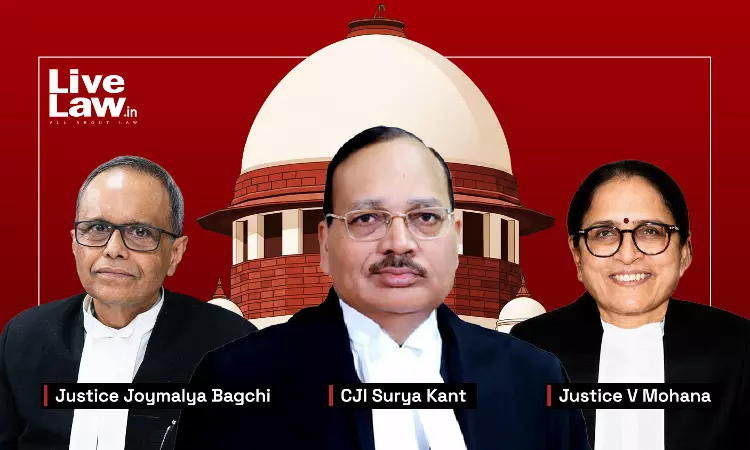
The Court also raised concerns over lengthy bail orders being written by the High Courts.
The Supreme Court on Wednesday voiced serious concerns over the growing number of appeals against bail orders reaching the apex court, observing that prosecutors should focus more on securing convictions than opposing bail and reiterating that bail matters should ordinarily rest with the High Courts.A Bench comprising Chief Justice of India Surya Kant, Justice Joymalya Bagchi and Justice V...
This is a premium content
Available exclusively to
Our subscribers
Subscribe Premium 
INR 1099+GST
Your support helps us to bring you more content at
an affordable subscription scheme !!!
All payment options available
The Supreme Court on Wednesday voiced serious concerns over the growing number of appeals against bail orders reaching the apex court, observing that prosecutors should focus more on securing convictions than opposing bail and reiterating that bail matters should ordinarily rest with the High Courts.
A Bench comprising Chief Justice of India Surya Kant, Justice Joymalya Bagchi and Justice V Mohana refused to cancel the bail granted to Chaitanya Baghel, son of former Chhattisgarh Chief Minister Bhupesh Baghel, in the alleged Chhattisgarh liquor scam. While dismissing petitions filed by the Enforcement Directorate (ED) and the State Economic Offences Wing (EOW), the Court expunged certain adverse remarks made by the Chhattisgarh High Court against the prosecution, holding that they were "completely uncalled for."
During the hearing, Justice Joymalya Bagchi questioned the increasing tendency of prosecutors to challenge bail orders before the Supreme Court instead of concentrating on ensuring successful prosecutions.
"If a prosecutor and an investigator invest so much on interlocutory liberties, his ultimate duty to procure a conviction is lessened," Justice Bagchi observed.
He pointed out that conviction rates have declined to around 40-50 per cent while the Supreme Court's docket remains burdened with challenges to bail orders.
"When it is a [diminution] of Article 21 rights, we have to see the balance of Article 21 (right of victim) and the commitment of courts to the society, administration of justice. These are the guiding principles...Number of SLPs have burgeoned in the last couple of decades. Cancellations. This is concern of the Court. Today, every bench has not less than 10 SLPs against interlocutory bail jurisprudence. Why we are so concerned? If a prosecutor and an investigator invests so much on interlocutory liberties, his ultimate duty to procure a conviction is lessened. You can justify social accountability to continued undertrial detention. At the same time, absolve yourself from the higher test of ensuring a full-proof conviction.
This is when bringing in so much of correctness of an order of bail is infact tilting the scale for a prosecutor who can ensure continued detention in one hand, and be absolved of a responsibility of a fair, just trial, which the victim wants for conviction. How many cases...73% detenus in India are undertrials. What is the conviction rate? Today it has decreased to around 40% or 50%. Not less than 1/3rd of those undertrials are acquitted. And mind you, these are not always honorable acquittals. They are acquittals because the investigator slipped, the prosecutor failed. This is where the attention should lie. The accountability should lie that we have been able to procure a conviction, not procured a cancellation. These observations from the bench are observations of concern about the administration of criminal justice and not liberty of X, Y or the respondent. We are least concerned about that."
"Under Article 136, we are not so concerned with the correctness of an order. We are concerned with the balance of liberty against rule of law. So in this situation, to put or pitch the liberty of an individual on the legal artistry of an order or the judicial sustenance of an order may be the wrong approach. On the other hand, we should dig deeper and see, notwithstanding the illegality of an order, whether the scales of justice require deprivation of liberty? We do not feel that the scale of justice would be served by going into the correctness of the order and guillotining liberty on that score."
Justice Bagchi further questioned Jethmalani whether legal soundness of an order should become the sole test for depriving a person of his liberty? He also said that bail matters should ideally rest at the High Court level and lamented a growing trend of bail orders being challenged before the Supreme Court.
"We have developed an interesting jurisprudence. The jurisprudence of review...that not merit review, but a judicial review jurisdiction to test liberty. We would request you, as one of the most experienced senior advocates of the Bar, that is it a correct approach and particularly in the court of last resort - that the correctness of an order becomes the sole and only test to deprive liberty where liberty had been restored?
Or should there be another layer? That okay order is wrong...reasons are absent...but when a court interferes under Article 136, it interferes on the anvil whether the continuance of liberty is so egregious that it affects the administration of justice. If it does not, why should we interfere? There may be wrong orders- right, left and centre. And this is where the bulk of interlocutory bail jurisprudence we have developed in the court of last resort. In the 80s, Justice Bhagwati said orders of bail should rest at the High Court."
The Court also expressed concern over High Courts delivering lengthy bail orders, particularly in cases under the Prevention of Money Laundering Act (PMLA) and the Unlawful Activities (Prevention) Act (UAPA).
"What we have seen... 40-page bail orders in PMLA cases, 50-page bail orders in UAPA cases... why?" Justice Bagchi asked, observing that judges' time must be apportioned appropriately.
Additional Solicitor General SV Raju responded that judges often write detailed orders because bail decisions are cited in subsequent cases on the principle of parity.
CJI Surya Kant acknowledged that the Supreme Court itself was partly responsible for this trend.
"We are partly responsible because whenever a short order is passed, we interfere," the CJI remarked, adding that lengthy bail orders often result in judges commenting extensively on the merits of the case.
Solicitor General Tushar Mehta agreed that while bail orders need not run into dozens of pages, they should nevertheless contain adequate reasons.
"It need not be an article for a law review. A judgment and an article for law review has to have a difference," he said.
The hearing also highlighted delays in disposal of bail applications in High Courts. The CJI referred to a case heard a day earlier in which an advocate had remained in custody because his bail application had not been decided by the High Court for over two years.
"What to do? An advocate has failed to secure an order on merit for last more than two years... We can visualize what must be happening," the CJI observed.
At this juncture, Senior Advocate Siddharth Dave commented that in Allahabad High Court, not just judges, but advocates are also responsible for delayed hearings. "They will take a passover...passover in Allahabad means for the next week, because there are 300 bails, it will not come up only". "That High Court is an overburdened High Court...the amount of work the judges are doing is remarkable", said CJI Kant in response.
Justice Bagchi, however, stressed that the legal incorrectness of a bail order could not by itself justify depriving an accused of liberty.
ASG Raju ultimately agreed that every legally flawed bail order need not necessarily be cancelled, though he expressed concern that such orders could be cited as precedents in future cases. Justice Bagchi responded that the Court would clarify that aspect.
At this point, Sibal pointed out that in the High Court order granting bail to Baghel, the judge has said that the order should not be used as a precedent. "Why the exception made for this individual?" Jethmalani questioned.
Responding to this, senior counsels for Baghel said that while many accused in the case are on bail, others have not been arrested and the trial has not even begun. "Please do not bring up the facts of your case...there are some very serious reservations", Justice Bagchi told them later.
Sharing his personal opinion, Justice Bagchi further complimented the judgment authored by Justice Surya Kant (as he then was) in KA Najeeb. "It really created an avenue for release under Article 21, in light of the statutory bars" the judge said.
In this regard, Rohatgi lamented that despite the pathbreaking judgment in KA Najeeb, some courts have sought to distinguish the cases before them and not applied the mandate laid down in that case. "Still we have to go on struggling after that judgment. In High Courts...and I am sorry to say, sometimes in Supreme Court as well," Rohatgi said.
Subsequently, Justice Bagchi reiterated that Article 136 jurisdiction is not one of judicial review. "It's a repository of ensuring justice and interpretation of the Constitution", the judge said.
The Bench eventually refused to interfere with the grant of bail but expunged the High Court's remarks against the prosecution.
The Court also disposed of Chaitanya Baghel's separate petition challenging his arrest by the ED, noting that he had already been granted bail and had not misused the concession. However, it kept open the larger legal question of whether prior court permission is required before conducting further investigation in complaint cases, observing that the issue would be decided in an appropriate future case.
Appearance: Senior Advocates Kapil Sibal, Mukul Rohatgi, N Hariharan, Siddharth Dave and Advocates Mayank Jain, Harshwardhan Parganiha, Madhur Jain and Arpit Goel (for Chaitanya Baghel); Senior Advocate Mahesh Jethmalani (for State)and ASG SV Raju (for ED)
Case Title: CHAITANYA BHAGHEL v. DIRECTORATE OF ENFORCEMENT, SLP(Crl) No. 17232/2025 (and connected cases)
Tags

Debby Jain
Debby Jain is a Correspondent with LiveLaw, covering the Supreme Court of India

