



- Home
- /
- Top Stories
- /
- Supreme Court Expresses Reluctance...
Supreme Court Expresses Reluctance To Set Timeline For Centre To Decide Citizenship Of CAA-Protected Refugees
Debby Jain
24 March 2026 6:28 PM IST
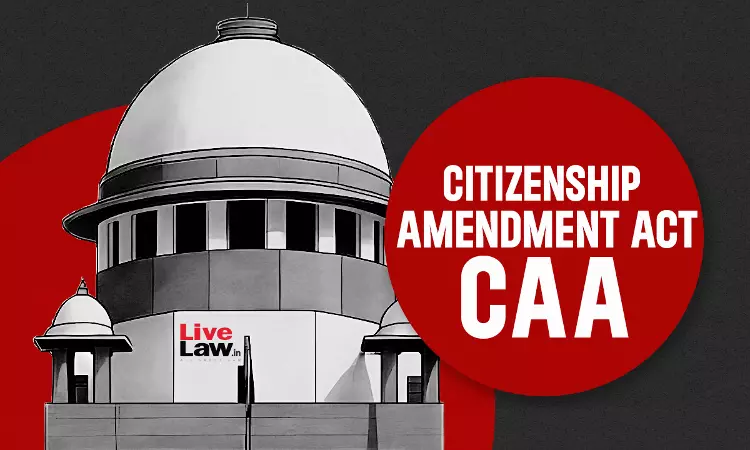
The Supreme Court today expressed reluctance to set timelines for the Centre to decide applications seeking Indian citizenship as per the Citizenship Amendment Act, 2019, saying that it was a matter for executive decision, where "minimised judicial intervention" was desirable.The Court was hearing a plea seeking citizenship for refugees from Bangladesh in West Bengal, who are eligible for...
This is a premium content
Available exclusively to
Our subscribers
Subscribe Premium 
INR 1099+GST
Your support helps us to bring you more content at
an affordable subscription scheme !!!
All payment options available
The Supreme Court today expressed reluctance to set timelines for the Centre to decide applications seeking Indian citizenship as per the Citizenship Amendment Act, 2019, saying that it was a matter for executive decision, where "minimised judicial intervention" was desirable.
The Court was hearing a plea seeking citizenship for refugees from Bangladesh in West Bengal, who are eligible for the benefit of the CAA. The petitioners raised the apprehension that they might be disenfranchised in the SIR process, as their CAA applications have not been processed.
The Court orally noted that there is a statutory regime in place (Citizenship Amendment Act 2019) and now it is for the Centre to see how it has to give effect to it.
A bench of CJI Surya Kant and Justice Joymalya Bagchi was hearing a special leave petition filed by NGO Aatmadeep. The petition challenges a Calcutta High Court order that declined to entertain a PIL seeking protection for Hindu, Buddhist, Christian and Jain refugees who entered India before 2014 but have not yet been granted citizenship.
During the hearing, Senior Advocate Karuna Nundy, for the petitioner, submitted that the Citizenship Amendment Act intended to reduce the time period (of naturalization) from 11 years to 5 years for specific minorities. But already two years have passed since the CAA Rules were notified and the applications are still pending, she stated, highlighting the need for the Court to set timelines.
"These are religiously persecuted minorities from Afghanistan, Pakistan and Bangladesh. Our prayer is to expedite in line with other provisions of the Citizenship Act. There is no doubt that this is in the realm of the Centre and the empowered committee setup by it. What we are seeking is a timeline. It's been 2 years. The intent of the Act was to reduce the time period from 11 years to 5 years. Now 2 additional years have passed and there is no timeline that has been specified. If they can commit to a timeline, the work will be done", Nundy urged.
In response to the submissions, CJI Kant conveyed that the Court would not like to significantly intervene in the matter, as there is a new statutory regime in place.
"This is an issue where we would like to have minimized judicial intervention because they have to verify...Statute is now there. The amended law is there in your favor. Favor in the sense there is hope now under the new statutory regime... Now how they will give effect to it, you have to leave it to their machinery - verification part, ascertainment of facts, etc.", the CJI said.
Notably, Nundy also highlighted that earlier, the Union had sought 3 weeks' time to place its response before the Court on affidavit. In this regard, Solicitor General Tushar Mehta said, "It's under process. Non-filing of affidavit is not because of lack of interest".
Calling for a "concrete response" from the Union, the bench re-listed the case.
Earlier also, the Court had expressed reluctance to interfere and turned down a prayer to include the CAA applicants in the voters list, saying that first, citizenship has to be acquired before seeking
Case Title: AATMADEEP v. THE UNION OF INDIA | SLP(C) No. 034474/2025
Tags

Debby Jain
Debby Jain is a Correspondent with LiveLaw, covering the Supreme Court of India

