



- Home
- /
- Top Stories
- /
- Supreme Court Declines Plea Seeking...
Supreme Court Declines Plea Seeking Reservation For Advocates From Scheduled Castes & Scheduled Tribes In Bar Councils
Amisha Shrivastava
22 Jan 2026 7:00 PM IST
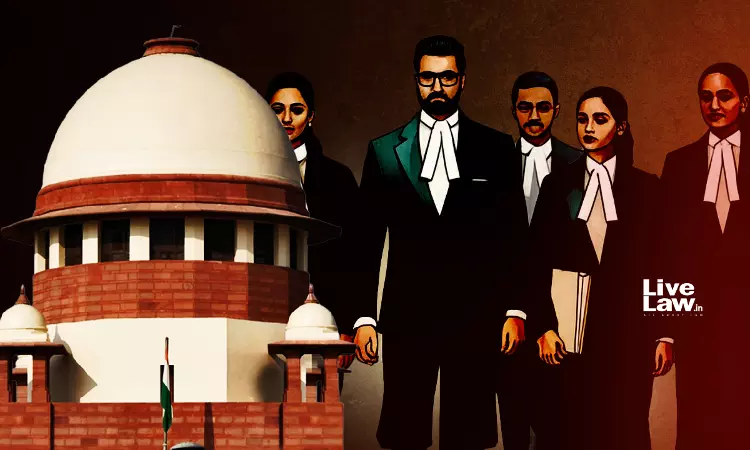
The Supreme Court today declined to issue directions for reservation for Scheduled Caste and Scheduled Tribe advocates in elections of State Bar Councils and the Bar Council of India, holding that such a measure can be provided only through a statutory amendment.A bench of Chief Justice Surya Kant, Justice Joymalya Bagchi and Justice Vipul Pancholi stated, “It is not in dispute that such...
This is a premium content
Available exclusively to
Our subscribers
Subscribe Premium 
INR 1099+GST
Your support helps us to bring you more content at
an affordable subscription scheme !!!
All payment options available
The Supreme Court today declined to issue directions for reservation for Scheduled Caste and Scheduled Tribe advocates in elections of State Bar Councils and the Bar Council of India, holding that such a measure can be provided only through a statutory amendment.
A bench of Chief Justice Surya Kant, Justice Joymalya Bagchi and Justice Vipul Pancholi stated, “It is not in dispute that such a reservation can be provided only through amendment in the statute for which State Bar Council of Telangana, as well as the Bar Council of India, took a categorical stand before the High Court that the matter has been taken up With the competent authorities and is under active consideration. That being so, we find it difficult to issue a mandamus to provide any reservation to SC ST in the absence of an express provision.”
The Court was hearing a writ petition by Universal Dr. Ambedkar Advocates Association seeking a declaration that “proportional representation” under Section 3(2)(b) of the Advocates Act, 1961 includes proportional representation of Scheduled Castes, Scheduled Tribes and other marginalized communities in State Bar Councils and the Bar Council of India.
In the alternative, the petitioner sought directions to reserve seats for these communities till appropriate legislation is enacted.
Section 3(2)(b) of the Advocates Act provides that members of State Bar Councils are to be elected in accordance with the system of proportional representation by means of the single transferable vote.
It stipulates that State Bar Councils shall consist of fifteen members where the electorate does not exceed 5,000 advocates, twenty members where the electorate exceeds 5,000 but does not exceed 10,000 advocates, and twenty-five members where the electorate exceeds 10,000 advocates.
During the hearing, the petitioner's counsel highlighted that the Court had earlier ensured inclusivity and parity for women lawyers in Yogamaya M.G. v. Union of India and Ors. and for specially abled persons in Pankaj Sinha v. Bar Council of India and Ors., and submitted that Scheduled Caste and Scheduled Tribe advocates were now seeking similar consideration.
She counsel urged the Court to carve out alternative measures such as co-option or reduction in registration fees, as was done in Pankaj Sinha, to address the absence of representation. She added, “In many other verticals also, be it Parliament or any other managing, governance body, SC ST is given a special category.”
Responding to this, the Chief Justice said that it was “too late” at this stage and noted that the Court had already directed the authorities to examine the issue, which would require statutory intervention.
When parity with women lawyers was pressed, Justice Surya Kant observed, “With great difficulty, we have been able to create an environment where consensus arrived at for the women lawyers they have been able to agree otherwise, the entire legal fraternity…”
He added that providing reservation would require a comprehensive amendment to the Advocates Act by Parliament.
The petitioner's counsel, Senior Advocate NS Nappinai, acknowledged that legislative amendment was the long-term remedy but requested limited interim relief.
At the CJI's prompting, she read the petition which highlighted proceedings before the Telangana High Court, wherein the Bar Council of Telangana had forwarded a representation seeking such reservation to the Bar Council of India. She pointed out that it was just for Telangana, and the petition was seeking similar parity across other states.
Justice Surya Kant noted that the issue was already under active consideration of the Bar Council of India.
In the order, the Court noted that the petitioner was seeking a direction for reservation for Scheduled Castes and Scheduled Tribes in State Bar Councils and the Bar Council of India, and that it was not in dispute that such reservation could be provided only through amendment of the statute.
The Court noted that both the State Bar Council of Telangana and the Bar Council of India had taken a categorical stand before the High Court that the matter had been taken up with the competent authorities and was under active consideration.
“In that being so, we find it difficult to issue a mandamus to provide any reservation to SC ST in the absence of an express provision,” the Court said.
On the plea of parity with women members of the Bar, the Court observed that representation of women lawyers in Bar Associations and Bar Councils had been ensured through consensus and active support of the respective bodies.
The Court added that it goes without saying that the petitioner would be at liberty to approach the competent authority to seek appropriate remedies.
At the end of the hearing, the petitioner's counsel sought a clarification that the Bar Council could consider extending the same remedies granted in Pankaj Sinha, including co-option and reduction in registration fees, to Scheduled Caste and Scheduled Tribe advocates.
The Chief Justice declined, noting that in some states Bar Council elections were already in the pipeline and it was too late to issue such directions at this stage. He added that if suitable amendments did not come, the petitioner could approach the Court at an appropriate time so that directions could be considered.
Case no. – W.P.(C) No. 6/2026
Case Title – Universal Dr. Ambedkar Advocates Association v. Union of India
Tags
Amisha Shrivastava
Amisha Shrivastava is a Senior Correspondent with LiveLaw, covering the Supreme Court of India. She can be reached at amisha@livelaw.in

