



- Home
- /
- Top Stories
- /
- Supreme Court Directs AIIMS To...
Supreme Court Directs AIIMS To Assess IIT Kharagpur Student Seeking Transfer To IIT Roorkee On Medical Grounds
Amisha Shrivastava
15 July 2026 1:37 PM IST
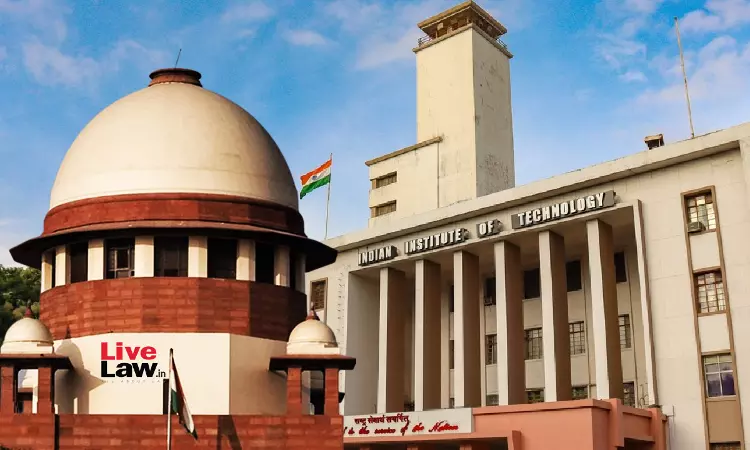
The Supreme Court on Wednesday directed the Director of AIIMS, New Delhi, to constitute a medical board to assess a student of Indian Institute of Technology (IIT), Kharagpur, who has sought transfer to IIT Roorkee on medical grounds.The Court also directed IIT Roorkee to keep one seat vacant pending consideration of his plea. The petitioner, belonging to Scheduled Caste, has sought transfer...
This is a premium content
Available exclusively to
Our subscribers
Subscribe Premium 
INR 1099+GST
Your support helps us to bring you more content at
an affordable subscription scheme !!!
All payment options available
The Supreme Court on Wednesday directed the Director of AIIMS, New Delhi, to constitute a medical board to assess a student of Indian Institute of Technology (IIT), Kharagpur, who has sought transfer to IIT Roorkee on medical grounds.
The Court also directed IIT Roorkee to keep one seat vacant pending consideration of his plea. The petitioner, belonging to Scheduled Caste, has sought transfer for mental healthcare treatment, on the ground that he was suffering from depression, and therapy facilities were not available at Kharagpur.
A bench of Justice BV Nagarathna and Justice R Mahadevan passed the interim directions after noting that the last date for admissions is July 17, 2026.
"Since the last date for admission is said to be 17th of July 2026, we direct IIT Roorkee to keep one seat vacant subject to the result of this writ petition," the Court ordered. It further directed the AIIMS Director to constitute a medical board, which shall evaluate the petitioner and submit its report before the Court. The matter has been listed for hearing on July 29.
The Court directed the petitioner to appear before AIIMS on July 20, observing that it would not be feasible to require him to travel to IIT Kharagpur for medical evaluation.
The petitioner, an Architecture student at IIT Kharagpur, has sought migration to IIT Roorkee, stating that he suffers from depression and requires specialised therapy that is unavailable in Kharagpur. According to his counsel, the treatment is presently available to him in Chandigarh and similar therapy facilities are available at IIT Roorkee. It was submitted that the therapy is regular in nature and may be required throughout his life.
The petitioner's counsel argued that the IIT rules governing transfers on medical grounds fully supported his case. It was contended that the applicable regulations require constitution of a medical board and approval of its recommendation by the Directors of both IITs, but no such medical board was ever constituted despite the petitioner applying for transfer on August 6, 2025, along with detailed medical records.
The counsel further submitted that two academic years had elapsed because the transfer request remained pending and clarified that the petitioner was seeking admission into the second year, contrary to IIT's contention that he had already completed three years of study. He also stated that the petitioner was willing to attend additional classes to bridge any academic gap.
At the outset, Justice Nagarathna expressed displeasure over IIT Roorkee's delayed appearance before the Court after notice had been issued.
Addressing the institute's counsel, she remarked, "How long did you take to file your vakalatnama? What is this? You are an educational institution and you don't appear before this Court. Today for the first time you are appearing and you are seeking adjournment."
Counsel appearing for IIT submitted that the institute had "full sympathy" for the petitioner's situation but pointed to differences in the curriculum and course parity between IIT Kharagpur and IIT Roorkee. It was also argued that the closing rank for admission to IIT Roorkee was significantly higher and permitting the transfer could set an undesirable precedent.
Justice Nagarathna, however, questioned the relevance of the closing ranks in the context of a transfer.
"He got a seat in IIT Kharagpur. The same merit must transfer," Justice Nagarathna observed, adding that the petitioner had secured admission to an IIT on merit and was only seeking migration on medical grounds.
When informed that IIT Kharagpur had no objection in principle to the petitioner's transfer, the Court noted in its order that the only impediment to migration to IIT Delhi was the difference in the curriculum for the B.E. Architecture course, and that the petitioner was instead seeking transfer to IIT Roorkee.
The Court observed that for such a transfer, a medical board was required to examine the petitioner before making any recommendation for migration. Since requiring the petitioner to travel to IIT Kharagpur for that purpose was impracticable, it entrusted the evaluation to AIIMS and protected the petitioner's claim by directing IIT Roorkee to reserve one seat until further orders.
In the petition filed under Article 32 of the Constitution, the petitioner referred to the recent judgment in Sukdeb Saha Vs State of Andhra Pradesh which declared that "mental health is an integral component of the right to life under Article 21 of the Constitution of India" and issued a set of guidelines to Higher Educational Institutions to protect the mental health of students.
Senior Advocate Shobha Gupta along with advocate Jaydip Pati represented the petitioner.
Case : XXX v. Indian Institute of Technology, Kharagpur and others | WP(C) 889/2025

Amisha Shrivastava
Amisha Shrivastava is a Senior Correspondent with LiveLaw, covering the Supreme Court of India. She can be reached at amisha@livelaw.in

