



- Home
- /
- Top Stories
- /
- DA Must Be As Per Formula In Rules...
DA Must Be As Per Formula In Rules : Supreme Court Directs To Refix Dearness Allowance Of Bengal Employees For 2008-19
Amisha Shrivastava
5 Feb 2026 12:30 PM IST
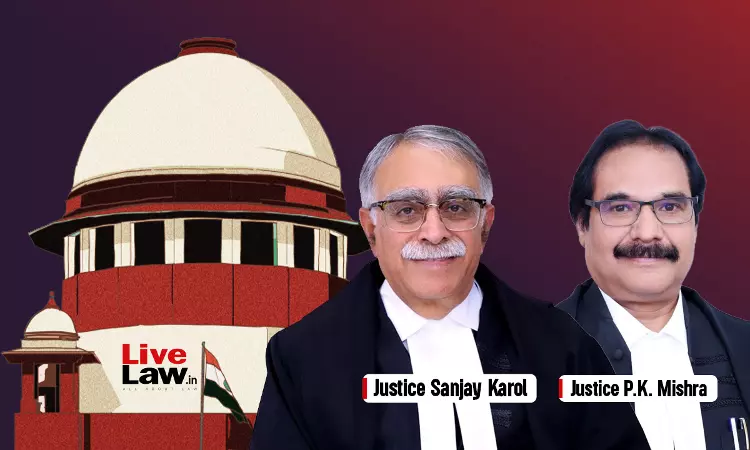
The Court formed a committee led by former judge Justice Indu Malhotra to oversee the implementation of the judgment.
The Supreme Court today held that West Bengal government employees are entitled to Dearness Allowance as per the West Bengal Services (Revision of Pay and Allowances) Rules, 2009 for the period of 2008-2019, calculated using the All-India Consumer Price Index.A bench of Justice Sanjay Karol and Justice Prashant Kumar Mishra held that once DA is defined by linking it to the All-India...
This is a premium content
Available exclusively to
Our subscribers
Subscribe Premium 
INR 1099+GST
Your support helps us to bring you more content at
an affordable subscription scheme !!!
All payment options available
The Supreme Court today held that West Bengal government employees are entitled to Dearness Allowance as per the West Bengal Services (Revision of Pay and Allowances) Rules, 2009 for the period of 2008-2019, calculated using the All-India Consumer Price Index.
A bench of Justice Sanjay Karol and Justice Prashant Kumar Mishra held that once DA is defined by linking it to the All-India Consumer Price Index as in the statutory rules, the State could not modify the manner of calculating DA through later office memoranda.
“DA, by its very nature, is non static, fluid and subject to change. How that change is to be carried out is through the AICPI. The first memorandum as also subsequent memoranda fall prey to the fatal flaw that they do not make reference to the AICPI which is absolutely essential to the determination the DA which, in turn is indispensable to the computation of the total amount of existing emoluments. As a necessary follow up thereto, it would be observed that the incorporation of AICPI cannot be termed as a one-time measure, and once DA was defined using it, to take a different path would be impermissible in law”, the Court held.
The Court partially upheld the Calcutta High Court's judgment directing the West Bengal government to pay Dearness Allowance to its employees calculated on the basis of the All-India Consumer Price Index average (1982=100), as prescribed under the Revision of Pay and Allowances Rules(ROPA) 2009.
The Court held that DA accrued as a legally enforceable right in favour of permanent employees of the State of West Bengal by virtue of its incorporation in the ROPA Rules.
The Court however, partly allowed the State's appeals against the High Court judgment, holding that the employees were not entitled to DA twice a year.
Background
The dispute relates to payment of Dearness Allowance to West Bengal government employees under the West Bengal Services (Revision of Pay and Allowances) Rules, 2009, framed after the Fifth Pay Commission was constituted in 2008.
In 2016, employees' unions approached the West Bengal Administrative Tribunal alleging prolonged non-payment and delay in release of DA despite ROPA 2009 linking DA to the All-India Consumer Price Index average of 536 (1982=100). They also alleged discrimination, pointing out that employees posted at Banga Bhawan in New Delhi and at the Youth Hostel in Chennai were being paid DA at Central Government rates.
On February 16, 2017, the Tribunal dismissed the application, holding that DA was within the State's discretion and not a legally enforceable right.
This order was set aside by a Division Bench of the Calcutta High Court on August 31, 2018, which held that to the extent the Fifth Pay Commission recommendations were accepted through ROPA 2009, the right to DA had crystallised into a legally enforceable right. The matter was remanded to the Tribunal to decide whether state employees were entitled to DA at Central Government rates and whether higher DA paid to employees posted outside West Bengal was discriminatory.
The State's review petition against the remand order was dismissed, rendering the finding on enforceability of DA final.
After remand, the Tribunal on July 26, 2019, held that state employees were not entitled to DA at Central Government rates but found discrimination in payment of higher DA to employees posted in New Delhi and Chennai. It directed the State to evolve norms for payment of DA based on the All-India Consumer Price Index and to clear arrears within fixed timelines.
The High Court dismissed the State's challenge to this decision, holding that once ROPA 2009 was framed under Article 309, the State could not depart from the statutory formula for DA. The States's review petition was dismissed on September 22, 2022, prompting the State to approach the Supreme Court.
Supreme Court verdict
The Court held that once DA was defined through reference to the AICPI, the subsequent memoranda issued by the State revising DA suffered from a “fatal flaw” as they did not refer to the AICPI.
The Court held that deviation from the AICPI-based framework without any rational basis amounted to manifest arbitrariness under Article 14 of the Constitution. It held that such deviation lacked a reasoned principle and rendered the State's action capricious.
“In the present facts, since the legislative exercise did incorporate AICPI into the framework, deviation therefore from without any basis falls in the lacking of reasoned principle prone to manifest arbitrariness passed from legislative competence. For the appellant state to have deviated from the recognized position to something else without laying groundwork therefore compromises the exercise, rendering it capricious”, the Court held.
The Court also held that a legitimate expectation arose in favour of employees once ROPA 2009 recognised the AICPI as the determining factor for DA computation.
The Court held that the findings returned by the Calcutta High Court in the first round of litigation had conferred a right on the employees. However, it agreed with the State that employees did not have a right to receive DA twice a year merely because the Central Government followed that pattern.
The Court further held that once a legal right to DA had accrued, financial capacity of the State could not be a ground to deny disbursement.
“We have elaborately discussed that once there is a right which is conferred upon a person, then fiscal policy cannot be come in the way of the disbursement of such rights”, the Court held.
The Court observed that the employees had been continuously pursuing their claims before various forums and DA claims were recurring in nature. Thus, it rejected the state's plea of delay and laches.
Directions issued
The Court held that employees were entitled to arrears of DA from 2008 to 2019. It clarified that any amounts paid pursuant to interim orders or the present judgment would not be recovered, even if there was a subsequent change in law.
Considering the financial implications and the need for phased relief, the Court constituted a committee to monitor implementation of the judgment. The committee will comprise Justice Indu Malhotra, former judge of the Supreme Court, former Chief Justice Tarlok Singh Chauhan of Jharkhand High Court, former Judge Gautam Bhiduri, and the Comptroller and Auditor General of India or a senior officer nominated by the CAG.
The committee has to determine the total amount payable and fixing a payment schedule in consultation with the State authorities. The Court directed that the exercise be completed before March 06, 2026 and the first instalment be paid by March 31, 2026. The Court held that retired employees are also entitled to benefits as per the judgment.
The Court directed the State to extend full logistical support to the committee and bear all related expenses. The committee is to submit a final status report after payment of the first instalment, detailing the determination made, the payment schedule adopted, and the status of compliance.
Case no. – SLP(C) No. 22628 - 22630/2022
Case Title – State of West Bengal v. Confederation of State Government Employees, West Bengal
Citation : 2026 LiveLaw (SC) 120
Click here to read the judgment
Tags

Amisha Shrivastava
Amisha Shrivastava is a Senior Correspondent with LiveLaw, covering the Supreme Court of India. She can be reached at amisha@livelaw.in

