



- Home
- /
- Top Stories
- /
- Supreme Court Disapproves Judgment...
Supreme Court Disapproves Judgment Denying Bail To Umar Khalid For Ignoring Binding Precedent In 'KA Najeeb'
Amisha Shrivastava
18 May 2026 11:09 AM IST
'Bail is the rule' even in cases under the UAPA, the Court noted.
The Supreme Court on Monday (May 18) expressed reservations about the judgment delivered by a two-judge bench in January this year in Gulfisha Fatima v. State (which denied bail to Umar Khalid & Sharjeel Imam in the Delhi riots larger conspiracy case) saying that it did not properly follow the judgment delivered by a three-judge bench in 2021 in Union of India v. KA Najeeb which...
This is a premium content
Available exclusively to
Our subscribers
Subscribe Premium 
INR 1099+GST
Your support helps us to bring you more content at
an affordable subscription scheme !!!
All payment options available
The Supreme Court on Monday (May 18) expressed reservations about the judgment delivered by a two-judge bench in January this year in Gulfisha Fatima v. State (which denied bail to Umar Khalid & Sharjeel Imam in the Delhi riots larger conspiracy case) saying that it did not properly follow the judgment delivered by a three-judge bench in 2021 in Union of India v. KA Najeeb which recognised long delay in trial as a ground for bail in cases under the Unlawful Activities Prevention Act.
The Court also expressed disapproval of the judgment of the two-judge bench delivered in 2024 in Gurwinder Singh v. Union of India for not applying KA Najeeb.
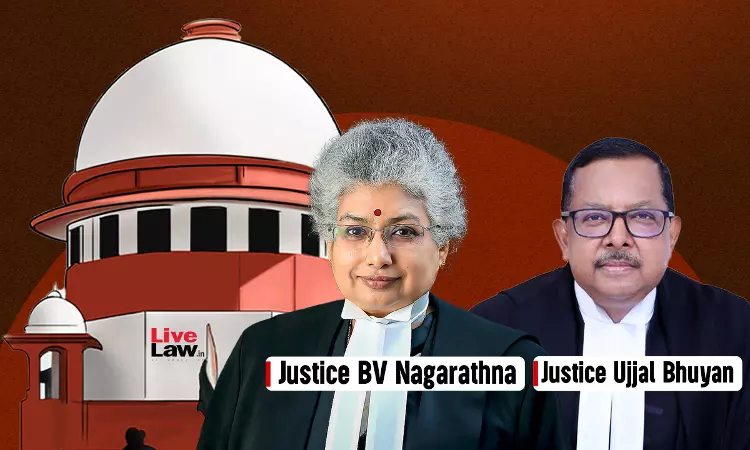
A bench comprising Justice BV Nagarathna and Justice Ujjal Bhuyan made these observations while allowing the bail plea of one Syed Iftikhar Andrabi, who has been under custody for over 6 years in a case under the UAPA for allegedly funding terrorism through supply of narcotics.
The judgment pronounced by Justice Bhuyan noted that the 3-judge bench in KA Najeeb had clearly held that prolonged incarceration was a ground for the Constitutional Courts to grant bail under UAPA despite the rigours under Section 43D(5) of the UAPA. However, the judgments delivered by two-judge benches in Gurwinder Singh and Gulfisha Fatima took a somewhat divergent view, Justice Bhuyan noted.
The bench observed that it was difficult to accept the views taken in Gurwinder Singh and Gulfisha Fatima.
"A judgment rendered by a bench of lesser strength is bound by the law declared by the bench of greater strength. Judicial discipline mandates that such a binding precedent must either be followed or, in case of doubt, be referred to a larger bench. A smaller bench cannot dilute, circumvent or disregard the ratio of a larger bench," Justice Bhuyan stated in the judgment.
The bench observed that the pre-Najeeb judgment in NIA v. Zahoor Ahmed Shah Watali (2019)cannot be invoked to justify prolonged pre-trial incarceration under UAPA. Hence, the attempt made in Gurwinder Singh to read Watali as laying down a general rule of bail denial in UAPA cases is difficult to reconcile with.
Also, the 'two-prong' test laid down in Gurwinder Singh was something which did not flow from either from the UAPA or the KA Najeeb decision. As per this two-prong test, bail will be considered only if the accused satisfies that there was no prima facie merit in the case. The Court stated that this was clearly contrary to the view in Najeeb that if there was a prolonged delay in trial, bail must be considered, regardless of other factors.
Highlighting the danger of adopting this two-prong test, Justice Bhuyan's judgment stated :
"If this test is accepted, the State needs only to satisfy a low prima facie threshold while the trial may continue for years, with the result that pre-trial incarceration begins to acquire a post-trial punitive character. And even then, no court will ever grant bail, no matter the length of period of such incarceration, because the case is prima facie true."
A plain reading of Najeeb will show that it was trying to prevent precisely this possibility from arising when it cautioned that Section 43D(5) must not become the sole metric for denial of bail, causing wholesale breach of the constitutional right to speedy trial.
Disapproval of Gulfisha Fatima judgment
The bench also specifically expressed its reservations about the Gulfisha Fatima judgment for holding that the principle in Najeeb applies only in exceptional cases. "We make it clear that KA Najeeb is binding law and entitled to the protection of stare decisis. It cannot be diluted, circumvented or disregarded by the trial court, the High Court or even by benches of lower strength of this court," Justice Bhuyan pronounced.
The bench noted that KA Najeeb judgment was rendered specifically noting the fact that the rigours of Section 43D(5) made the securing of bail a near impossibility, leading to prolonged pre-trial incarceration. It is to avoid this situation, which will lead to the infringement of the right to personal liberty guaranteed under Article 21 of the Constitution, that KA Najeeb recognised prolonged custody occasioned by delay in trial as a ground for bail.
The bench specifically recorded its disapproval of the trend of smaller benches "hollowing out" the precedents laid down by larger benches, without expressly disagreeing with them.
Incidentally, both the judgments in Gurwinder Singh and Gulfisha Fatima were authored by Justice Aravind Kumar.
Bail is the rule even in UAPA cases
The bench reiterated that the rule 'bail is the rule, jail is the exception' remains valid even in cases under the UAPA.
The statutory embargo of Section 43D(5) UAPA must remain subject to the guarantee of Article of the Constitution.
"Therefore, we have no manner of doubt in stating that even under the UAPA, bail is the rule and jail is the exception," the Court held.
The Court noted that it has been reiterated in a number of cases that Article 21 applies irrespective of the nature of the offence. "Ideally, the more serious the accusations are, the speedier the trial should be," the Court stated. Reference was also made to the 2024 judgment in Sheikh Javed Iqbal which followed KA Najeeb to grant bail in a UAPA case on the sole ground of delay in trial.
The Court observed that the departure made by the two-judge benches in both Gurwinder and Gulfisha was against judicial discipline. "Judicial discipline and certainty demand that benches of smaller strength are mindful of the decisions rendered by larger benches and are bound to follow the same," the Court stated.
In the judgment, the Court also cited statistics showing the low rate of conviction in UAPA cases.
The case pertained to one Syed Iftikhar Andrabi, a resident of Handwara in Kupwara district of Jammu and Kashmir, who was arrested by the NIA on June 11, 2020.
The NIA alleged that Andrabi was part of a cross-border syndicate that procured heroin from the Tangdhar border area and channelled the proceeds to fund terrorist organisations, including Lashkar-e-Taiba and Hizbul Mujahideen.
He is facing trial before a Special NIA Court in Jammu under Sections 8, 21, 25 and 29 of the Narcotic Drugs and Psychotropic Substances Act (NDPS Act), Sections 17, 38 and 40 of the Unlawful Activities (Prevention) Act, and Section 120-B (conspiracy) of the Indian Penal Code.
The Special NIA Court had rejected his bail application in August 2024. Andrabi challenged that order before the High Court of Jammu and Kashmir and Ladakh at Jammu. A High Court Division Bench of Justices Sanjeev Kumar and Sanjay Parihar dismissed his bail plea on August 19, 2025. The High Court, while acknowledging that Andrabi had spent close to five years in custody, held that the seriousness of the charges and the material on record outweighed the case for bail. It held that the trial was at an early stage and it would be premature to conclude that the accusations were baseless.
Mr. Shadan Farasat, Sr. Adv. Mr. Talha Abdul Rahman, AOR Mr. Umair Andrabi, Adv. Ms. Tanisha, Adv. Mr.Naseer H Jafri, Adv. Mr. Dilwar H., Adv. Mr. Uzair, Adv. Mr. Deepesh Kasana, Adv. Ms. Suvarna Swain, appeared for the petitioner.
Mr. SD Sanjay ASG, Advocates Khushal Kolwar, Akshat Agarwal, Milli Baxi, Aman Jha, Anuj Udupa, Parthvi Ahuja & AOR Arvind Kumar Sharma appeared for Respondent
Case : Syed Iftikhar Andrabi Vs NIA, Jammu | SLP(Crl) 1090/2026
Citation : 2026 LiveLaw (SC) 512
Tags

Amisha Shrivastava
Amisha Shrivastava is a Senior Correspondent with LiveLaw, covering the Supreme Court of India. She can be reached at amisha@livelaw.in

