



- Home
- /
- Top Stories
- /
- Supreme Court Dismisses Meenakshi...
Supreme Court Dismisses Meenakshi Natarajan's Plea Against Rajya Sabha Nomination Rejection, Allows Her To File Election Petition
Gursimran Kaur Bakshi
12 Jun 2026 1:26 PM IST
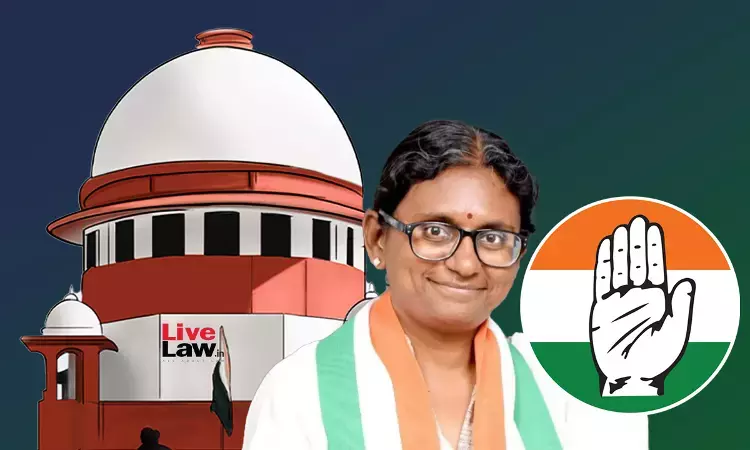
The Supreme Court on Friday (June 12) dismissed the writ petition filed by Congress member Meenakshi Natarajan challenging the rejection of her Rajya Sabha candidature from Madhya Pradesh, and gave her liberty to raise the challenge in an election petition filed in terms of the Representation of the People Act.A bench comprising Justice Prashant Kumar Mishra and Justice AS Chandurkar declined...
This is a premium content
Available exclusively to
Our subscribers
Subscribe Premium 
INR 1099+GST
Your support helps us to bring you more content at
an affordable subscription scheme !!!
All payment options available
The Supreme Court on Friday (June 12) dismissed the writ petition filed by Congress member Meenakshi Natarajan challenging the rejection of her Rajya Sabha candidature from Madhya Pradesh, and gave her liberty to raise the challenge in an election petition filed in terms of the Representation of the People Act.
A bench comprising Justice Prashant Kumar Mishra and Justice AS Chandurkar declined the exercise of its writ jurisdiction citing the Constitutional bar as per Article 329. The writ petition was accordingly dismissed as non-maintainable.
The bench rejected the argument of the petitioner that Article 32 can be invoked to cure "glaring and manifest" errors in the rejection of nomination.
"If the Court accepts such arguments to find out glaring cases which are required to be interfered under Article 32/226, and the other sets of cases, where the rejection is not so improper prima facie to relegate them to election petitions, this Court would be reading some principle which is not provided for under Article 329. We are afraid that any such interpretation that in some of the matters this Court can interfere while leaving some others to avail the remedy of the election tribunal cannot be encouraged."
Leaving open the remedy of election petition, the Court clarified that it has not observed anything on the merits of the case.
Petitioner's arguments
Natarajan's nomination was rejected by Returning Officer Arvind Sharma on June 9 on the ground that she did not disclose in her Form 26 affidavit a private complaint filed against her in a Telangana Court despite receiving a summons on it.
Today, Senior Advocate Abhishek Manu Singhvi, for Natarajan, submitted that as per Section 33A of the Representation of the People Act, only the criminal cases where charges have been framed by the trial court need to be disclosed in the nomination. He added that as per Section 223 of the Bharatiya Nagarika Suraksha Sanhita, the potential accused has to be sent a notice before taking cognizance on a private complaint.
Singhvi submitted that Natarajan has only received the notice under Section 223, and no cognizance on the complaint has been taken by the Court.
Justice Mishra then said that a Court issues a summons only after applying its mind. Singhvi reiterated that the RP Act only requires disclosure of a criminal case only if charge has been framed. Further, as per the new law (S.223 BNSS), the accused has to be heard before taking cognizance, and the private complaint is at a pre-cognizance stage presently.
"If there is no cognizance, there is no case in the eye of law. Even if there is cognizance, law requires disclosure only if charge is framed," Singhi stated, adding that the Returning Officer's decision to reject her nomination was "bizarre & arbitrary" and resulted in "rank injustice." "If this way a level playing field can be made non-level, there can be no election in the country," he submitted.
Singhvi informed that the private complaint was essentially a molestation allegation against another person, and Natarajan was added as the 4th accused in the private complaint only on the allegation that she did not take action against the alleged molester as the AICC member in charge of Telangana Congress.
"The charge is he molested me three years ago, and I, who was appointed three years after as Telangana in-charge, did not take action," Singhvi stated, highlighting that Natarajan was appointed as Telangana in-charge only in 2025 whereas the alleged molestation occurred in 2022.
Singhvi then stated that though the petitioner had approached the Election Commission of India, it has not said anything yet. "It is reprehensible," Singhvi stated.
He added that the ECI declared the results yesterday, declaring the other candidates as the uncontested winners, resulting in the apprehension voiced by him yesterday at the time of mentioning becoming true.
Responding to the query by the bench if the Court can interfere in a writ petition in the election process, Singhvi referred to the Constitution Bench judgment in Mohinder Singh Gill v. The Chief Election Commissioner, and said that the Court can intervene to aid the election process. He cited the following passage from MS Gill.
"For example, after the President notifies the nation on the holding of elections under s. 15 and the Commissioner publishes the calendar for the poll under s. 30, if the latter orders returning officers to accept only one nomination or only those which come from one party as distinguished from other parties or independents, is that order immune from immediate attack. We think not."
He argued that the present case has parallels with the observations in the MS Gill. The results were declared yesterday, the last date of withdrawing nominations, as there was no rival candidate. Singhvi stated that this was the RO "preventing election."
Justice Mishra asked if there is any precedent of the Court reversing the rejection of nomination in a writ petition. Singhvi contended that in cases of glaring errors, the Court can interfere.
"If tomorrow the RO writes that 2+2 = 6, will the Court say please wait after the election process is over?" Singhvi said. He stated that realistically, an election petition will remain pending for at least three years, despite the statutory mandate to dispose of them within 6 months. Justice Mishra then referred to a recent order of the Madras High Court which criticised the Supreme Court for keeping an election matter pending.
Singhvi pleaded that technicalities must not bar judicial review of glaring injustices. He then moved to address Justice Mishra referring to the judgment in Ashok Kumar, which held that Courts should not interfere with the election process. He argued that Ashok Kumar does not bar interference, and cited the following observation from it. "Anything done towards completing or in furtherance of the election proceedings cannot be described as questioning the election". He argued that the Court's interference in this case will actually ensure an election, because the other candidates have been declared winners uncontested.
Justice Mishra then observed :
"The whole difficulty, if we allow your writ petition and allow your nomination, then there will be splitting of the jurisdiction or the powers under 32 or the fetters created by the Constitution under 329. One set of nominations, which are rejected, will be dealt with by the Supreme Court; if we under 32 can do it, High Court under 226 can also do it. One set will be dealt with by the Supreme Court, and the other in election petitions."
Singhvi repeated that the facts of the present case were glaring, and there was brazen arbitrariness and illegality, warranting the invocation of the extraordinary powers of the Court.
"This Court is the 'sentinel on qui vive'. It is not a seminar phrase, but a jurisprudential position. Here is a woman seeking the right to stand in an election, not to win it, just the right to participate," he said.
"I would beseech, this matter requires justice to be done. Every objection from the other side will be procedural. What is the justice of the case? To set aside a patently erroneous order of the RO. The Court needs to set aside an order which prevented the election. Technical objections will defeat the ends of justice," Singhvi concluded.
Arguments of the respondents :
Senior Advocate Mukul Rohatgi, for the rival candidate, started by saying that the right to contest an election is not a fundamental right and only a statutory right. If there is no fundamental right, Article 32 cannot be invoked. He then cited the bar under Article 329 of the Constitution on judicial interference, by virtue of which Articles 32 and 226 are ousted from the election process. Rohatgi contended that Singhvi selectively cited MS Gill judgment.
He referred to the judgment in NP Ponnuswamy v. Returning Officer, which held that in cases of improper rejection of nomination, the remedy is not a writ petition but an election petition.
When Rohatgi, who was appearing virtually, got disconnected, Solicitor General of India Tushar Mehta sought to complete his arguments. Singhvi then asked if the Solicitor General was supporting the candidate. "Government has come to support the candidate," Singhvi said. The SG clarified that he is appearing for the State of Madhya Pradesh which is seeking to intervene in the writ petition.
Advocate Kanu Agarwal, the AoR for Rohatgi, who was physically present in the Court, took over the arguments of Rohatgi. He submitted that an Election Tribunal is competent to pass orders for appropriate reliefs. He stressed on the words "Notwithstanding anything in the Constitution" in Article 329, which necessarily bars Article 32 in the election process. He argued that the remedy of an election petition provided by the RP Act must be availed. He also cited the judgment in Manda Jaganath vs K.S.Rathnam.
Senior Advocate Dama Seshadri Naidu, referring to Section 100 of the RP Act, said that exclusive jurisdiction is conferred on the Election Tribunal to deal with the election disputes. Once the jurisdiction is conferred on a specific forum, the ECI cannot entertain a complaint against a decision of the RO. Naidu added that the declaration of results was legal, as the RP Act mandates that if there are no opposing candidates, then the candidate who filed the nomination must be declared the winner.
Rohatgi, who at this moment got re-connected, submitted that after 2018, a candidate has to disclose all pending cases, and Form 26 mandates that. In response, Singhvi submitted that Form 26 cannot override Section 33A.
Case Details: MEENAKSHI NATARAJAN Vs ELECTION COMMISSION OF INDIA|W.P.(C) No. 766/2026 Diary No. 36330 / 2026
Citation : 2026 LiveLaw (SC) 627
Gursimran Kaur Bakshi
Gursimran is the Principal Correspondent with LiveLaw for the Supreme Court. She can be reached out at: simrankaurbakshi@livelaw.in

