



- Home
- /
- Top Stories
- /
- Supreme Court Dismisses Gangster...
Supreme Court Dismisses Gangster Abu Salem's Plea For Premature Release In 1993 Bombay Blasts Case
Amisha Shrivastava
10 Sept 2026 10:36 AM IST
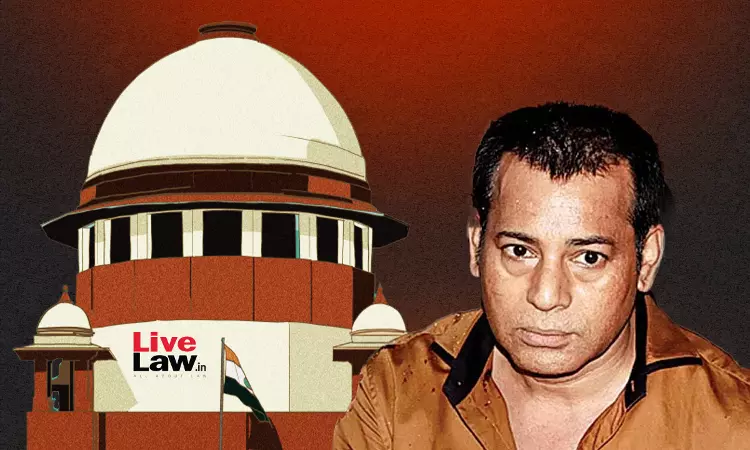
The Supreme Court today dismissed a plea filed by gangster Abu Salem, sentenced to life imprisonment for the 1993 Mumbai serial blasts, seeking premature releaseSalem approached the court contending that his earned prison remission and undertrial custody should be counted towards the 25-year imprisonment cap flowing from India's extradition assurances to Portugal.A bench of Justice Vikram...
This is a premium content
Available exclusively to
Our subscribers
Subscribe Premium 
INR 1099+GST
Your support helps us to bring you more content at
an affordable subscription scheme !!!
All payment options available
The Supreme Court today dismissed a plea filed by gangster Abu Salem, sentenced to life imprisonment for the 1993 Mumbai serial blasts, seeking premature release
Salem approached the court contending that his earned prison remission and undertrial custody should be counted towards the 25-year imprisonment cap flowing from India's extradition assurances to Portugal.
A bench of Justice Vikram Nath and Justice Sandeep Mehta pronounced the verdict. The Court held that Salem continues to serve life imprisonment and the 25-year stipulation flowing from the extradition assurance did not convert his life sentence into a fixed-term sentence.
On the previous date, after hearing arguments by Senior Advocate Rishi Malhotra for Salem, the Court had indicated that it will dismiss the plea.
Malhotra argued that the period spent as an undertrial had to be set off against Salem's sentence, as directed by the TADA Court. He also contended that earned remission for good conduct had to be counted towards actual imprisonment. He distinguished such earned remission from statutory remission under Section 432 CrPC, which he said he was not claiming.
Referring to Swamy Shraddananda@Murali Monahar vs State Of Karnataka, Malhotra argued that earned remission granted on account of monthly, quarterly or yearly good conduct, or for performing assigned duties, forms part of actual imprisonment.
He submitted that Salem had already earned approximately three years and two months of remission for good conduct and that other convicts had been released after taking such remission into account. According to him, the Bombay High Court had wrongly distinguished Salem's case by holding that the 25-year period under the extradition assurance was not a fixed-term sentence and, therefore, could not be reduced by earned remission.
The Supreme Court held that his jail-earned remission cannot be counted to advance his release from the 25-year imprisonment period arising from the sovereign assurance given by India to Portugal at the time of his extradition.
Background
In April 2025, the Bombay High Court rejected Abu Salem's plea seeking premature release.
In the impugned judgment, the Bombay High Court had held that the 25-year period contemplated by the Supreme Court had not yet concluded and would expire only in November 2030. The Court held that Salem's plea, which sought inclusion of earned remissions while computing the 25-year period, was premature and misconceived.
India had assured Portugal on December 17, 2002, that Salem would neither be awarded the death penalty nor remain imprisoned for more than 25 years if extradited to India. Salem relied on these assurances and the Supreme Court's July 2022 judgment, in which the apex court too relied on the treaty with Portugal and held that in line with the said treaty, Salem will have to be released on him completing 25 years in jail.
Salem claimed that he had spent about 11 years, 9 months and 26 days in custody as an undertrial between November 2005 and September 2017, and another 9 years, 10 months and 4 days as a convict. He further claimed remission of three years and sixteen days for good conduct in the 2006 case and an additional one month's relaxation granted by the Supreme Court for the period spent as an undertrial prisoner in Portugal. These periods together amounted to nearly 25 years of imprisonment, he contended, adding that continuing his incarceration violated Article 21 of the Constitution and sought directions to the authorities to specify his exact date of release.
Rejecting the contention, the High Court held that earned remissions could not be used to reduce the 25-year ceiling flowing from the extradition arrangement. It observed that the 25-year cap itself operated as a substantial remission of a life sentence necessitated by India's international obligations. The Court opined that permitting ordinary prison remissions to further reduce that period would defeat the Supreme Court's directions and the very basis of the sentence structure arising from the extradition treaty. It also found no indication in the Supreme Court's 2022 judgment that earned remissions under prison rules were intended to shorten the 25-year period.
The High Court held that Salem was first arrested on November 11, 2005 and that a simple computation from that date showed that the 25-year period would expire only in November 2030. It further clarified that neither the remissions under Rule 4(a), (b) and (c) of the Maharashtra Prisons (Remission System) Rules, 1962 nor remission under Section 432 of the Code of Criminal Procedure could be invoked to reduce the fixed 25-year threshold.
Supreme Court Verdict
The Supreme Court rejected Salem's computation of his custody period, finding that it involved an overlap between his undertrial and post-conviction custody and resulted in the same period being counted twice.
Salem had claimed that as on June 30, 2026, he had completed 26 years, 9 months and 22 days of incarceration. His calculation included 11 years, 9 months and 26 days of undertrial custody, 11 years, 4 months and 4 days of post-conviction custody, and 3 years, 6 months and 2 days of earned remission.
The Supreme Court found that the computation was legally impermissible. While Salem calculated his undertrial custody from November 11, 2005 to September 7, 2017, he calculated his post-conviction custody from February 25, 2015. This resulted in the period between February 25, 2015 and September 7, 2017 being counted twice. Since the sentences imposed in the two cases were directed to run concurrently, the Court said the same period of incarceration could not be counted twice to secure a double benefit.
The Court reiterated that its July 11, 2022 judgment had fixed October 12, 2005 as the date from which Salem's detention would be computed for the purpose of the 25-year period
The Court further rejected Salem's argument that his jail-earned remission should be added to his actual incarceration. It held that the judgments cited by Salem could not be mechanically applied because they did not concern a case involving a sovereign assurance given in the context of extradition that a prisoner would not be detained beyond a stipulated period.
The Court explained that its July 2022 judgment did not alter the two life sentences imposed on Salem by the TADA Court. It had merely recognised the sovereign assurance given by the Union Government to Portugal and directed that, upon completion of 25 years, the Central Government would have to consider advising the President under Article 72 of the Constitution or exercising powers under Sections 432 and 433 of the CrPC.
The Court therefore held that Salem could not claim jail-earned remission to further advance his release. Allowing such a benefit would effectively give him an additional benefit over and above the consequence already flowing from the sovereign assurance, while his sentence continued to remain one of life imprisonment.
Case: SLP(Crl) No. 12871/2026 Diary No. 41145 / 2026 ABU SALEM ABDUL QAYOOM ANSARI Vs THE STATE OF MAHARASHTRA
Citation : 2026 LiveLaw (SC) 932
Tags

Amisha Shrivastava
Amisha Shrivastava is a Senior Correspondent with LiveLaw, covering the Supreme Court of India. She can be reached at amisha@livelaw.in

