



- Home
- /
- Top Stories
- /
- Independent Cooperative Societies...
Independent Cooperative Societies Not 'State' Under Art 12; Their Election Process Not Amenable To Writ Jurisdiction: Supreme Court
Debby Jain
11 April 2026 3:58 PM IST
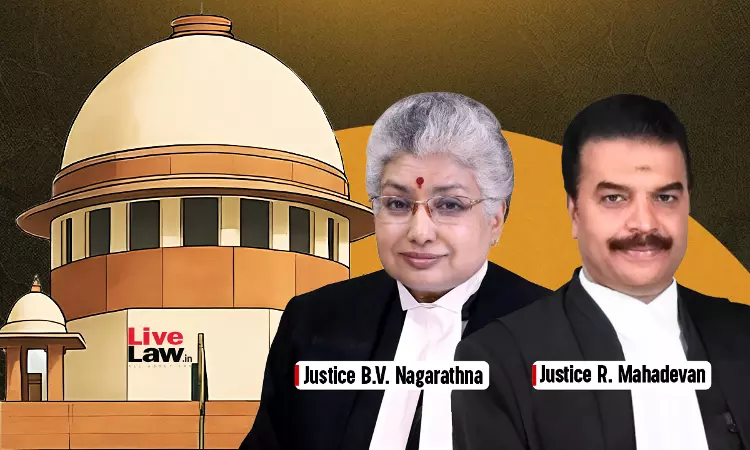
In a dispute pertaining to election of the Management Committee of District Milk Unions in Rajasthan, the Supreme Court recently held that District Milk Unions are independent co-operative societies not amenable to writ jurisdiction of High Courts.A bench of Justices BV Nagarathna and R Mahadevan observed that the Rajasthan High Court erred in entertaining pleas challenging bye-laws framed by...
This is a premium content
Available exclusively to
Our subscribers
Subscribe Premium 
INR 1099+GST
Your support helps us to bring you more content at
an affordable subscription scheme !!!
All payment options available
In a dispute pertaining to election of the Management Committee of District Milk Unions in Rajasthan, the Supreme Court recently held that District Milk Unions are independent co-operative societies not amenable to writ jurisdiction of High Courts.
A bench of Justices BV Nagarathna and R Mahadevan observed that the Rajasthan High Court erred in entertaining pleas challenging bye-laws framed by the District Milk Unions, as the District Milk Unions cannot be characterized as "instrumentalities of State" within the meaning of Article 12 of the Constitution.
"In the present case, the District Milk Unions are autonomous, member driven bodies governed by the provisions of the Act, 2001, the Rules framed thereunder, and their bye-laws. They are neither departments of the State nor owned, financially controlled, or administratively dominated by the State in a manner that would render them instrumentalities of the State within the meaning of Article 12" it said.
"The fact that such societies are subject to statutory regulation, oversight by the Registrar or supervision by the State Co-operative Election Authority does not detract from their essential character as independent co-operative institutions. Furthermore, the disputes raised pertain essentially to the internal governance and electoral framework of co-operative societies and do not disclose any breach of a statutory or public duty of a public law character", the Court added.
Background
The dispute pertained to elections to the Management Committee (Boards of Directors) of various District Milk Unions in the State of Rajasthan. Particularly, the challenge was against Bye-law Nos. 20.1(2), 20.1(4), 20.2(7) and 20.2(9) framed by the District Milk Unions which prescribed qualifications for contesting the elections to the Board of Directors.
Certain representatives of Primary Societies, which are members of District Milk Unions, challenged the Bye-Laws by way of writ proceedings before the High Court. A Single Judge held the Bye-Laws ultra vires. In intra-Court appeal, a Division Bench affirmed the Single Bench's judgment. Aggrieved, the appellants, who were not party in the writ proceedings, approached the Supreme Court.
Court Observations
Insofar as the appellants raised a challenge to the High Court entertaining the underlying pleas under Article 226, the Court held that a writ would lie against a non-State entity only where it performs public duties, discharges public functions or is alleged to have acted in breach of statutory or constitutional obligations of a public character.
"disputes which pertain purely to the internal management, governance or electoral processes of co-operative societies do not, as a matter of course, attract writ jurisdiction merely because such societies owe their incorporation to a statute. The existence of a statutory framework regulating such societies does not by itself convert internal disputes into matters of public law."
The Court found fault with the High Court's interference in the matter considering the nature and character of the respondent-societies as well as the availability of statutory remedy under the Rajasthan Co-operative Societies Act, 2001.
It said that disputes which are essentially private or internal in nature fall outside the ambit of judicial review under Article 226. Even existence of regulatory or supervisory control by the State is not determinative [Ref: General Manager, Kishan Sahkari Chini Mills Ltd. v. Satrughan Nishad]. However, a body, though not "State" within the meaning of Article 12, may become amenable to writ jurisdiction when the degree of State control is such that it alters the character of the body.
In arriving at the decision, the Court also referred to other judicial precedents on the subject, including, Ajay Hasia v. Khalid Mujib Sehravardi, Thalappalam Service Co-operative Bank Ltd. v. State of Kerala, and Federal Bank Ltd. v. Sagar Thomas.
With regard to the existence of a dispute resolution mechanism within the statutory framework, the Court noted that the issues raised pertained to internal governance and electoral process of the society. As such, they fell within the ambit of Sections 58(1) and 58(2)(c) [which covers “dispute arising in connection with the election of an officer of the society”] of the 2001 Act.
"The existence of such a self-contained, multi-tiered remedial framework evinces a clear legislative intent that disputes relating to elections and internal governance of co-operative societies be resolved within the statutory domain", the Court stated.
Ultimately, it was held that the High Court ought not to have entertained the underlying writ petitions.
"In entertaining the writ petitions and adjudicating upon the validity of the bye-laws, the High Court effectively bypassed the statutory dispute resolution mechanism and rendered the remedies under Sections 58 and 104-105 nugatory. Such an approach is contrary to the legislative scheme and undermines the discipline of exhausting statutory remedies."
Also from the judgment- Right To Vote & Right To Contest In Elections Not Fundamental Rights: Supreme Court
Appearances: Mr. Kapil Sibal, Senior Advocate, along with Mr. Purushottam Sharma Tripathi, AOR, Mr. Ravi Chandra Prakash, Advocate, Mr. Amit, Advocate, Ms. Vani Vyas, Advocate, and Mr. Prakhar Singh, Advocate, appeared for the Petitioner(s).
Mr. Shiv Mangal Sharma, Additional Advocate General, along with Ms. Arushi Rathore, Advocate, Ms. Nidhi Jaswal, AOR, and Mr. Namit Saxena, AOR, appeared for the Respondent(s)
Headnote
Constitution of India, 1950 — Article 226 — Maintainability of Writ Petition against Co-operative Societies — The Supreme Court held that disputes pertaining purely to the internal management, governance, or electoral processes of co-operative societies do not ordinarily attract writ jurisdiction – Noted that District Milk Unions are autonomous, member-driven bodies and not "State" or "instrumentalities of the State" under Article 12, even if they are subject to statutory regulation or oversight by the Registrar - A writ lies against a non-State entity only when it performs public duties or acts in breach of statutory obligations of a public character, which was not the case here. [Relied on Federal Bank Ltd. v. Sagar Thomas (2003) 10 SCC 733; Thalappalam Service Co-operative Bank Ltd. v. State of Kerala, (2013) 16 SCC 8]
Rajasthan Co-operative Societies Act, 2001 — Sections 58, 60, 104, and 105 — Alternative Remedy — Supreme Court ruled that the High Court should not have entertained the writ petitions given the existence of a comprehensive, self contained, multi-tiered statutory remedial framework - Section 58(2)(c) specifically deems disputes relating to elections as disputes "touching the constitution, management or business" of a society, falling under the Registrar's jurisdiction - Bypassing such efficacious statutory remedies is contrary to legislative intent. [Relied on Titaghur Paper Mills Co. Ltd. v. State of Orissa (1983) 2 SCC 433; Umesh Shivappa Ambi v. Angadi Shekara Basappa, (1998) 4 SCC 529]
Rajasthan Co-operative Societies Act, 2001 — Section 28 vs. Section 32 — Eligibility vs. Disqualification — Supreme Court distinguished between "disqualifications" (statutory disabilities under Section 28) and "eligibility criteria" (threshold qualifications under bye-laws) - Bye-laws prescribing minimum milk supply (Bye law 20.2(7)) or audit classification (Bye-law 20.1(2)) are positive, objective functional requirements aimed at ensuring active participation and are not "disqualifications" - The High Court erred by conflating these two distinct legal concepts.
Co-operative Societies — Right to Vote vs. Right to Contest — Supreme Court emphasized that neither the right to vote nor the right to contest is a fundamental right; they are purely statutory - While the right to vote is a member's franchise, the right to contest is an additional right subject to stricter regulation and eligibility conditions - The impugned bye-laws regulated the eligibility to contest (candidature) and did not curtail the right to vote. [Relied on Jyoti Basu v. Debi Ghosal AIR 1982 SC 983; Supreme Court Bar Association v. B.D. Kaushik (2011) 13 SCC 774]
Administrative Law — Subordinate Legislation — Ultra Vires — Bye-laws framed under Section 8 read with Schedule B (Clauses da and v) are intra vires - The power to prescribe norms for "minimum essential utilisation of services" (Clause da) and to "send a representative to another society" (Clause v) provides a direct statutory source for conditions requiring minimum milk supply and operational continuity for contesting elections to District Milk Unions. [Relied on State of T.N. v. P. Krishnamurthy (2006) 4 SCC 517; Naresh Chandra Agrawal v. ICAI (2024) 13 SCC 241]
Natural Justice — Audi Alteram Partem — Non-joinder of Necessary Parties — The Supreme Court set aside the High Court's judgment for striking down bye-laws in rem without impleading or hearing all affected District Milk Unions - Adjudicating upon the internal governance of autonomous bodies without granting them an opportunity of hearing is a substantive violation of natural justice. [Relied on Dattatreya v. Mahaveer (2004) 10 SCC 665; Paras 14-22]
Case Title: RAM CHANDRA CHOUDHARY & ORS VERSUS ROOP NAGAR DUGDH UTPADAK SAHAKARI SAMITI LIMITED AND OTHERS, CIVIL APPEAL NO. 4352 OF 2026
Citation : 2026 LiveLaw (SC) 361

Debby Jain
Debby Jain is a Correspondent with LiveLaw, covering the Supreme Court of India

