



- Home
- /
- Top Stories
- /
- Ex-Judges, Lawyers Write Letter To...
Ex-Judges, Lawyers Write Letter To CJI Surya Kant Objecting To Remarks On Rohingyas
Debby Jain
5 Dec 2025 4:45 PM IST
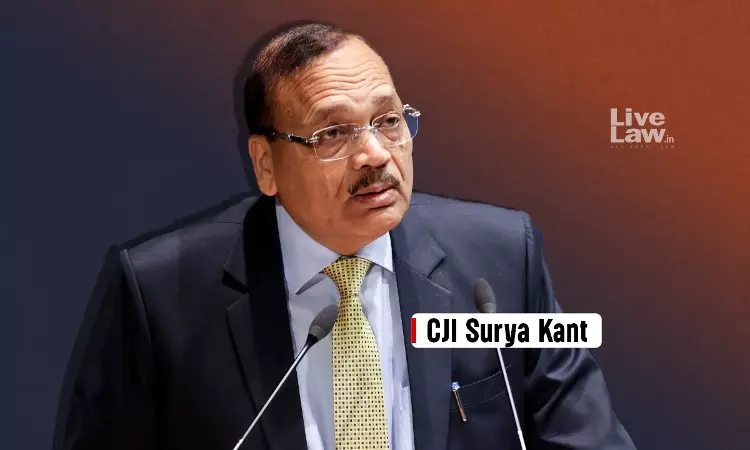
The signatories of the letter opined that the comments of the CJI were "contrary to core constitutional values."
Former Judges, practicing advocates and the Campaign for Judicial Accountability and Reforms have written an open letter to Chief Justice of India Surya Kant expressing their concern over the “unconscionable remarks” made regarding Rohingya refugees by the CJI's bench in a recent hearing. It may be recalled that on December 2, sharply reacting to a petition filed in relation to Rohingyas,...
This is a premium content
Available exclusively to
Our subscribers
Subscribe Premium 
INR 1099+GST
Your support helps us to bring you more content at
an affordable subscription scheme !!!
All payment options available
Former Judges, practicing advocates and the Campaign for Judicial Accountability and Reforms have written an open letter to Chief Justice of India Surya Kant expressing their concern over the “unconscionable remarks” made regarding Rohingya refugees by the CJI's bench in a recent hearing.
It may be recalled that on December 2, sharply reacting to a petition filed in relation to Rohingyas, a bench led by CJI Kant asked if there was any order issued by the Government of India declaring Rohingyas as 'refugees'.
"Where is the order of the Government of India declaring them (Rohingyas) as refugees? Refugee is a well defined legal term and there is a prescribed authority by the Government to declare them. If there is no legal status of a refugee, and somebody is an intruder, and he enters illegally, do we have an obligation to keep that fellow here?" remarked the CJI.
Taking objection these remarks, particularly the equation of Rohingya refugees to “illegal intruders digging tunnels” to enter India, the former judges have written to CJI Kant, stating,
“The remarks from the bench are contrary to core constitutional values. They have had the effect of dehumanizing Rohingya refugees whose equal humanity and equal human rights are protected by the Constitution, our laws and by international law.”
Objection has been taken particularly to the bench's reported statements questioning the legal status of the Rohingya as refugees, equating them with intruders illegally entering India, the references to persons who dig tunnels to enter illegally, the questioning whether such entrants are entitled to food, shelter and education, the invocation of domestic poverty as a reason to deny basic constitutionally guaranteed entitlements to refugees and the suggestion that they be spared third degree measures, in their treatment in India.
The former judges, advocates and CJAR highlight the plight of Rohingyas and point out that the United Nations has described Rohingya as “the most persecuted minority in the world”.
“They are an ethnic minority in Buddhist majority Myanmar who have endured decades of violence and discrimination. Denied citizenship, the Rohingya are stateless. They have fled to neighbouring countries in waves over the past many years, escaping what has been described by the International Court of Justice as ethnic cleansing and genocide at the hands of the armed forces. They are fleeing to India, like centuries of refugees before them, seeking basic safety.”
The letter states that the CJI is not just a legal functionary but also the custodian and final arbiter of rights of the poor, whose words carry weight in the conscience of the country and have a cascading effect.
“As the head of the judiciary, the Chief Justice is not just a legal functionary — but is also the custodian and final arbiter of the rights of the poor, the dispossessed, and the marginalised. Your words carry weight not simply in the courtroom but in the conscience of the nation and have a cascading effect on the High Courts, the lower judiciary and other government authorities.”
According to the former judges, the remarks made on December 2 dehumanize those fleeing genocidal persecution and weaken the moral authority of the judiciary.
“The Rohingya, as indeed any person residing in India, is entitled to the protections of Article 21 and not just protections from “third degree measures”. This fundamental right is available to an individual who is a citizen or any other person residing in India. In NHRC v State of Arunachal Pradesh, 1996 SCC (1) 742, this Hon'ble Court has held that, “the State is bound to protect the life and liberty of every human being, be he a citizen or otherwise”, the letter states.
The letter goes a step further to say that the remarks provide a reasonable basis for apprehension of prejudice on the part of the CJI bench.
“Such remarks provide a reasonable basis for apprehension of prejudice on the part of the bench against the rights of the Rohingya refugees and for concern that they will adversely affect public trust and confidence in the judiciary when it comes to protecting the rights of the most vulnerable amongst us.”
The letter calls upon the CJI to reaffirm in public statements a commitment to constitutional morality based on human dignity and justice for all. “The majesty of the Supreme Court and your office is measured not merely by the number of verdicts or administrative measures but more by the humanity with which those verdicts are delivered and considered”, it says.
Notably, the former judges, advocates and CJAR emphasize that Rohingyas occupy a distinct legal position as refugees, not merely as illegal immigrants. "Refugee status is declaratory, meaning individuals are recognised as refugees because they already meet the criteria, not because the State confers the status. Consequently, under the customary international law principle of non-refoulement, which Indian courts have read into Article 21, no refugee can be deported, detained or imprisoned without an individual and formal assessment of their claim."
It is pointed out that India's own Standard Operating Procedure for Foreign Nationals Claiming to be Refugees (2011, updated 2019) aligns with international norms. It defines a refugee as someone with a well-founded fear of persecution based on race, religion, sex, nationality, ethnic identity, membership of a social group or political opinion, showing harmony between customary international law and domestic practice.
The signatories state that India has a longstanding tradition of recognising refugees as a category distinct from migrants. The country has extended humanitarian protection to Tibetans, Sri Lankan Tamils and, historically, millions fleeing persecution in 1970–71 from East Pakistan. The Citizenship Amendment Act similarly grants exemptions to certain persecuted religious minorities, though its exclusionary design faces constitutional challenges pending before the Supreme Court.
The signatories to the letter are :
Justice AP Shah, former Chief Justice, Delhi High Court
Justice K. Chandru, Former Judge, Madras High Court
Justice Anjana Prakash, Former judge, Patna High Court
Prof. Mohan Gopal, Former Director, National Judicial Academy
Dr. Rajeev Dhavan, Senior Advocate, Supreme Court
Mr. Chander Uday Singh, Senior Advocate, Supreme Court
Mr. Colin Gonzalves, Senior Advocate, Supreme Court
Ms. Kamini Jaiswal, Advocate, Supreme Court
Mr. Mihir Desai, Senior Advocate, Bombay High Court
Mr. Gopal Shankar Narayan, Senior Advocate, Supreme Court
Mr. Gautam Bhatia, Advocate, High Court & Supreme Court
Ms. Shahrukh Alam, Advocate, High Court & Supreme Court
Working Group, CJAR
Prashant Bhushan - Advocate, Supreme Court
Nikhil Dey - RTI Activist &Co Founder Majdoor Kisan Shakti Sangathan
Alok Prasanna Kumar - Advocate and Co-Founder, Vidhi Centre for Legal Policy
Venkatesh Sundaram - Lok Raj Sanghatan
Indu Prakash Singh - Convenor, National Forum for Housing Rights
Anjali Bhardwaj - Transparency Activist, Founder Satark Nagrik Sangathan and co-convenor, National Campaign for People's Right to Information (NCPRI)
Amrita Johri - Transparency Activist and working committee member, NCPRI
Annie Raja - National Federation of Indian Women
Beena Pallical- Beena- National Campaign on Dalit Human Rights
Cheryl D'souza - Advocate, Supreme Court
Indira Unninayar - Advocate, High Court and Supreme Court
Siddhartha Sharma - Advocate
Devvrat - Advocate, High Court and Supreme Court
Vijayan MJ - Policy Analyst, Independent Researcher and Writer
Vipul Mudgal - Director, Common Cause
Koninika Ray - National Federation of India Women
Meera Sanghamitra - Convenor, National Alliance of People's Movements
Apar Gupta - Advocate & Co-Founder & Founder Director, Internet Freedom Foundation
Anurag Tiwary - Advocate, High Court and Supreme Court
Debby Jain
Debby Jain is a Correspondent with LiveLaw, covering the Supreme Court of India

