



- Home
- /
- Top Stories
- /
- Supreme Court Forms 5-Member...
Supreme Court Forms 5-Member Committee Led By Ex-SC Judge Subhash Reddy To Probe Student Protest Violence
LIVELAW NEWS NETWORK
20 Aug 2026 4:45 PM IST
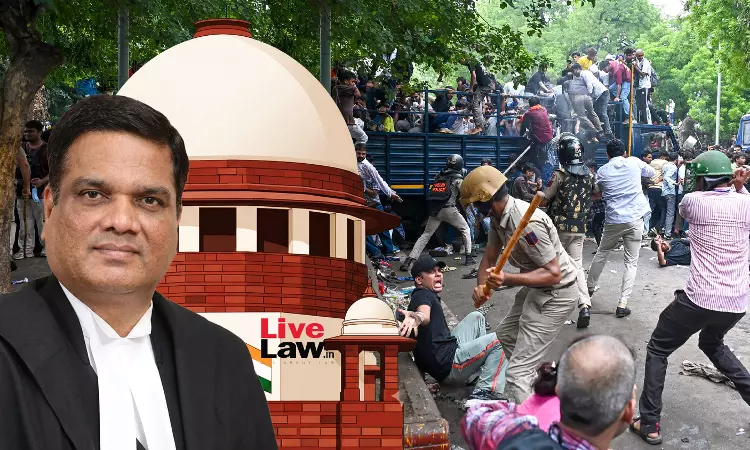
The Court asked the committee to give its interim report on alleged excessive police force and molestation of female protesters at the earliest.
The Supreme Court has constituted a five-member High-Powered Enquiry Committee (HPEC) to independently examine allegations of violence during the student demonstrations at Jantar Mantar, New Delhi, and other locations across the country last month.The Committee has been asked to examine both the allegations of excessive and disproportionate use of force by police and paramilitary forces...
This is a premium content
Available exclusively to
Our subscribers
Subscribe Premium 
INR 1099+GST
Your support helps us to bring you more content at
an affordable subscription scheme !!!
All payment options available
The Supreme Court has constituted a five-member High-Powered Enquiry Committee (HPEC) to independently examine allegations of violence during the student demonstrations at Jantar Mantar, New Delhi, and other locations across the country last month.
The Committee has been asked to examine both the allegations of excessive and disproportionate use of force by police and paramilitary forces against protesters, as well as the alleged use of violence by protesters against security personnel and injuries sustained by them.
The HPEC will be chaired by former Supreme Court judge Justice R. Subhash Reddy. Its other members are former Punjab and Haryana High Court Chief Justice Ravi Shankar Jha, former Delhi High Court judge Justice Shalinder Kaur, former CBI Director Rishi Kumar Shukla and retired Meghalaya Director General of Police Dr. L.R. Bishnoi.
A Bench comprising Chief Justice of India Surya Kant, Justice Joymalya Bagchi and Justice V. Mohana passed in batch of writ petitions concerning the violence during the student protests.
The Court noted that it had observed on the first day itself that allegations raised by the petitioners and respondents made out a prima facie case for an independent and impartial investigation and warranted the constitution of an HPEC. The allegations include the use of pellet guns, electric batons, indiscriminate lathi charges and tear gas against peaceful protesters, as well as alleged violence by plain-clothes personnel.
Terms of reference
The Court, while delineating the issues to be examined by the High-Powered Enquiry Committee (HPEC), recorded separate suggestions advanced by the petitioners and the respondents.
The petitioners submitted that the HPEC should examine :
- Excessive and disproportionate use of force by police authorities and other security agencies against protesters.
- Deployment of pellet guns, electric batons, lathi charges and tear gas without adequate warning or proportionality
- Whether police responses during protests and peaceful assemblies were proportionate and measured.
- Police and security personnel should wear proper uniforms and visible nameplates when making arrests or using force, so that individual officers could be identified and held accountable where necessary.
- Monitoring and surveillance of protesters and whether such practices, if undertaken, were consistent with the constitutional rights to privacy and free assembly.
- Targeted violence, harassment, molestation and secondary victimisation of female protesters.
- Medical and other assistance provided to victims of alleged police abuse, including the adequacy of such support and the possibility of compensation.
- Blanket orders under Section 163 of the Bharatiya Nagarik Suraksha Sanhita, 2023 should be regulated so that they were not routinely or pre-emptively used to prevent peaceful assembly, except where there was a genuine and proportionate response to a real and imminent threat to public order.
Respondents' submissions
- Alleged use of force and violence by protesters against police officers and other security personnel.
- Examine damage to public property allegedly caused during the demonstrations. This included alleged destruction of or damage to government installations, vehicles and other assets belonging to both the State and private citizens.
- njuries suffered by police personnel while performing their duties. These injuries, as well as the mental and emotional trauma suffered by the family members of police personnel, deserved recognition and consideration on a footing comparable to the grievances raised by the petitioners.
Both issues require consideration
After considering the submissions from both sides, the Supreme Court held that all the issues raised by the petitioners and respondents merited examination by the HPEC.
The court identified allegations of targeted violence and sexual harassment against female protesters as a priority issue. It also asked the committee to examine serious injuries allegedly caused by police and security personnel, including the chain of command, responsibility for the alleged excesses and possible violations of existing laws, rules or norms.
The HPEC has been empowered to seek assistance from forensic, technical and other domain experts. Parties may submit documentary evidence, material and suggestions to the committee, including anonymously where necessary to protect the identity of complainants and witnesses.
The Court also reiterated directions requiring police authorities, paramilitary forces and investigating agencies to preserve CCTV and drone footage, body-worn camera recordings, videography, wireless communication records and PCR call logs relating to the student protests. The records are to be furnished to the HPEC, with the concerned authorities directed to cooperate fully with the inquiry.
The constitution of the committee, the court clarified, does not prevent police authorities or security forces from taking administrative or disciplinary action against officers found to have violated applicable conduct rules.
The Supreme Court has asked the HPEC to complete its examination of allegations concerning excessive force and targeted violence against female protesters and submit its First Interim Report at the earliest. The matters will be next considered on September 10, 2026.
Case : Shailendra Mani Tripathi v Union of India and others | WP(Crl) 280/2026


