- Home
- /
- Top Stories
- /
- Supreme Court Invites Applications...
Supreme Court Invites Applications For Law Clerk-cum-Research Associates 2026–27 Term; Last Date February 7
LIVELAW NEWS NETWORK
20 Jan 2026 4:14 PM IST
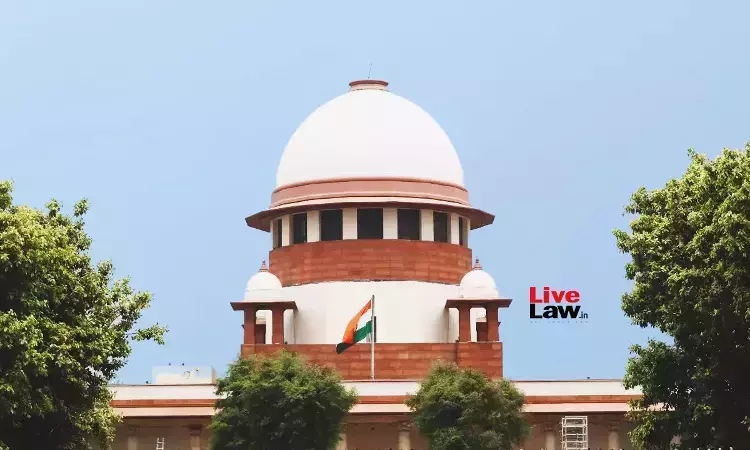
The Supreme Court has invited online applications for the engagement of Law Clerks-cum-Research Associates for the assignment term 2026 to 2027. The recruitment will be carried out under the Scheme for Engaging Law Clerk-cum-Research Associates on Short-Term Contractual Assignment in the Supreme Court of India (January 2024, as amended).As per the notification, a panel of approximately...
This is a premium content
Available exclusively to
Our subscribers
Subscribe Premium 
INR 1099+GST
Your support helps us to bring you more content at
an affordable subscription scheme !!!
All payment options available
The Supreme Court has invited online applications for the engagement of Law Clerks-cum-Research Associates for the assignment term 2026 to 2027. The recruitment will be carried out under the Scheme for Engaging Law Clerk-cum-Research Associates on Short-Term Contractual Assignment in the Supreme Court of India (January 2024, as amended).
As per the notification, a panel of approximately 90 candidates will be prepared for engagement on a purely contractual basis. Selected candidates will be paid a consolidated remuneration of ₹1,00,000 per month.
The Court clarified that the engagement is a full time contractual assignment and does not confer any right to seek regular appointment or continuation in service in the Supreme Court of India. The Registry retains the power to terminate the engagement at any point of time in accordance with the prescribed notice requirements.
The notification further states that Law Clerks-cum-Research Associates will not be permitted to accept any other assignment during the tenure of their engagement and shall not practise as Advocates in any court of law for the duration of the assignment.
Selection will be subject to fulfillment of the prescribed essential qualifications and other eligibility conditions laid down under the Scheme.
Eligibility and Age Criteria
Applicants must be law graduates holding a Bachelor's degree in Law, including an integrated law degree, from an institution recognised by the Bar Council of India for enrolment as an Advocate. Students currently in the fifth year of a five year integrated law course or the third year of a three year law course after graduation will also be eligible to apply, subject to furnishing proof of acquiring the law degree before taking up the assignment.
Candidates must possess strong research and analytical skills, writing ability, and working knowledge of computers, including legal research platforms such as e-SCR, Manupatra, SCC Online, LexisNexis and Westlaw.
The age limit is prescribed between 20 and 32 years as on 07 February 2026.
Selection Process
The selection process will be conducted in three stages. Part I will consist of multiple choice questions to test candidates' understanding and application of law and comprehension skills. Part II will be a subjective written examination assessing writing and analytical abilities. Candidates qualifying both written stages will be called for an interview in Part III.
Written tests will be held on 07 March 2026. The Part I test will be conducted in online mode, while the Part II question paper will be displayed on a computer screen and answers will be written in pen and paper mode.
The Part I and Part II examinations will be conducted on the same day in two sessions across 23 cities, including Delhi, Mumbai, Bengaluru, Chennai, Kolkata, Hyderabad, Ahmedabad, Lucknow, Patna, Pune, Thiruvananthapuram and Srinagar, among others. The number of test centres may be modified depending on the number of applications received, subject to directions of the Chief Justice of India or the Judges' Committee on Law Clerks.
Model answer keys for the Part I test will be uploaded on the Supreme Court website on 08 March 2026 and objections may be submitted online till 11.59 pm on 09 March 2026 on payment of ₹100 per objection, refundable if found valid.
Application Process
Online applications will be accepted from 20 January 2026 through the Supreme Court's website. The last date for submission of applications is 07 February 2026. Applicants will be required to pay a non refundable application and test fee of ₹750 plus applicable bank charges through online mode only.
The Registry cautioned that applications not complying with the prescribed instructions will be summarily rejected. Admit cards will be issued provisionally and will not confer any right to selection. The Court also clarified that no travelling or daily allowance will be paid for appearing in the written examination, and that selected candidates may be required to work at odd hours and on holidays in exigencies of work.
In case of disputes, legal jurisdiction will lie in Delhi.
The official notification can be found here.