



- Home
- /
- Top Stories
- /
- 'Treat Elephant Like Deity, Not...
'Treat Elephant Like Deity, Not Servant': Supreme Court Issues Directions To Ensure Welfare Of Captive Elephants
Debby Jain
18 Aug 2026 6:11 PM IST
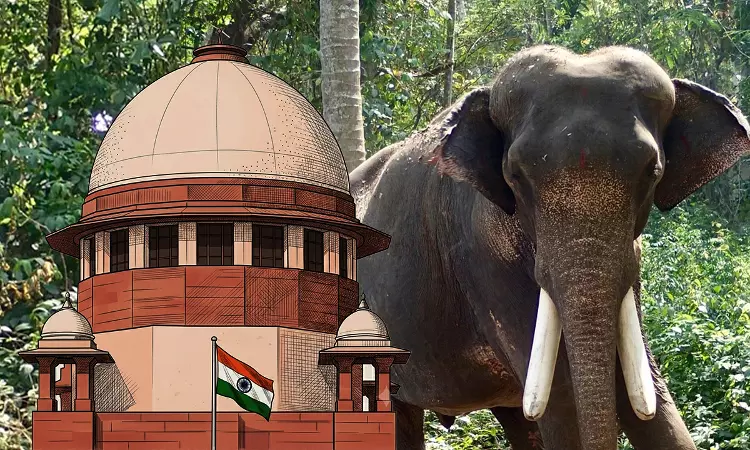
The Supreme Court on Tuesday issued a slew of directions to ensure the welfare and upkeep of captive elephants, while stressing that there shall be no ownership/transfer of elephants without compliance with the relevant rules as well as clear documentation as to the transferor and transferee and the purpose of the transfer.A bench of CJI Surya Kant, Justice Joymalya Bagchi and Justice V...
This is a premium content
Available exclusively to
Our subscribers
Subscribe Premium 
INR 1099+GST
Your support helps us to bring you more content at
an affordable subscription scheme !!!
All payment options available
The Supreme Court on Tuesday issued a slew of directions to ensure the welfare and upkeep of captive elephants, while stressing that there shall be no ownership/transfer of elephants without compliance with the relevant rules as well as clear documentation as to the transferor and transferee and the purpose of the transfer.
A bench of CJI Surya Kant, Justice Joymalya Bagchi and Justice V Mohana further directed the MoEFCC/Captive Elephant Healthcare and Welfare Committee (constituted by the MoEFCC) to explain whether DNA profiling of the elephants is complete, and if so, whether the same is reflected on the Gajah Suchana App.
The Court noted that the population of captive elephants had gone up from 2675 in 2018 to 2725 in 2026, out of which 1678 were stated to be possessed by private persons. It emphasized that its concern for now was not with the ownership of the elephants, but rather, their health, well-being and upkeep.
It directed the Committee to take necessary steps for implementation of its decisions (qua issuance of guidelines/advisory) and file a status report. It also ordered the Union to pass mandatory guidelines if required and to take up the matter with the concerned states to lay down a transparent and effective mechanism for establishment of Elephant Clinics with specialised services.
The Court observed that there should be a mandatory prescription for all elephant owners to take the elephants for a medical checkup and medical records of the elephants should be maintained.
It also asked the Committee to ensure that medical treatment is provided to the elephants, and to lay down minimum standards for their housing and upkeep.
The Court further recorded that there should be a mechanism for renewal of the Ownership Certificates, and while renewing, entire data with respect to the captive elephant should be revisited.
The status report called from the respondents shall also indicate whether order dated 01.11.2018 has been complied with, the Court said. Vide this order, the Chief Wildlife Warden of every state was directed to ascertain whether owners of captive elephants have Ownership Certificates. If they did not have such certificates, the Court said that provisional certificates could be granted after following mandatory procedure, subject to final decision.
During the hearing, Senior Advocate Aparna Bhat, for petitioner, pointed out that a census of the elephant population was conducted by the Union in 2018, as per which there were 2675 captive elephants in the country. The highest number of these elephants was in Assam and Kerala.
The senior counsel prayed for a direction that no new elephant shall be brought into captivity, and a fresh survey to find out the current number of captive elephants. "These are wild animals. Illegally trafficked. They are being used for religious and commercial purposes, begging", she said.
Bhat also highlighted the paucity of rehabilitation centres for elephants in the country, underlining that there are only 4 (1 each in Mathura, Gujarat, Kerala and Karnataka).
Additional Solicitor General Aishwarya Bhati, for the Union, apprised the court that according to a census completed this year, there are 2725 captive elephants in the country across 27 states. Out of the total number, 1678 elephants are with private persons, 47 are circus elephants, 96 are with temples, 768 with forest departments, 63 in zoos, and 332 in rehabilitation centres. The ASG further contended that there has been substantial progress insofar as DNA profiling of the elephants is concerned.
In response, Justice Bagchi questioned if there is any mechanism under the government-formulated Gajah app for reviewing the health and wellbeing of the elephants. The judge particularly flagged the issue of elephants held captive for circus shows. It was opined that ownership certificate granted qua elephants does not amount to ownership of the animal, as elephants are a natural resource, ownership of which lies with the state.
"Are reports to be regularly submitted by circus owners? Including...about what activities the elephants are engaged in? Some activities would not be in consonance with the Prevention of Cruelty Act. Has that regime been set up?" Justice Bagchi asked the ASG.
When CJI Kant commented that there are some areas where authorities need to commence work, and that temples and circus owners may not be in a position to maintain health and upkeep of the elephants, Senior Advocate K Parmeswar (for an elephant owners' association) opposed the equation of temples and circus owners. He stated that Kerala is at the forefront in terms of rules for captive elephants and all elephants are radio-tagged.
Parmeswar contended that there may be some isolated incidents warranting attention, but all elephants in Kerala cannot be painted with the same brush. "Broad brush painting that elephants can't be used by temples - something needs to be said on that", he exclaimed. He alleged that the petitioner was targeting Hindu temple traditions, especially when the festival season in Kerala was about to commence.
Responding to the submission, Justice Bagchi said that the bench was not intruding into religious or personal rights, but it had to harmoniously apply laws (like the Prevention of Cruelty Act). The judge further said that if an elephant is used in a procession by a temple, its use must be regulated in terms of hours. "We are concerned with health and wellbeing of elephants, with which temple management must also be interested. Respect to divinity must extend to elephant also" Justice Bagchi said.
The CJI, on the other hand, was of the view that possession of captive elephants by private persons was the bigger concern. "Are they (private persons) lawfully authorized? Are they financially viable? Can they properly feed and take care of elephants? Why are they keeping - for commercial or other purpose? Is there digitized record of elephants' age, health, and identity? What kind of food is being served - is it adequate? What is its quality?" the CJI posed.
The CJI further remarked that the ownership certificates should be conditional upon the concerned owner periodically bringing the elephant to a health clinic for examination. He categorically clarified that the Court was not on the temple issue, but rather, the issue of ownership by private persons and circus owners, as the latter amounts to commercial exploitation.
At this point, Parmeswar pointed that parading of elephants in Rajasthan's forts has stopped. He also said that in Kerala, the captive elephants are used only for temple purposes. "Any sort of exploitation, no one wants", Parmeswar said.
Bhat, however, contested the claim that the captive elephants in Kerala are primarily owned/kept by temples. She alleged that temples take these elephants from private persons for processions and later return them to the concerned persons, who are holding them illegally. She however clarified that it was not only a question of Kerala. Assam too has a high number of captive elephants. Bhat further clarified that the idea was not to send the elephants back into the wild, but rather, to rehabilitate them.
Before the hearing ended, Bhat also submitted that elephants get hunted and captured in the wild. Justice Bagchi in reply said that for the said issue, no direction is required from the court, as hunting and capturing is banned by the statute itself. When another counsel claimed that Hindu temple traditions were being targeted, Justice Bagchi said, "You worship the elephant, alright? Take care of the elephant equivalent to a deity. Not your servant", said Justice Bagchi.
The bench refrained from passing a direction that there should be no captive elephants at all. The CJI said that such a direction can be detrimental to elephants, who may be abandoned without due care.
Case : WILDLIFE RESCUE AND REHABILITATION CENTRE AND ORS. v. UNION OF INDIA AND ORS. W.P.(C) No. 743/2014
Citation : 2026 LiveLaw (SC) 867
Tags

Debby Jain
Debby Jain is a Correspondent with LiveLaw, covering the Supreme Court of India

