



- Home
- /
- Top Stories
- /
- Supreme Court Issues Notice To...
Supreme Court Issues Notice To Union On PIL Seeking Stronger Enforcement Of Disability Commissioners' Recommendations
Amisha Shrivastava
1 Jun 2026 7:28 PM IST
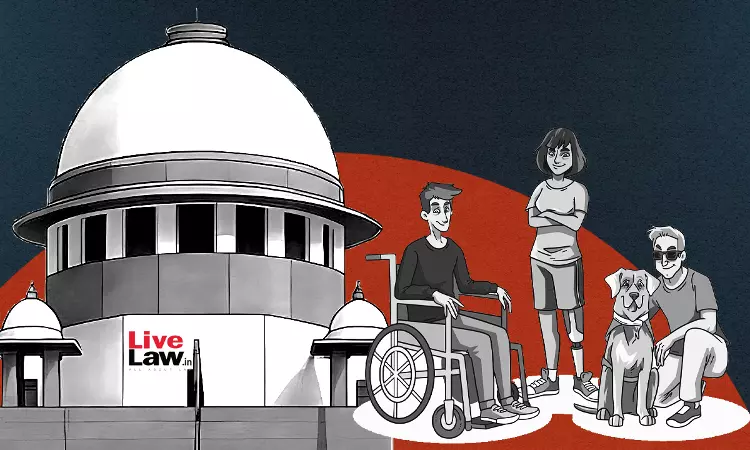
The Supreme Court today issued notice on a PIL seeking directions to strengthen the grievance redressal framework under the Rights of Persons with Disabilities Act, 2016 and ensure effective implementation of recommendations made by the Chief Commissioner and State Commissioners for Persons with Disabilities.A bench of Justice Vikram Nath and Justice Prasanna B. Varale listed the plea on July...
This is a premium content
Available exclusively to
Our subscribers
Subscribe Premium 
INR 1099+GST
Your support helps us to bring you more content at
an affordable subscription scheme !!!
All payment options available
The Supreme Court today issued notice on a PIL seeking directions to strengthen the grievance redressal framework under the Rights of Persons with Disabilities Act, 2016 and ensure effective implementation of recommendations made by the Chief Commissioner and State Commissioners for Persons with Disabilities.
A bench of Justice Vikram Nath and Justice Prasanna B. Varale listed the plea on July 21, 2026.
The petition seeks directions to ensure effective implementation of recommendations issued by disability commissioners and to address deficiencies in the composition, resourcing and functioning of disability commissions across the country.
Under the Rights of Persons with Disabilities Act, the Chief Commissioner for Persons with Disabilities (CCPD) and State Commissioners for Persons with Disabilities (SCPDs) are the primary oversight and enforcement bodies for disability rights.
The petition contends that several statutory requirements governing these bodies are not being implemented in practice, resulting in an ineffective grievance redressal mechanism.
Sections 76 and 81 of the Act require authorities to act on recommendations issued by the disability commissioners within three months. If an authority declines to comply, it must communicate reasons for non-acceptance to the commissioner concerned as well as the aggrieved person.
The petition alleges that, in a large number of cases, authorities neither comply with the recommendations nor furnish reasons for non-compliance.
“To illustrate, as per official figures by the Union of India, between 2022 and 2024, only in 10-15% of the cases in which recommendations of the CGPD were not complied with, were the reasons given by the respondent for non-compliance. In such instances, the Disability Commissions, have been given the power to penalize such authorities under S., 93, but in practice, this provision is not being utilized to secure compliance with recommendations”, the plea states.
Relying on data disclosed by the Union Government in proceedings pending before the Supreme Court in Satendra Singh v. Union of India, the petition claims that recommendations of the CCPD frequently remain unimplemented and that the statutory provisions empowering commissioners to impose penalties are not being effectively used.
The plea also highlights that most state disability commissions lack online grievance portals, many do not maintain functional websites, and advisory committees mandated under Sections 74(8) and 79(7) of the Act have not been constituted.
“At present, only 4 State Commissioners for Persons with Disabilities [SGPDs] have an online portal for registration of grievances. Further, 20 SCPDs do not have a functional website. Further, the RPwD Act envisions the appointment of Advisory Committees, consisting of domain experts, to assist the Disability Commissions [Section 74(8) qua the Chief Commissioner and Section 79(7) qua the State Commissions]. However, at present, neither the Chief Commissioner, nor any State Commissioner has an Advisoiy Committee as per publicly available information”, the plea states.
At the central level, the petitioner states that there has been no full-time Chief Commissioner since 2019 and that one of the two posts of Commissioner envisaged under Section 74(2) remains vacant. “What is envisioned as a panel of 3 members, therefore, has been reduced to only 1 full-time member”, the petition highlights.
The plea contends that the Office of the Chief Commissioner receives substantially lower funding than several other statutory commissions. It notes that the office received an allocation of mere ₹5.5 crore in the Union Budget 2025-26 and ₹6.5 crore for 2026-27.
“In the Union Budget 2025-26, several statutory and quasi judicial oversight bodies have received identifiable and earmarked allocations. The Central Information Commission has been allocated Rs. 42.49 crore, the National Human Rights Commission Rs. 75.53 crore, and the National Green Tribunal Rs. 52.68 crore for their institutional functioning. In sharp contrast, the Chief Commissioner for Persons with Disabilities received a paltry allocation of INR 5.5 Crore out of which only 4.54. Crore has been spent. Similarly, for the 2026-27 budgetary allocations, a sum of INR 6.5 Cr. has been allocated to the Disability Commissioner while other Commissions like National Commission for Scheduled Caste and National Commission for Scheduled Tribes have been allocated INR 40 Cr. and 43.36 Cr respectively”, the plea highlights.
The petition seeks guidelines to ensure effective and time-bound compliance with recommendations issued by disability commissioners and to provide consequences for non-compliance, including imposition of fines under Sections 89 and 93 of the RPwD Act.
It also seeks directions to fill the vacant post of Additional Commissioner in the Central Commission for Persons with Disabilities, constitute advisory committees under Sections 74(8) and 79(7) of the Act, and conduct an independent audit of the offices of the Chief Commissioner and State Commissioners to identify and remedy infrastructural deficiencies.
Advocate Rahul Bajaj along with Advocate on Record Talha Abdul Rahman represented the petitioner.
Case no. – W.P.(C) No. 715/2026
Case Title – Shashank Pandey v. Union of India
Tags

Amisha Shrivastava
Amisha Shrivastava is a Senior Correspondent with LiveLaw, covering the Supreme Court of India. She can be reached at amisha@livelaw.in

