



- Home
- /
- Top Stories
- /
- S.133 Contract Act | Surety Not...
S.133 Contract Act | Surety Not Liable For Borrower's Withdrawals After Modification Of Loan Limit Without Consent : Supreme Court
Yash Mittal
5 March 2026 10:33 AM IST
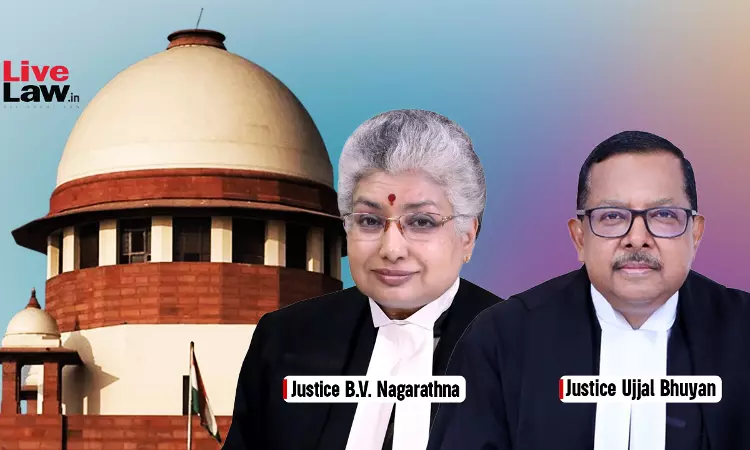
The Supreme Court recently held that a guarantor cannot be held liable for loan amounts withdrawn by the borrower beyond the sanctioned limit without the guarantor's consent. However, the guarantor would remain liable for the loan amount originally guaranteed.A bench of Justices BV Nagarathna and Ujjal Bhuyan set aside the Gujarat High Court's judgment which has ruled that variance in a...
This is a premium content
Available exclusively to
Our subscribers
Subscribe Premium 
INR 1099+GST
Your support helps us to bring you more content at
an affordable subscription scheme !!!
All payment options available
The Supreme Court recently held that a guarantor cannot be held liable for loan amounts withdrawn by the borrower beyond the sanctioned limit without the guarantor's consent. However, the guarantor would remain liable for the loan amount originally guaranteed.
A bench of Justices BV Nagarathna and Ujjal Bhuyan set aside the Gujarat High Court's judgment which has ruled that variance in a loan agreement would discharge the surety of entire liability.
The Court examined the provisions relating to guarantees under Chapter VIII of the Indian Contract Act, particularly Sections 133 and 139.
Section 133 provides that any variance in the terms of the contract between the principal debtor and creditor, made without the surety's consent, discharges the surety only with respect to transactions subsequent to the variance.
In contrast, Section 139 applies when the creditor's act or omission impairs the surety's eventual remedy against the principal debtor.
The Court clarified that under Section 133 of the Indian Contract Act, a surety is not released from their entire obligation due to a contract modification. Instead, the guarantor is discharged only regarding transactions that occur after the unauthorized variance, while remaining liable for the original amount they initially consented to.
The dispute began on October 30, 1993, when M/s Darshak Trading Company (Respondent No. 6) obtained a cash-credit facility for Rs. 4,00,000 from Appellant-Bhagyalakshmi Co-Operative Bank. Respondent Nos. 1 and 2 executed contracts of guarantee, standing as sureties specifically for this sanctioned loan.
However, the borrower allegedly connived with Appellant-bank officials to withdraw amounts far exceeding the original limit. When the borrower defaulted, the Bank filed a Suit seeking to recover Rs. 26,95,196.75—nearly seven times the original sanctioned amount—from both the borrower and the sureties.
The Gujarat High Court had previously ruled that the sureties were not liable at all. It reasoned that because the Bank allowed the borrower to overdraw, the contract was fundamentally altered, discharging the sureties from the entire debt under Section 139 of the Act.
Setting aside the impugned order, the judgment authored by Justice Nagarathna observed that the surety would be liable for the original amount, not transaction entered post variance.
“The surety is discharged only in respect of transactions that occurred subsequent to the variance of the terms of the contract. Thus, the observation of the High Court in the impugned order that the sureties must either be liable for the entire loan amount or not at all is erroneous, as the discharge of the sureties in the instant case can only be in respect of the amounts in excess of the Rs.4,00,000/- (Rupees Four Lakhs Only) that were withdrawn as under Section 133 of the Act, as it is only these amounts that would constitute a variance of the contract. The said bifurcation that was deemed to be impermissible by the High Court is, in fact, mandated by the statute in order to determine the extent of the sureties' liability as per Section 133 of the Act.”, the court observed.
Rejecting the reliance placed by the guarantors on Section 139, the Court held that the provision applies only when the creditor's act impairs the surety's eventual remedy against the principal debtor.
In the present case, although the bank permitted overdrawing beyond the sanctioned amount, there was no impairment of the sureties' remedy against the borrower. Hence, Section 139 had no application.
The Court rejected the High Court's view that sureties must be liable for the "entire amount or not at all". It held that the law mandates a split: liability remains for the original contract, but ends for the "variance" (the overdrawn amounts).
“The High Court was not right in holding that guarantors may be either liable to pay the entire amount which is deemed payable by the principal borrower or not at all and that there cannot be a bifurcation of the liability. This is contrary to Section 133 of the Act which speaks about discharge of surety by variance in terms of contract and that any variance made without the consent of the surety only can be resisted. Hence, in the instant case, since there was no intimation to the respondent-sureties about the over drawing from the cash credit facility, they are liable to the extent of their liability till the variance was made in the instant case, which is of the original amount of Rs.4,00,000/- (Rupees Four Lakhs only) with applicable interest.”, the court observed.
Accordingly, the appeal was allowed.
Headnote
Indian Contract Act, 1872; Section 133 - Discharge of surety by variance in terms of contract - The Supreme Court held that any variance made in the terms of the contract between the principal debtor and the creditor without the surety's consent discharges the surety only as to transactions subsequent to the variance - The discharge of the surety is not absolute; they remain liable for the original amount for which they stood as guarantee before the unauthorized variance occurred.
Liability of Guarantors - Bifurcation of Liability - Supreme Court set aside the High Court's finding that guarantors are either liable for the entire amount or not at all. It held that liability can be bifurcated; sureties are liable to the extent of their original engagement (plus applicable interest) but are not liable for excess amounts permitted to be withdrawn by the creditor in connivance with the principal debtor without the sureties' intimation or consent - The cardinal rule is that a guarantor must not be liable beyond the terms of his engagement – noted that unless there is bad faith, misrepresentation, or a material variation to the prejudice of the surety, the creditor's actions within the contract terms do not automatically discharge the surety – Appeal allowed. [Relied on State of Maharashtra vs. Dr. MN Kaul (D) by his LRs, AIR 1967 SC 1634; Syndicate Bank vs. Channaveerappa Beleri & Ors., (2006) 11 SCC 506; Paras 4-7]
Cause Title: BHAGYALAXMI CO-OPERATIVE BANK LTD. VERSUS BABALDAS AMTHARAM PATEL (D) THROUGH LEGAL REPRESENTATIVES & OTHERS
Citation : 2026 LiveLaw (SC) 210
Tags

Yash Mittal
Yash Mittal is a Correspondent with LiveLaw, covering the Supreme Court of India

