



- Home
- /
- Top Stories
- /
- Does Lokpal Act Envisage Separate...
Does Lokpal Act Envisage Separate Sanctions For Chargesheet & Prosecution? Supreme Court To Examine In Plea Against Mahua Moitra
Debby Jain
13 March 2026 11:59 AM IST
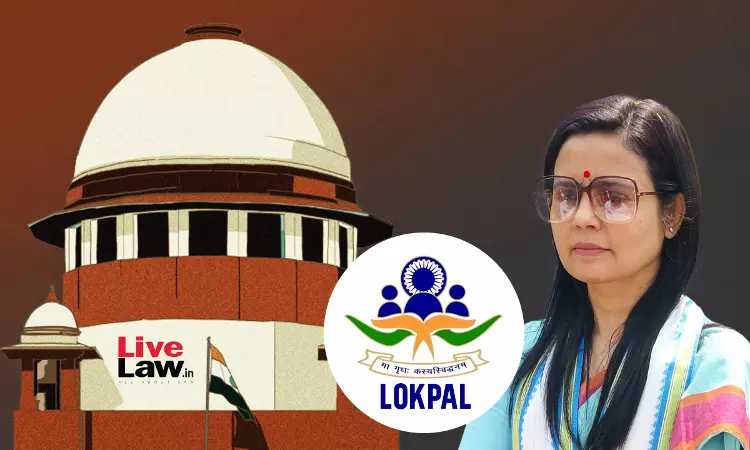
The Supreme Court on Friday issued notice to Trinamool Congress MP Mahua Moitra on a petition filed by the Lokpal of India challenging the Delhi High Court's judgment, which held that separate sanctions for the filing of a charge sheet and initiating prosecution are not contemplated by the Lokpal and Lok Ayuktas Act, 2013.Holding that Section 20 of the Lokpal Act did not contemplate the...
This is a premium content
Available exclusively to
Our subscribers
Subscribe Premium 
INR 1099+GST
Your support helps us to bring you more content at
an affordable subscription scheme !!!
All payment options available
The Supreme Court on Friday issued notice to Trinamool Congress MP Mahua Moitra on a petition filed by the Lokpal of India challenging the Delhi High Court's judgment, which held that separate sanctions for the filing of a charge sheet and initiating prosecution are not contemplated by the Lokpal and Lok Ayuktas Act, 2013.
Holding that Section 20 of the Lokpal Act did not contemplate the separate grant of a sanction for filing of a chargesheet, and the sanction is granted only in a composite manner for prosecution, the High Court had quashed the sanction granted by the Lokpal to the CBI to file a chargesheet against Mahua Moitra in relation to the cash-for-query row. The authority approached the Supreme Court, challenging the interpretation given by the High Court.
While agreeing to examine the matter, the Supreme Court passed an interim order clarifying that the Lok Pal need not take a decision on sanction for prosecution as directed in paragraph 89 of the High Court's order.
The bench comprising Chief Justice of India Surya Kant and Justice Joymalya Bagchi orally expressed prima facie reservations about the High Court's view. The bench said that the matter required the examination of the interplay between Section 20(7)(a) and 20(8).
Senior Advocate Ranjit Kumar, for the Lok Pal, submitted that the authority was aggrieved with the interpretation given to the Lokpal Act by the High Court, and was not concerned with any particular individual.
Solicitor General of India Tushar Mehta submitted that the CBI was supporting the interpretation given by the High Court. However, the respondent (Mahua Moitra) needs to be investigated, he added. SG said that the essential question was whether two rounds of sanctions were contemplated - one for filing of the chargesheet and the second for initiating prosecution.
In response, Justice Bagchi said that Section 20 envisages separate stages for sanction for filing of a chargesheet and the initiation of prosecution, because the Lokpal can also choose that its own agency, and not the investigating agency, must conduct the prosecution.
"Mr. Solicitor, ff you see the provisions (Section 20(7)(a) and 20(8)), apparently they overlap. But there are fine distinctions between the filing of a charge sheet and the conduct of prosecution. And when the conduct of prosecution comes into interplay, see the history of Lokpal Act. Lokpal Act is to create public confidence in the enquiry into and prosecution of public servants who are highly placed, where there's a real or perceptible fear that he/she may disable the investigating and prosecution agencies from conducting their duties. So does the Lokpal not apply its mind when the sanction under Section 20(7)(a), that he's satisfied about the fairness of investigation...as soon as it is filed, it would be duty to conduct the prosecution, through the prosecution agency which is aligned with the investigating agency. But in 20(8), the Lokpal takes the second call, that this investigation fairly done should not go to waste by an indolent prosecution. So Lokpal may say we will withhold the prosecution from the investigating agency and may direct prosecution through my agency. Let's examine the interplay of the sections in light of BNSS and the Prevention of Corruption Act."
CJI pointed out that the expressions in 20(7) and 20(8) are different.
When the bench expressed its inclination to issue notice on the petition, Senior Advocate Nidhesh Gupta, for Mahua Moitra, submitted that a status quo must be ordered. The bench observed that a direction that Lok Pal need not act as per paragraph 89 of the High Court Judgment will address the concerns of both sides. In Para 89, the High Court had directed :
"The learned Lokpal is requested to accord its consideration for grant of sanction under Section 20 of the Lokpal Act, strictly in accordance with provisions thereof as construed hereinabove, within a period of one month from today."
The Supreme Court also issued notice on petitions filed by Lokpal against other High Court judgments adopting similar view.
To recap, Moitra is accused of receiving cash in exchange for posing questions on behalf of businessman and friend Darshan Hiranandani. In an interview with The Indian Express, she accepted the fact that she had provided her Parliament login and password details to Hiranandani, however, she refuted the claim of receiving any cash from him.
The dispute arose after BJP's Nishikant Dubey wrote a complaint to the Lok Sabha Speaker alleging that Moitra purportedly took bribes to ask questions in the Parliament. Dubey claimed that the genesis of the said allegations was a letter addressed to him by Advocate Jai Dehadrai.
Moitra then sent a legal notice to Dubey, Dehadrai and media houses wherein she denied the allegations made against her.
Before the High Court, she challenged the order passed by the Lokpal on November 12, 2025, saying that the same was erroneous, de hors the provisions of the Lokpal Act and a gross violation of principles of natural justice.
It was her case that while arguments and filings were invited from her, they were completely ignored before issuing an order granting sanction under Section 20(7)(a) of the Lokpal Act.
The plea stated that the Sanction Order reduced the role of the Lokpal to merely “rubber-stamping of the Investigation Report”, without considering any defense whatsoever being offered by Moitra and granting sanction to file a chargesheet.
It added that the Lokpal has closed the door on the filing of a closure report without even considering the arguments and defense of Moitra and instead summarily accorded sanction for the filing of a chargesheet to her prejudice.
The CBI, on the other hand, argued that before grant of sanction, an accused is not required to be heard and can only give comments without any oral hearing.
Upon hearing the parties, the High Court ruled that the Lokpal of India erred in understanding the provisions of the Lokpal Act.
The High Court observed that the Lokpal had incorrectly interpreted the Act as creating two separate sanctions: one for filing a chargesheet under Section 20(7)(a) and another for initiating prosecution under Section 20(8).
Rejecting this interpretation, the Court held that the Lokpal Act contemplates only one stage of sanction for prosecution. It explained that Section 20(8) merely enables the Lokpal to direct which agency will conduct the prosecution and does not create a second stage of sanction.
The Bench noted: “Section 20(7)(a) of the Lokpal Act constitutes the sole and final stage for grant of sanction for prosecution.”
The High Court further held that once sanction is granted under Section 20(7)(a), the Special Court becomes competent to take cognisance and proceed under criminal procedure law.
According to the High Court, at the stage of Section 20(7), the Lokpal is only required to consider the investigation report and written comments of the public servant and the competent authority. The Bench observed that the Lokpal had “departed from the prescribed statutory procedure” and engaged in an impermissible exercise of “statutory ingenuity” by restructuring the process laid down by Parliament.
Case Title: LOKPAL OF INDIA v. MAHUA MOITRA, SLP(C) No. 8919/2026
Tags

Debby Jain
Debby Jain is a Correspondent with LiveLaw, covering the Supreme Court of India

