



- Home
- /
- Top Stories
- /
- Supreme Court Issues Notice On Plea...
Supreme Court Issues Notice On Plea Challenging Constitutionality Of NIA Act
Debby Jain
21 April 2026 4:30 PM IST
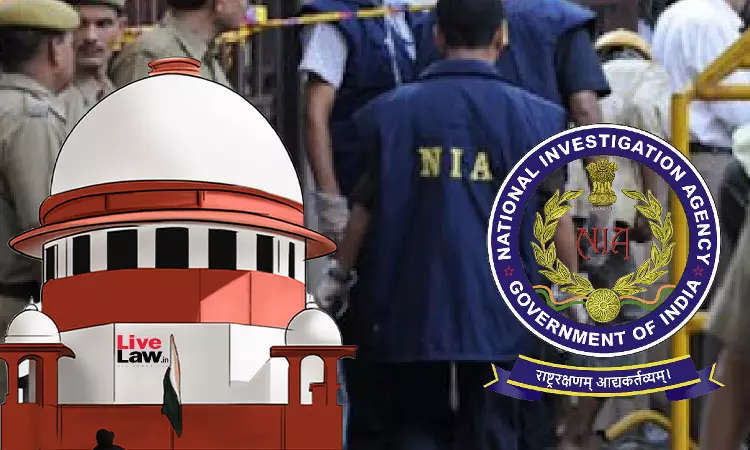
The Supreme Court today issued notice on a public interest litigation challenging the National Investigation Agency Act, 2008 as arbitrary, lacking in legislative competence and an encroachment on state power.A bench of Justices Vikram Nath and Sandeep Mehta passed the order, after hearing Senior Advocate Siddharth Dave (for petitioner). Additional Solicitor General Aishwarya Bhati...
This is a premium content
Available exclusively to
Our subscribers
Subscribe Premium 
INR 1099+GST
Your support helps us to bring you more content at
an affordable subscription scheme !!!
All payment options available
The Supreme Court today issued notice on a public interest litigation challenging the National Investigation Agency Act, 2008 as arbitrary, lacking in legislative competence and an encroachment on state power.
A bench of Justices Vikram Nath and Sandeep Mehta passed the order, after hearing Senior Advocate Siddharth Dave (for petitioner). Additional Solicitor General Aishwarya Bhati represented the Union.
During the hearing, Dave contended that no Central agency has 'police' power, except the NCB (as provided in Tofan Singh case). However, the NIA Act vests complete powers of a police officer in officers of the NIA. In this regard, he referred to Section 3 (Constitution of NIA) and 6(5) of the Act, highlighting that Section 6(5) allows the Central government to direct suo motu investigation by the NIA if it is of the opinion that a scheduled offense has been committed. He emphasized that in such a situation, the state's power to investigate is complete ousted.
Dave further argued that the subject of 'police' falls only within the state list, as public order is the domain of state governments, and Parliament cannot legislate in that regard. He also contrasted the NIA Act with the PMLA to stress that even ED is not empowered as a police force.
"If there is a specific list and a specific entry which says 'police', then the enactment of the NIA which confers and declares the NIA to be a police force is a power on which only the state could have legislated...they could have constituted any force, but not a 'police force'. Like under PMLA, ED is not treated as police. It can't be a police force because Parliament does not have the competence to legislate and constitute a 'police force'. Powers under S.3 are sweeping", Dave argued.
Briefly put, the PIL is filed by a Kerala-based advocate, who was booked in a case relating to unlawful activities of the Popular Front of India. The case (RC-2/2022) was registered by the NIA in 2022 under Sections 120B, 153A of IPC, Sections 13, 18, 18A, 18B, 20 and 23 of UAPA and Sections 25(1)(a) of the Arms Act, on the orders of the Ministry of Home Affairs. The petitioner got arrested after searches were conducted in Kerala in relation to the case and remained in custody for over a year before being released on bail by the High Court.
Besides this case, the petition refers to a second case (Cr No. 318/2022) lodged by Kerala police in 2022 over the alleged killing of a BJP activist by certain PFI members. After investigation of the said case by the state police, a final report was filed in July, 2022 against 43 accused for offenses under Sections 120B, 34, 118, 119, 109, 143, 144, 147, 148, 449, 341, 201, 212, 302 r/w 149 IPC and Section 3(a)(b)(d) r/w Section 7 of the Religious Institutions (Prevention of Misuse) Act. After further investigation, some more accused were arrayed in supplementary chargesheets.
While the committal proceedings qua these accused were pending, the Union passed an order, exercising its power under section 6(5) r/w Section 8 of the NIA Act directing the NIA to take up investigation into offenses committed by PFI leaders/members. In 2023, the NIA filed a final report in RC-2/2022. The Kerala High Court also transferred the aforementioned committal proceedings to the NIA Court.
In this backdrop, the petitioner is aggrieved by the NIA's invocation of Section 8 and investigation of a case already investigated by the state police. It is stated that in the state police's final report, there was no allegation of any scheduled offense having been committed. As such, the NIA's clubbing of RC-2/2022 and Cr No.318/2022 renders the state investigation otiose.
The petitioner claims that 'police' is a subject matter falling under Entry 2 of State List in Schedule 7, and as per CrPC, it has the power to investigate offenses. It is contended that the intention of the Parliament behind the NIA Act was not to create a national investigative agency which would have overriding powers over the state police.
The petitioner avers that the NIA Act is against the federal structure of the Constitution and confers unbridled power on the Union government to encroach upon the exclusive domain of a state. Grounds taken to challenge the vires of the NIA Act include:
- The Act, especially Sections 6-10, empower the agency constituted with unbridled powers without any rules or guidelines, and is manifestly arbitrary falling foul of Article 14;
- The Act is violative of the petitioner's fundamental rights guaranteed under Articles 20 and 21;
- On the basis of doctrine of pith and substance, the Act is a colorable exercise of legislative power, which violates the principle of federalism;
- Parliament did not have requisite legislative competence to enact the Act, which interferes in the domain of the State in relation to 'public order' and 'police' [List 2 of Schedule 7].
As an alternative to the prayer for setting aside of the NIA Act as unconstitutional, the petitioner seeks a direction for the Union to frame appropriate rules/guidelines for exercise of powers under Section 6(5) and 6(5) of the NIA Act.
The petition was filed through AoR Vishnu P.
In 2020, the State of Chhattisgarh had filed a suit challenging the NIA Act. Petitions are also pending in the Supreme Court challenging the 2019 amendmneet to the NIA Act.
Case Title: MOHAMMED MUBARAK AI Versus UNION OF INDIA AND ORS., W.P.(C) No. 320/2026

Debby Jain
Debby Jain is a Correspondent with LiveLaw, covering the Supreme Court of India

