



- Home
- /
- Top Stories
- /
- Supreme Court Agrees To Hear Plea...
Supreme Court Agrees To Hear Plea Challenging UGC Students' Grievances Redressal Regulations 2023
Debby Jain
16 May 2026 8:45 AM IST
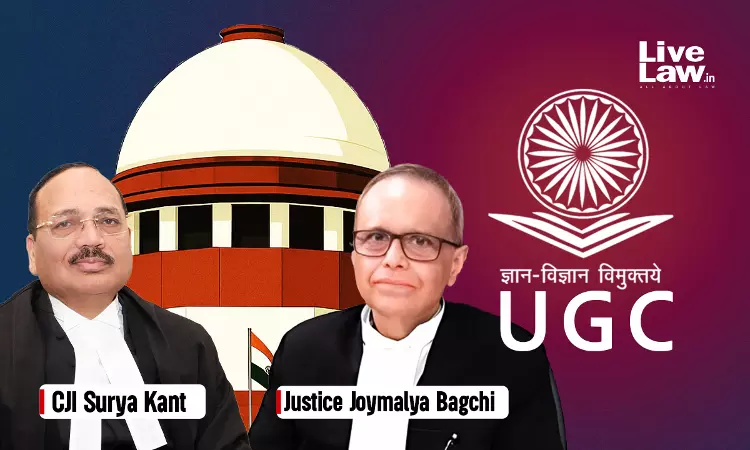
The Supreme Court recently refused to issue notice on a petition to the extent it challenged the 2012 University Grants Commission Regulations. The Court restricted notice on the plea insofar as it challenged provisions of UGC's 2023 Regulations.A bench of CJI Surya Kant and Justice Joymalya Bagchi passed the order, after hearing Senior Advocate J Sai Deepak (for petitioners). The matter...
This is a premium content
Available exclusively to
Our subscribers
Subscribe Premium 
INR 1099+GST
Your support helps us to bring you more content at
an affordable subscription scheme !!!
All payment options available
The Supreme Court recently refused to issue notice on a petition to the extent it challenged the 2012 University Grants Commission Regulations. The Court restricted notice on the plea insofar as it challenged provisions of UGC's 2023 Regulations.
A bench of CJI Surya Kant and Justice Joymalya Bagchi passed the order, after hearing Senior Advocate J Sai Deepak (for petitioners). The matter was listed alongwith similar petitions pending before the court.
At the outset, the bench expressed disinclination to entertain a challenge to the 2012 Regulations, observing that while staying the 2026 Regulations, the Court directed that the 2012 Regulations would operate in the meantime.
It may be recalled that the Court is seized of a batch of writ petitions challenging the University Grants Commission (Promotion of Equity in Higher Education Institutions) Regulations, 2026. In January this year, these Regulations were ordered to be kept in abeyance, with a direction that the 2012 Regulations shall remain operative in the meantime.
During the hearing in January, the Court expressed certain reservations about the 2026 Regulations, which were challenged as discriminatory towards "general classes". It suggested that the Regulations be revisited by a committee comprising eminent jurists. The Regulations are prima facie "vague" and are "capable of misuse", the Court observed.
The 2026 Regulations, formulated with the objective of promoting "equity" in higher education institutions, are being opposed by some sections. While members of non-reserved categories are seeking a roll back of the Regulations, the reserved categories are opposing any roll back.
What does the present petition say?
The petitioners contend that the 2012 Regulations ought not to be treated as a substitute, as "inadequacies" of the said Regulations led to the framing of the 2026 Regulations, which suffer from ambiguities and are capable of misuse.
Further, it is averred that any enactment intended to tackle discrimination must not become a tool for harassment or further discrimination, or be loaded with presumptions for or against a particular class of people. "Tested on this anvil, both the 2012 and the 2026 Regulations suffer from fatal constitutional infirmities, which defeat the very object they claim to advance."
According to the petitioners, both 2012 and 2026 Regulations suffer from vagueness, arbitrariness, absence of procedural safeguards and safeguards against misuse. Further, there is no mass-level empirical data supporting their promulgation.
The 2026 Regulations have been challenged inter-alia on the following grounds:
- Regulation 3(c) restricts the scope of discrimination by sub-classifying discrimination as "caste-based discrimination";
- Treating Other Backward Classes as a category for defining "caste-based discrimination" lacks intelligible differentia or rational nexus to the object sought to be achieved. Further, the Supreme Court has observed in MR Balaji v. State of Mysore that classification of OBCs must be on both social and educational bases and it cannot be determined on a purely caste-basis;
- Regulation 5(7), providing for Equity Committees, mandates representation from specified classes, like OBCs, Schedules Castes, Scheduled Tribes, etc., thereby "foregoing on the need for equal representation of all classes";
- Regulations do not prescribe any penalty/punishment for discriminatory actions or harassment; the same is to be determined by Head of Institution, which is "impermissible sub-delegation".
The 2023 Regulations have been challenged on the following grounds:
- As per Regulation 3(f)(iv), complaint against discrimination can be made only by certain classes of people - SC, ST, OBC, women, minorities or persons with disabilities. Not providing equal treatment to all classes is itself discriminatory and the provision therefore violative of Articles 14 and 15;
- Penalty/punishment for discrimination or harassment is left to be determined by the Ombudsperson. The delegation is without any guidelines or policy framework.
The 2012 Regulations have been challenged on the following grounds:
- Despite general directives in Regulation 3 regarding measures to be taken by higher educational institutions against discrimination, sub-clause (2) only contains specific directions for measures to protect students belonging to SC/ST categories. UGC is bound by Articles 14, 15 and 16, therefore, it must ensure that protection is extended throughout;
- UGC Act does not confer any power of sub-delegation of UGC's rule-making powers to HEIs. Therefore, 2012 Regulations are unconstitutional to the extent they confer rule-making powers on HEIs [such as under Regulation 3(2)(h)];
- The Regulations leave the punishment/penalty for discrimination or harassment upto the HEIs, without providing any clear guidelines. They merely state that the punishment should be commensurate with the nature of the discrimination/harassment.
Case Title: SANTHOSH TAMILARASAN AND ANR. Versus UNION OF INDIA AND ANR., W.P.(C) No. 457/2026
Tags

Debby Jain
Debby Jain is a Correspondent with LiveLaw, covering the Supreme Court of India

