



- Home
- /
- Top Stories
- /
- 'Peaceful Protests Constitutionally...
'Peaceful Protests Constitutionally Protected, Mere Agitation Can't Justify Lathi-Charge': CJI Surya Kant In Pleas Over Jantar Mantar Police Action
Debby Jain
27 July 2026 11:01 AM IST
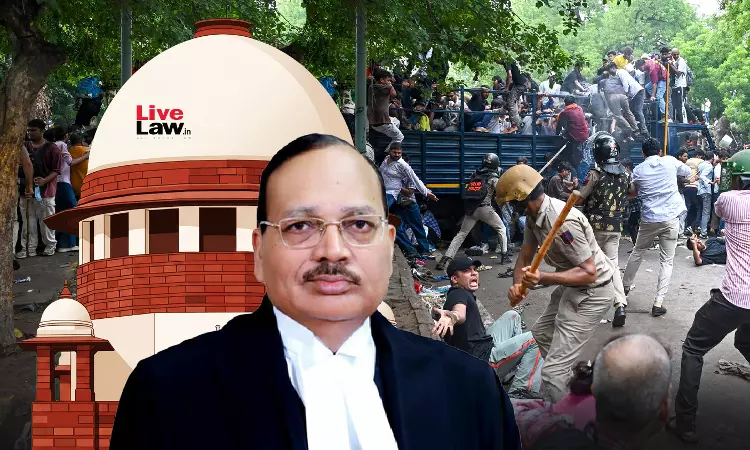
The Chief Justice of India Surya Kant today orally observed that the right to peaceful and lawful protest is constitutionally protected and that mere agitation cannot justify a lathi-charge.A bench of CJI Surya Kant, Justice Joymalya Bagchi and Justice V Mohana made the observations on mentioning of a batch of petitions before the Supreme Court, alleging excessive use of police force...
This is a premium content
Available exclusively to
Our subscribers
Subscribe Premium 
INR 1099+GST
Your support helps us to bring you more content at
an affordable subscription scheme !!!
All payment options available
The Chief Justice of India Surya Kant today orally observed that the right to peaceful and lawful protest is constitutionally protected and that mere agitation cannot justify a lathi-charge.
A bench of CJI Surya Kant, Justice Joymalya Bagchi and Justice V Mohana made the observations on mentioning of a batch of petitions before the Supreme Court, alleging excessive use of police force against students participating in protests across the country over the issue of examination paper leaks.
The Court further observed that allegations of police excess should be independently examined and stressed the need for uniform police protocols for handling demonstrations across the country.
CJI Kant orally observed, "Right to peaceful, lawful protest absolutely guaranteed under Constitution. So long as it is peaceful agitation, merely because there is agitation, there can't be [excess]...If there is excess committed, it should be independently examined. It's not only a case of Delhi. Uniformity in protocol required. Merely because agitation there, doesn't mean lathi-charge. Discipline integral to democratic process."
The Court also allowed request of a counsel, appearing for families of policemen injured during the incident, to participate in the proceedings. Justice Bagchi orally observed, "Injury to individual, be it to policemen or [students], is of equal concern. We may call upon state to concern why adequate equipment not given to police to handle such...they should have helmets"
All the petitions will be heard together tomorrow.
Last Friday, the matter was mentioned before a bench led by CJI Kant by Senior Advocate Gopal Sankaranarayanan. Citing the ongoing protests and reported incidents of use of excessive force by the police, the senior counsel pressed for urgent listing. In response to the same, the CJI said that the matter would be entertained.
Prior to that, on July 22, the CJI had refused to take up a letter petition raising the issue of police force at Jantar Mantar protest on July 20 (mentioned by Advocate Narendra Mishra). Later, the CJI clarified that the listing was denied as there was no properly filed petition before the court at the time.
What do the petitioners say?
One of the petitions, filed through Advocate-on-Record Chand Qureshi, seeks directions to regulate police action during public protests, including a ban on the deployment of plainclothes personnel for crowd-control duties, guidelines governing the use of prohibitory orders under Section 163 of the BNSS, and an independent probe into the police action during the July 20 student protest in Delhi.
The plea states, "The current generation of youth is experiencing deprivation, unemployment, expensive education, loneliness, and a sense of alienation and betrayal by their own government within their own country (violating Article 16). They are presenting their legitimate demands to the government in a peaceful manner (Article 19). However, in return, they are receiving lathi charges, tear gas, pellet guns, and outrage against the modesty of female students peacefully protesting (violating Article 21). Day by day, the government is becoming increasingly cruel toward these protests. The atrocities committed on July 20 against students protesting peacefully are no less than the atrocities of the Jallianwala Bagh."
The petition has been filed by Advocate Shailendra Mani Tripathi against the Union of India, the Delhi Government, the Delhi Police Commissioner and all States and Union Territories. It seeks enforcement of the fundamental rights guaranteed under Articles 14, 19(1)(a), 19(1)(b), 19(1)(d) and 21 of the Constitution.
The petition states that the immediate cause of action arose from the events of July 20, 2026, when students and other citizens marched towards Parliament over issues concerning the education system, and seeking the resignation of Union Education Minister Dharmendra Pradhan. It contends that the demonstration was met with extensive police deployment, barricading, tear gas, baton charges and large-scale detentions. The petition further alleges physical assaults on protesters, gender-based misconduct against female protesters, and the use of force by unidentified or plainclothes personnel. The petition alleges that at least 60 protesters were injured during the police action, and contends that these allegations require an independent and impartial inquiry.
The petition also contends that the closure of metro services and internet shutdowns during the protests disrupted the daily lives of commuters, office-goers, students and patients, and affected access to banking, telemedicine, remote work and emergency services.
The petition states that the issues raised go beyond a single incident and concern broader constitutional questions relating to police accountability, regulation of peaceful assemblies and the exercise of coercive police powers across the country. It relies on the July 20 incident as an illustration of recurring concerns regarding restrictions on peaceful protests.
The petition also questions the repeated invocation of Section 163 of the BNSS, which replaced Section 144 of the CrPC and empowers executive authorities to issue prohibitory orders in urgent situations. It argues that authorities have converted the constitutional right to assemble peacefully into a system requiring prior police permission and have imposed “rolling prohibitory orders” over long periods. It contends that repeated prohibitory orders without a proximate threat to public order are unconstitutional.
The petition also raises concerns regarding Section 152 of the BNS, which criminalizes acts endangering the sovereignty, unity and integrity of India. It contends that the provision is vague and overbroad, has the potential to criminalize peaceful political dissent and criticism of the government, and has a chilling effect on free speech.
It further alleges that the deployment of plainclothes or unidentified police personnel during the July 20 protest violated the Supreme Court's decisions in D.K. Basu v. State of West Bengal and Somnath v. State of Maharashtra, which require officers carrying out arrests or interrogations to wear visible identification.
The petitioner has prayed for national guidelines prohibiting police officers from carrying out crowd-control operations or arrests in plain clothes or without displaying visible identity badges. It also seeks an SOP governing the exercise of powers under Section 163 BNSS to prohibit blanket or repetitive prohibitory orders without a recorded threat to public order.
The petitioner has also sought guidelines restricting the invocation of Section 152 BNS so that it cannot be used against political dissent, academic criticism or peaceful protest unless there is direct and imminent incitement to armed rebellion or secessionist violence. Further, it seeks directions for implementation of the police reforms ordered in Prakash Singh v. Union of India (2006), including the establishment of independent Police Complaints Authorities.
Additionally, the petition seeks the constitution of an independent Judicial Commission or a Special Investigation Team headed by a retired Supreme Court judge to investigate the alleged police excesses, gender-based violence and arbitrary detentions during the July 20 protest. It also seeks directions for registration of an FIR against police personnel allegedly involved in assaults and sexual abuse of female protesters, besides their identification, suspension and prosecution.
Case Title: Shailendra Mani Tripathi v. Union of India & Ors. Diary no. 44078/2026 (and connected case)
Tags

Debby Jain
Debby Jain is a Correspondent with LiveLaw, covering the Supreme Court of India

