



- Home
- /
- Top Stories
- /
- Supreme Court Questions 'Shocking'...
Supreme Court Questions 'Shocking' Rule Allowing Nursing Colleges 30 Km Away From ICU Hospitals; Issues Directions To Improve ICUs
Gursimran Kaur Bakshi
21 May 2026 10:52 AM IST
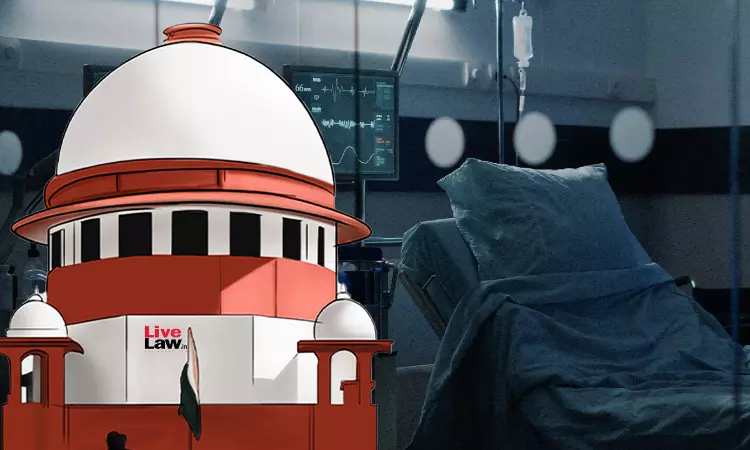
The Court also suggested that States explore the option of getting CSR funds to upgrade ICU and ambulance facilities.
In a significant intervention on healthcare standards, the Supreme Court on Tuesday expressed shock over a reported Indian Nursing Council norm permitting nursing colleges to be located up to 30 kilometres away from hospitals with Intensive Care Unit (ICU) facilities, questioning how nursing students could be expected to receive meaningful hands-on training under such an arrangement.A bench...
This is a premium content
Available exclusively to
Our subscribers
Subscribe Premium 
INR 1099+GST
Your support helps us to bring you more content at
an affordable subscription scheme !!!
All payment options available
In a significant intervention on healthcare standards, the Supreme Court on Tuesday expressed shock over a reported Indian Nursing Council norm permitting nursing colleges to be located up to 30 kilometres away from hospitals with Intensive Care Unit (ICU) facilities, questioning how nursing students could be expected to receive meaningful hands-on training under such an arrangement.
A bench of Justice Ahsanuddin Amanullah and Justice R. Mahadevan was informed that the nursing curriculum requires students to undertake daily ICU visits as part of practical training. The Court found it startling that institutions could be approved despite being located far from hospitals equipped with functioning ICUs.
“The Court is shocked,” the bench observed, noting that nursing students must work on real patients as part of their training and cannot be entrusted with responsibility without actual clinical exposure. When informed that existing guidelines permit the affiliated hospital to be located within a 30-kilometre radius, the Court said such an arrangement was wholly impractical.
Justice Amanullah orally remarked during the hearing that requiring students to travel such distances daily was “atrocious” and “shocking to the conscience of this Court.”
"Every day the student would have to travel 40-50 km to a hospital? How is this guideline there? Nothing short of fraud on the system. 30 Kms every day a student will go for the course to hospital? This is atrocious and shocking to the conscience of this Court. How did you allow the provision to be there?" Justice Amanullah asked.
Additional Solicitor General Aishwarya Bhati submitted that she would seek instructions on whether such a provision indeed exists and whether the competent authority could revisit it. The Court made it clear that ideally, nursing colleges should be attached to hospitals with ICU facilities, and if not, such hospitals should be within a one-kilometre radius. It directed the Indian Nursing Council to submit a report on around 800 such colleges and specify their distance from hospitals with ICU facilities.
The bench observed in the order :
"The Indian Nursing Council, on query, submitted that the basic course incorporates a daily visit to an ICU as per the course curriculum for hands-on training. At this juncture, the Court expressed its surprise as to how such institutions are approved or given permission to start the institute, where clearly the said institution is miles apart from the hospital having a proper and regular ICU. The Court was informed that, as per guidelines, the said hospital can be at a distance of 30 kms. The Court is shocked, and clearly it can't be believed that students of nursing can be visiting every day, which is also imperative for the reason that at the end of the course, they have to practically work on a real patient. Without real experience, they can't be entrusted with responsibility. ASG submitted that she would take instructions as to whether such a provision is there and if it's there, the authority may have a relook."
Court issues directions on improving ICU Standards
The observations came as the Court issued a series of nationwide directions to strengthen critical care infrastructure and standardise ICU facilities across India.
The bench approved the framework titled "Guidelines for Organisation and Delivery of Intensive Care Services", which classifies ICUs into Level I, Level II and Level III categories, and directed States and Union Territories to complete a gap assessment exercise within two months.
States have also been directed to simultaneously begin working on implementing minimum standards for Level I ICUs in healthcare institutions, with a focus on ensuring that critically ill patients receive stabilising care in time-sensitive emergencies.
Recognising financial constraints in expanding healthcare infrastructure, the Court suggested that States explore funding through Corporate Social Responsibility (CSR) initiatives, NGO support and public donations, while cautioning that such funds must be ring-fenced and used only for ICU-related infrastructure.
The Court also asked States to assess the feasibility of maintaining at least five fully-equipped ambulances, including ventilator support and trained personnel, through donated funding for transporting critically ill patients within districts.
In another major direction, the Centre was asked to formulate a nationwide GPS-based system mapping hospitals and indicating ICU availability and capacity, enabling faster referrals and coordinated transfers between institutions. The Court also endorsed tele-ICU and tele-consultation systems and called for a digital communication grid linking hospitals.
Observing that India's healthcare infrastructure was struggling to keep pace with rising demand, the Court emphasised that critical care access directly implicates the fundamental right to life.
The matter will now be heard in August, when the court-appointed committee is expected to place its final recommendations.
The Court passed the directions while hearing a long-pending matter concerning healthcare standards, after considering recommendations prepared by a court-appointed committee and suggestions from healthcare experts. The Court also endorsed the framework classifying ICUs into Level I, Level II and Level III categories, observing that the proposed standards were well considered and required strict enforcement.
Emphasising the urgency of strengthening critical care infrastructure, the Court said India's growing population had placed immense pressure on the healthcare system, resulting in a shortage of quality emergency care facilities.
“When it comes to a person in a critical health condition, there is a real dearth and shortage of facilities to ensure that the least patient is made stable so as to give him or her further corrective measures,” the bench observed, underlining that the right to life obligates the State to ensure access to such care.
Case Details: ASIT BARAN MONDAL Vs DR. RITA SINHA MBBS MS OBST. GYNAE|MA 1364/2026 in C.A. No. 8402/The 2016
Tags
Gursimran Kaur Bakshi
Gursimran is the Principal Correspondent with LiveLaw for the Supreme Court. She can be reached out at: simrankaurbakshi@livelaw.in

