



- Home
- /
- Top Stories
- /
- PC Act | Recovery Of Bribe Amount...
PC Act | Recovery Of Bribe Amount Alone Insufficient Without Proof Of Demand: Supreme Court
Saima Anjum
19 Aug 2026 7:35 PM IST
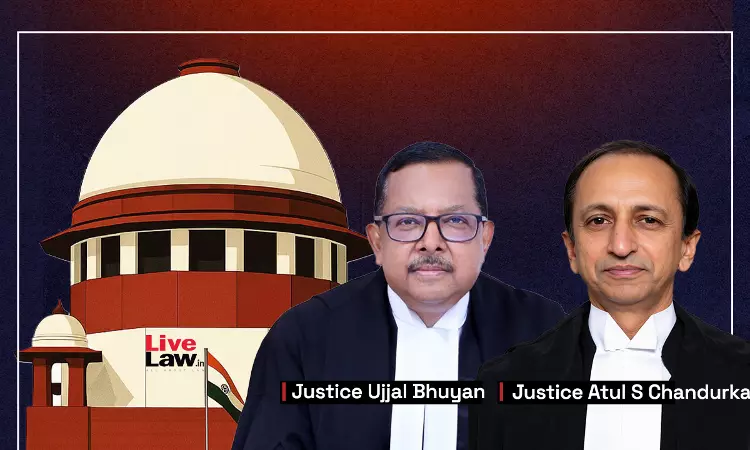
The Supreme Court on Wednesday (19.08.2026) has acquitted a former Talati-cum-Mantri and a Peon of a Gram Panchayat, who were convicted under the Prevention of Corruption Act, 1988 (PCA), holding that the prosecution has failed to prove the initial demand of bribe beyond reasonable doubt. It was also observed that mere recovery of a currency note from the co-accused could not sustain...
This is a premium content
Available exclusively to
Our subscribers
Subscribe Premium 
INR 1099+GST
Your support helps us to bring you more content at
an affordable subscription scheme !!!
All payment options available
The Supreme Court on Wednesday (19.08.2026) has acquitted a former Talati-cum-Mantri and a Peon of a Gram Panchayat, who were convicted under the Prevention of Corruption Act, 1988 (PCA), holding that the prosecution has failed to prove the initial demand of bribe beyond reasonable doubt. It was also observed that mere recovery of a currency note from the co-accused could not sustain the conviction.
A bench of Justice Ujjal Bhuyan and Justice Atul S Chandurkar set aside the Gujarat High Court judgment, which upheld the conviction of the appellants under Sections 7, 12, and 13(1)(d) of the Act.
The complainant had approached the Mamlatdat to procure an Income Certificate. The application was examined and forwarded to the Talati-cum-Mantri of village Bechri (A1). It was alleged that A1 demanded Rs 120 (Rs 100 for himself and Rs 20 for the Peon, A2), for issuing the certificate. A complaint was filed before the Anti-Corruption Bureau and a trap was laid. The complainant allegedly gave a Rs 20 note to A2, who was caught with the tainted currency.
Both the accused persons were convicted by the trial Court under Section 7 read with Section 13(1)(d) of the Act, while being acquitted of criminal conspiracy under Section 120B of the Indian Penal Code, 1860 (IPC, now Section 61 of the Bharatiya Nyaya Sanhita, 2023), and were sentenced to undergo rigorous imprisonment for six months along with fine of Rs 2000. On appeal, the Gujarat High Court upheld the conviction, however, State's plea for enhancement of sentence was dismissed, holding that there was no need to enhance punishment since the accused had already been dismissed from service.
While pursuing the evidence, the Court noted that the complainant, in a separate case, deposed contradictory versions of the amount allegedly asked for in bribe. Earlier, he deposed that A1 had initially demanded Rs 200, and that Rs 120 was arrived at “towards final settlement”, however, he did not state this in the present proceedings. The bench observed that “the version of the complainant as recorded in this case, therefore, is in variance with his deposition” in the other case.
The bench also noted that the complainant had been specifically instructed by the Bureau to hand over the entire amount of Rs 120 (in three notes) whenever the demand was made. However, despite A1 allegedly demanding the full amount after issuing the certificate, the complainant gave only one Rs 20 note to A1. Notably, A2 who was standing nearby, raised no query.
The Court held that this conduct, “considered along with his admission in the cross-examination that A2 did not make any demand,” rendered the entire episode suspicious. It was further noted that there was “no explanation as to why the instructions given to the complainant at the Anti-Corruption Bureau office of giving the entire amount of Rs 120 on demand were not followed.”
The Court also noted that both the accused had been acquitted of the charge of criminal conspiracy under Section 120B of IPC, which was significant as the demand was attributed only to A1 (who was never found with any money) while acceptance was attributed only to A2 (against whom demand was held not proved).
Rejecting the prosecution's reliance on the presumption under Section 20 of the Act, the bench held that such a presumption “would come into play only after the initial demand is proved by the prosecution beyond reasonable doubt,” and that “if the initial demand itself is not proved, mere recovery of the amount of Rs 20 from A2 would not resurrect the case of the prosecution to enable the Court to hold that the charge was proved.” Relying on N Vijayakumar v State of Tamil Nadu, it was held that the High Court erred in drawing the presumption merely on the premise that the accused were public servants and the currency note recovered from A2 was tainted.
The bench further observed that the Rs 20 note was given to A2 only after the Income Certificate had already been handed over to the complainant by A1, which added doubt surrounding the alleged demand.
The Court also examined the appellants' contention that the sanction issued by the Deputy District Development Officer for prosecuting A1, was invalid because only the District Development Officer was empowered to remove a Talati-cum-Mantri under the Gujarat Panchayats Act, 1961. Noting that the prosecution had failed to establish that a Deputy District Development Officer was empowered to issue sanction, the Court held that “the sanction granted to the prosecution of A1 by the Deputy District Development Officer is found to be invalid.” However, it was also clarified that the Court would “not set aside the conviction of A1 solely on the ground of an invalid order of sanction,” proceeding instead to hold that the prosecution's evidence independently fell “woefully short of proving the charge against both the accused beyond reasonable doubt.”
Further, the Court took note of A2's defence that he had been given Rs 20 by the complainant on account of Eid falling the next day, holding the explanation to be “also probable” in the facts of the case.
In the light of above, the bench held that “mere possession of a currency note of Rs 20 with A2 by itself would not be sufficient to uphold the conviction of A1 and A2 for the offence punishable under Sections 7, 12 and 13(1)(d) of the Act of 1988.”
Accordingly, the judgments of the trial Court and the High Court were set aside, and both the appellants were acquitted of the charges.
Headnote
Prevention of Corruption Act, 1988 — Sections 7, 13(1)(d), and 20 — Proof of Demand and Acceptance — Statutory Presumption - The statutory presumption under Section 20 of the PC Act comes into play only after the prosecution proves the foundational fact of demand beyond reasonable doubt - Mere recovery of tainted money from an accused, in the absence of proof of demand, cannot sustain a conviction - Where the initial demand by Accused No. 1 (Talati-cum-Mantri) was doubtful due to material contradictions, Accused No. 2 (Peon) made no demand, and both stood acquitted of the charge of criminal conspiracy under Section 120B IPC, mere recovery of ₹20/- from Accused No. 2 cannot resurrect the prosecution's case or attract the presumption under Section 20. [Relied On N. Vijayakumar v. State of Tamil Nadu, (2021) 3 SCC 687; Paras 10 – 18]
Prevention of Corruption Act, 1988 — Sections 7 and 13(1)(d) — Timing of Payment — Work Already Executed - Payment made after the delivery/issuance of the requested document casts serious doubt on the allegation of bribe demand - Where an income certificate was already prepared and handed over to the complainant before any money was allegedly passed to the peon, it cannot be assumed ipso facto that such payment was made pursuant to an illegal demand - The defence that the amount was handed over on the eve of a festival (Eid) was held to be probable. [Relied On State of Lokayuktha Police, Davanagere v. C.B. Nagaraj, 2025 INSC 736; Paras 16 - 18]
Prevention of Corruption Act, 1988 — Section 19(1)(c) — Validity of Sanction — Authority Competent to Remove - Cognizance under Sections 7 and 13 cannot be validly taken without previous sanction from the authority competent to remove the public servant from office - For a substantively appointed Talati-cum-Mantri under the Gujarat Panchayats Act, 1961, the competent authority to remove is the District Development Officer (DDO) - Sanction granted by the Deputy District Development Officer (Dy. DDO) is defective and invalid, notwithstanding that the initial ad-hoc appointment was made by the Dy. DDO. [Para 17]
Appellate Jurisdiction / Criminal Trial — Standard of Proof — Material Contradictions - Variance between the complainant's statements in the corruption trial and earlier depositions in collateral proceedings regarding the demanded amount, coupled with disobedience of the trap-laying instructions given by the Anti Corruption Bureau, creates serious doubt regarding the foundational fact of demand - the conviction cannot be sustained. [Paras 10–19]
Case Title: Rafikmiya Ahmedmiya Malek v State of Gujarat and Sirajbhai Rasulbhai Vora v State of Gujarat
Citation : 2026 LiveLaw (SC) 830
For Appellant: Mr. Sudhansu Palo, AOR Mr. Amit Sangwan, Adv. Ms. Shivangi Singh, Adv. Mr. Vikram Pratap Singh, Adv. Mr. Chandan Kumar Singh, Adv.
For Respondent:Ms. Swati Ghildiyal, AOR Ms. Deepanwita Priyanka, AOR Ms. Neha Singh, Adv.
Tags


