



- Home
- /
- Top Stories
- /
- Supreme Court Refuses To Suspend...
Supreme Court Refuses To Suspend CEC Gyanesh Kumar Ex Parte, Issues Notice On Plea Challenging ECI Decisions
Debby Jain
5 Oct 2026 1:14 PM IST
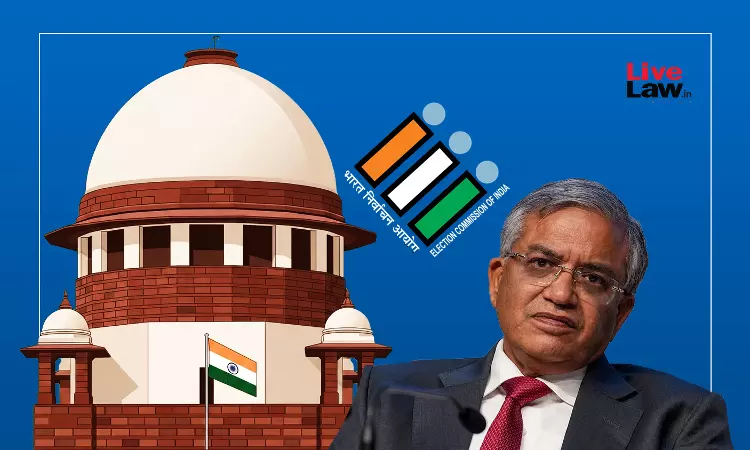
"The Court has to pass some interim orders, otherwise the country will burn," Senior Advocate Vikas Singh urged for the petitioner.
The Supreme Court on Monday declined to pass an ex-parte interim order seeking suspension of Chief Election Commissioner Gyanesh Kumar, observing that it should first seek the response of the Election Commission and other respondents on the allegations that several SIR-related decisions were taken unilaterally by the CEC.A bench of Chief Justice of India Surya Kant, Justice Joymalya Bagchi...
This is a premium content
Available exclusively to
Our subscribers
Subscribe Premium 
INR 1099+GST
Your support helps us to bring you more content at
an affordable subscription scheme !!!
All payment options available
The Supreme Court on Monday declined to pass an ex-parte interim order seeking suspension of Chief Election Commissioner Gyanesh Kumar, observing that it should first seek the response of the Election Commission and other respondents on the allegations that several SIR-related decisions were taken unilaterally by the CEC.
A bench of Chief Justice of India Surya Kant, Justice Joymalya Bagchi and Justice V Mohana issued notice to the Union of India, the Election Commission of India, CEC Gyanesh Kumar, Election Commissioners Dr Sukhbir Singh Sindhu, Dr Vivek Joshi, Dy Election Commissioner Maneesh Garg IAS and DG(IT) Seema Khanna on the petition.
The petition was filed following a report of The Indian Express that 14 crucial decisions relating to the Special Intensive Revision were taken in the name of ECI by the CEC, ignoring the objections recorded by two ECs.
Senior Advocate Vikas Singh, for petitioner Rakesh Kumar Singh, submitted that though the challenge to the appointment process under CEC law was pending before the larger bench, "some interim measures are needed as every citizen was now feeling unsafe about their voting rights."
He referred to Section 18 of the CEC Act, which says that the decisions of the Election Commission of India should be as far as possible unanimous, and if not unanimous, then the decision should be by majority.
He also referred to Section 16, which gives legal immunity to the CEC for acts taken in discharge of official duties, and said that such a protection is not available to Supreme Court judges.
Singh pressed for an interim order to suspend the CEC immediately. "We are dealing with a grave situation which can undermine the very basis of our democracy. The elections were conducted with the ECI having some respect. But today we are having a situation where the CEC is acting in a manner which is completely contrary to the statutory framework," Singh stated.
When the bench said that it has to first decide if there was any violation, Singh said, "The Court has to pass some interim orders, otherwise the country will burn."
The bench said that if the CEC is suspended, the ECI functioning will be stalled. "Who will conduct the elections?" the bench asked. Singh proposed that the other two ECs can discharge the functions.
The bench stated that it has to seek the responses of the persons before passing any order, Singh submitted that the Court should then order that the ECI should take decisions only unanimously or by majority. The CJI said, "There is a mandatory law, and we expect them to follow it. If there is any violation, we will undo."
Singh then asked, "What all can your lordships undo? Your lordships cannot undo an election, or undo an elected government."
Singh stated that the electoral roll itself was vitiated because of the unilateral decisions. Justice Bagchi then asked if the Court can pass such an order ex-parte without hearing the respondents. "If records show some decision was not unanimous etc., we will injunct those decisions and say they are ultra-vires. Can we ex-parte come to decision that all decisions were unilateral? We expect them to respond in a clear, transparent manner," Justice Bagchi said.
When Singh said that the press release of the ECI itself amounted to admitting the news reports, CJI Kant said that the Court cannot pass an order solely relying upon newspaper reports.
The bench ultimately issued notice on the petition. The bench also issued notice on a connected petition filed by Adv Shailendra Mani Tripathi, seeking similar reliefs. Senior Advocate Menaka Guruswamy appeared in the connected matter.
The CJI also clarified during the hearing that the Supreme Court has not approved the modified Form 6.
To recap, the petitions were filed in the context of reports that about 14 decisions were taken by Gyanesh Kumar unanimously, in the name of ECI, despite objections raised by the other two Election Commissioners, Sukhbir Singh Sandhu and Vivek Joshi. According to the petitions, the two Election Commissioners recorded at least 14 objections between October 2025 and August 2026 concerning various SIR steps.
One of the petitions was filed by Rakesh Kumar Singh, which seeks, among other things, a declaration that the decisions of ECI, being a multi-member body, cannot be taken unilaterally. The petitioner has further sought examination of the primary records of the Commission to determine whether the disputed actions were undertaken in accordance with the constitutional and statutory framework. As an interim relief, the petitioner also seeks the suspension of Gyanesh Kumar as the CEC.
The second petition was filed by Advocate Shailendra Mani Tripathi seeking quashing of the 14 decisions which were allegedly taken unilaterally. The petitioner has sought constitution of an independent Judicial Inquiry Commission/Special Investigation Team headed by a retired Supreme Court judge, assisted by cybersecurity and IT experts.
The proposed probe is sought to conduct a forensic audit of the ECINet and ERONet databases and investigate the circumstances in which, according to the petition, 13 crore names were deleted from electoral rolls across 30 States and Union Territories during the SIR exercise.
The petitioner has specifically sought directions to the competent authority to register complaints and initiate prosecution under Section 32 of the Representation of the People Act, 1950 against Gyanesh Kumar, Senior Deputy Election Commissioner Maneesh Garg, Director General (IT) Seema Khanna and other officials found responsible for an alleged breach of official duty. For context, Section 32 provides punishment for specified breaches of official duty in connection with the preparation, revision or correction of electoral rolls.
The petitioner alleges that the conduct complained of includes the alleged unauthorized modification of Form 6, centralization of electoral-roll databases, failure to restore eligible voters through the ECINet system and the filing of 16.10 lakh appeals in West Bengal challenging the inclusion of voters purportedly in the name of the ECI.
Cases : Rakesh Kumar Singh v Union of India W.P.(C) No. 1246/2026 & Shailendra Mani Tripathi v. Union of India W.P.(Crl.) No. 401/2026
Also from the hearing : Modified Form 6 Has Not Been Approved By Supreme Court : CJI Surya Kant
Tags

Debby Jain
Debby Jain is a Correspondent with LiveLaw, covering the Supreme Court of India

