



- Home
- /
- Top Stories
- /
- Supreme Court Asks Lok Sabha MP To...
Supreme Court Asks Lok Sabha MP To Approach Union With Plea Seeking Municipalities In Scheduled Tribal Areas
LIVELAW NEWS NETWORK
4 Aug 2026 2:19 PM IST
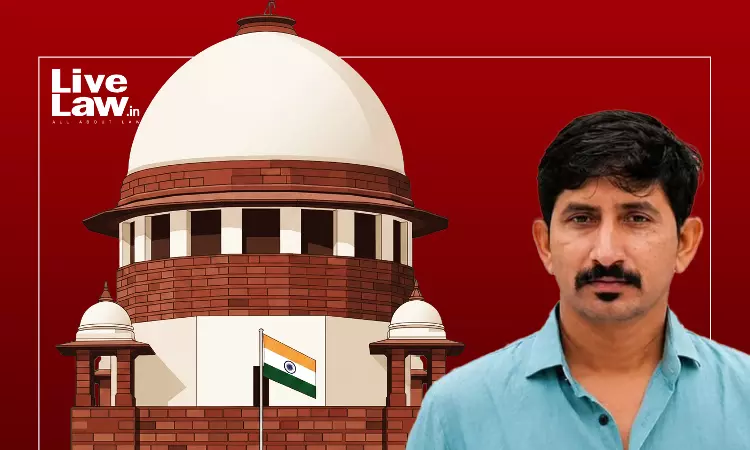
The Supreme Court on Tuesday disposed of a writ petition filed by Rajkumar Roat, Lok Sabha MP belonging to the Bharat Adivasi Party, seeking directions to create municipalities in urban areas falling within Scheduled Tribe areas, asking him to approach the Union Government.Observing that it was a matter within the legislative policy domain, the bench comprising Chief Justice of India Surya...
This is a premium content
Available exclusively to
Our subscribers
Subscribe Premium 
INR 1099+GST
Your support helps us to bring you more content at
an affordable subscription scheme !!!
All payment options available
The Supreme Court on Tuesday disposed of a writ petition filed by Rajkumar Roat, Lok Sabha MP belonging to the Bharat Adivasi Party, seeking directions to create municipalities in urban areas falling within Scheduled Tribe areas, asking him to approach the Union Government.
Observing that it was a matter within the legislative policy domain, the bench comprising Chief Justice of India Surya Kant, Justice Joymalya Bagchi and Justice V Mohana disposed of the matter, giving liberty to the petitioner to approach the concerned Ministry.
During the hearing, the bench commented that the petitioner, being a Member of Parliament, can pursue the matter in the legislature by moving a private member bill. The bench asked why the petitioner has approached the Court for a matter falling within the competence of the legislative wing.
The petition filed by the member of the Lok Sabha from Banswara in Rajasthan says that the Constitution (Seventy-Fourth Amendment) Act, 1992, inserted Part IX-A into the Constitution with the objective of establishing democratic institutions of urban local self-government. However, Article 243ZC excludes Scheduled Areas from the automatic application of Part IX-A.
Roat points out that a similar amendment, the Constitution (Seventy-Third Amendment) Act, 1992, inserted Part IX into the Constitution for local rural self-governance. Subsequently, the Parliament enacted the Panchayats (Extension to Scheduled Areas) Act, 1996 for extending Part IX to Scheduled Areas. Though more than three decades have passed since the 74th Amendment, no corresponding legislation has been enacted for urban local governance in tribal areas.
The petitioner points out that due to rapid urbanisation, demographic alterations such as expansion of urban infrastructure, growth of population, increased economic activities, etc have changed the characteristics of numerous settlements situated within the Scheduled Areas. However, they remain outside the purview of the municipal governance framework.
Referring to a comprehensive dataset of Scheduled Areas across India, it is claimed that continued legislative or administrative vacuum adversely affects the ability of residents of Scheduled Areas to effectively participate in urban decision-making processes concerning land use, public infrastructure, local planning, sanitation, public health, municipal finance, environmental protection and other matters having direct bearing upon their lives and livelihoods.
Further, it is stated that the petitioner submitted a representation in this regard to the Ministry of Housing and Urban Affairs on May 6, 2026, but no action was taken.
The petitioner has clarified that he doesn't seek a direction "compelling" the Parliament to enact a legislation but seeks appropriate directions for effective implementation of Article 243CZ consistent with the judgments of the Supreme Court in Vishaka v Rajasthan and Anoop Baranwal that where there is a legislative vacuum, the Court may fill the gap by laying down guidelines.
"That the present Petition does not seek a direction compelling Parliament to enact a law in a particular form. The Petitioner merely seeks effective implementation of the constitutional scheme under Article 243ZC through appropriate constitutional directions consistent with settled constitutional principles governing exercise of judicial power in cases of legislative vacuum, so that the continuing governance vacuum is addressed until Parliament exercises the legislative power expressly contemplated by the Constitution."
It may be recalled that the Municipalities (Extension to Scheduled Areas) Bill, 2001 was introduced in Parliament recognising the necessity of a separate legislative framework governing municipalities in Scheduled Areas. However, the Bill was not enacted.
The petitioner has sought a direction to the Union of India to constitute an expert committee comprising of representatives from Ministry of Tribal Affairs, Ministry of Housing and Urban Affairs, constitutional experts, tribal governance experts, urban planning experts, representatives of Scheduled Tribes and other relevant stakeholders for examining the existing constitutional and legal framework governing municipal administration in Scheduled Areas and for recommending appropriate legislative, administrative and institutional reforms.
Other than that, a writ of mandamus to the Union and authorities to examine and consider establishing appropriate framework for effective implementation of Part IX-A, fifth scheduled and other relevant provisions.
The petition has been filed through Advocate-on-Record Anilendra Pandey, and drafted by Advocates Aarati Sah and Animesh Shukla.
Case : Rajkumar Roat v. Union of India | W.P.(C) No. 910/2026


