



- Home
- /
- Top Stories
- /
- Supreme Court Refuses To Entertain...
Supreme Court Refuses To Entertain Plea Against Gurugram Demolitions, Allows Petitioners To Approach HC Today Itself
Debby Jain
27 April 2026 11:07 AM IST
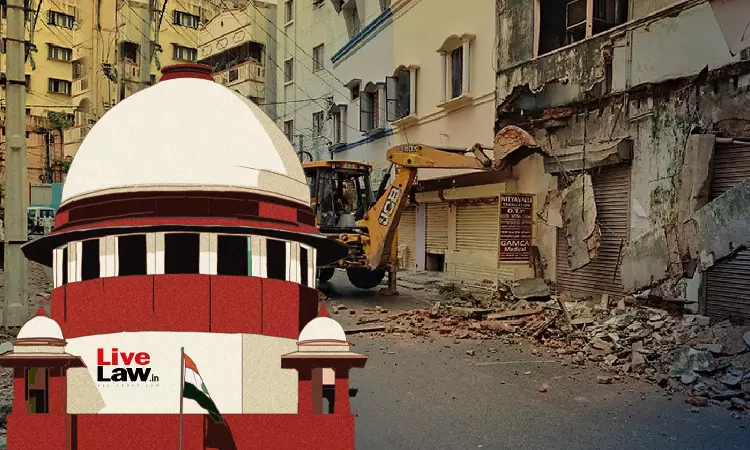
The plea challenged the demolition drive taken after the HC's stay of the 'Stilt +4(S+4)' policy.
The Supreme Court on Monday refused to entertain a petition challenging the demolition drive being undertaken in Gurugram, asking the petitioners to approach the Punjab and Haryana High Court.The petitioners were granted liberty to make an urgent mention before the High Court today itself, and the Chief Justice of the High Court was requested to entertain the matter at 1 PM or immediately...
This is a premium content
Available exclusively to
Our subscribers
Subscribe Premium 
INR 1099+GST
Your support helps us to bring you more content at
an affordable subscription scheme !!!
All payment options available
The Supreme Court on Monday refused to entertain a petition challenging the demolition drive being undertaken in Gurugram, asking the petitioners to approach the Punjab and Haryana High Court.
The petitioners were granted liberty to make an urgent mention before the High Court today itself, and the Chief Justice of the High Court was requested to entertain the matter at 1 PM or immediately after the lunch break.
Senior Advocate Gopal Sankaranarayanan orally mentioned the matter this morning before a bench comprising Chief Justice of India Surya Kant and Justice Joymalya Bagchi. He submitted that the demolitions are already underway, and claimed that the action was proceeding without the issuance of any mandatory show-cause notice.
"But these are unauthorized constructions. If the High Court is doing constitutional duty, as Apex Body, why should we cause hindrance?" CJI Kant asked.
Sankaranarayanan claimed that the authorities have started the demolition process by misconstruing an interim order passed by the High Court. He asserted that these are legal constructions. The CJI said that this argument can be raised before the High Court itself.
The petition was filed by Residents of Sector 31, Gurugram (Lane 635 to 957) challenging an interim order of the Punjab and Haryana High Court that imposed a blanket State-wide stay on the 'Stilt + 4' (S+4) construction policy, contending that the order has been misused by authorities to launch large-scale demolition drives affecting thousands of residents in Gurugram.
The Special Leave Petition has been filed against the High Court's interim order dated April 2, 2026 in a pending Public Interest Litigation, with the petitioners asserting that the administrative authorities have “weaponized” the stay to bypass statutory procedures and initiate city-wide anti-encroachment actions without notice or adjudication.
According to the plea, following the High Court's stay on the S+4 policy, the State authorities issued a directive dated April 16, 2026, interpreting the order as authorizing immediate demolition of boundary walls, ramps and green areas across multiple residential sectors. The petitioners contend that the High Court had merely stayed the operation of the policy notification and had not directed any demolition or anti-encroachment action.
The RWA submits that approximately 1,500 families residing in the affected sectors for over three decades now face imminent demolition of their properties, with authorities allegedly acting without issuing individual show cause notices or providing an opportunity of hearing.
The petition states that the affected residents were not parties to the underlying Public Interest Litigation and were therefore condemned unheard despite the sweeping consequences of the interim order. It argues that the absence of representative public notice and adjudication renders the demolition exercise a violation of the principles of natural justice and the constitutional right to property.
The plea further alleges that the administrative directive triggering the demolitions fails to cite any statutory provision authorizing such action and does not define what constitutes encroachment in the decades-old residential sectors.
Tracing the litigation history, the petition notes that the High Court had earlier declined to grant interim relief on multiple occasions, including on March 19, 2025, observing that granting a stay would amount to granting final relief in the PIL. However, on April 2, 2026, the Court reversed its earlier stance and imposed a blanket stay on the policy while stating that the validity of the notification was not being examined at that stage.
The petitioners contend that the stay was granted primarily because final arguments in the matter were taking a long time, which, according to them, is not a legally sustainable ground for granting interim injunctions affecting vested property rights.
The RWA also challenges the High Court's reliance on a physical inspection conducted in a single locality in Gurugram, arguing that deficiencies observed in a limited area were extrapolated to justify a blanket stay on the policy across the city and state. It asserts that infrastructural shortcomings such as sewage lines, electricity poles and trees were wrongly attributed to private encroachments, leading to disproportionate administrative action.
Case: Residents of Sector 31, Gurugram (Lane 635 to 957) v. Chief Administrator HSVP and others

Debby Jain
Debby Jain is a Correspondent with LiveLaw, covering the Supreme Court of India

