



- Home
- /
- Top Stories
- /
- Supreme Court Refuses To Entertain...
Supreme Court Refuses To Entertain Society's Writ Petition Over Karnataka-TN Cauvery River Water Dispute
Amisha Shrivastava
22 Sept 2026 3:32 PM IST
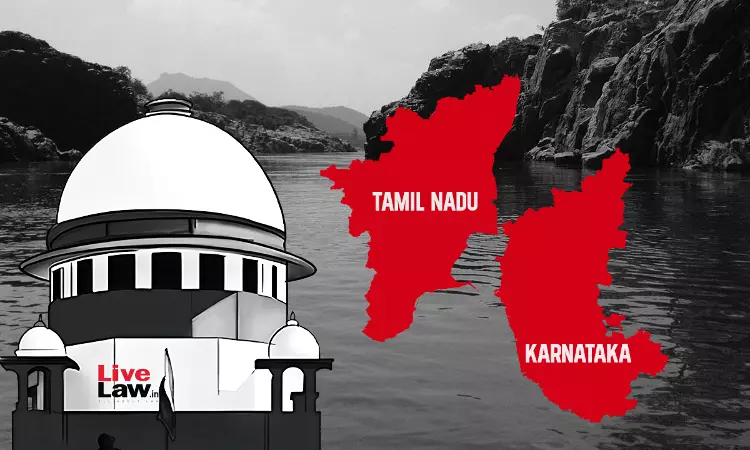
The Supreme Court has dismissed a writ petition filed by a society seeking reallocation of 70 TMC of Cauvery river water to the State of Karnataka from the share allocated to Tamil Nadu.The Court observed that the dispute over the allocation of Cauvery water is already being contested by the two States before the appropriate forums and there was no reason to entertain a separate petition filed...
This is a premium content
Available exclusively to
Our subscribers
Subscribe Premium 
INR 1099+GST
Your support helps us to bring you more content at
an affordable subscription scheme !!!
All payment options available
The Supreme Court has dismissed a writ petition filed by a society seeking reallocation of 70 TMC of Cauvery river water to the State of Karnataka from the share allocated to Tamil Nadu.
The Court observed that the dispute over the allocation of Cauvery water is already being contested by the two States before the appropriate forums and there was no reason to entertain a separate petition filed by a society seeking alteration of the inter-State water-sharing arrangement.
"If we start entertaining the society regarding disputes between two States, then there will be no end," a bench of Justice Vikram Nath and Justice Sandeep Mehta observed.
The bench noted that Karnataka and Tamil Nadu are already contesting the issues concerning the Cauvery water dispute and that the relevant matters are pending.
"States are already contesting, the matters are pending," the Court said, before dismissing the petition filed by Cauvery Nadhi Rakshna Samiti.
The petition had sought reallocation of 70 TMC of Cauvery water from Tamil Nadu's share to Karnataka's share.
The bench is already seized of the proceedings between both State Governments over the issue. Last month, it had directed the State of Karnataka to comply with the directives of the Cauvery Water Management Authority (CWMA).
The petitioner had claimed that 70.91 TMC ought to be transferred from Tamil Nadu's allocation to Karnataka's share on the basis of what it described as six errors in the existing allocation.
These included an alleged 20 TMC underestimation of Tamil Nadu's groundwater availability; inadequate allocation of 7.5 TMC for Karnataka's domestic and industrial requirements, including Bengaluru's projected population; and denial of Karnataka's lift irrigation schemes, which the petitioner claimed warranted redistribution of 17.44 TMC of balance waters.
The petitioner also claimed that Karnataka was wrongly denied 23.97 TMC for a second crop to irrigate 1.85 lakh acres, contending that the same principles used for allocating water for the second crop in Tamil Nadu should have been applied to Karnataka.
A further 5 TMC was sought on the ground that no allocation had been made for environmental protection along Karnataka's 320-km stretch of the Cauvery river. The petitioner also challenged the allocation of 4 TMC as "Escapage to Sea", contending that 2 TMC of this ought to have been retained by Karnataka.
Apart from the reallocation, the petition sought directions to formulate binding guidelines for the Cauvery Water Management Authority (CWMA) for managing distress and surplus years through a scientific, rainfall-responsive formula accounting for the different monsoon regimes and hydrological conditions of the riparian States.
It also sought a direction for a minimum carry-over storage of 20 TMC, with 10 TMC each in Karnataka and Tamil Nadu reservoirs, as recommended by the Tribunal's Assessors.
The petitioner further challenged the legal basis and powers of the CWMA. Among other reliefs, it sought a declaration that the findings concerning Sections 6(2) and 6A of the Inter-State Water Disputes Act, 1956 were erroneous, and questioned the statutory validity of the Cauvery Water Management Scheme notified on June 1, 2018, contending that it had not been placed before both Houses of Parliament as required under Section 6A(7).
The petition also sought curtailment of the CWMA's regulatory powers, arguing that its functions should be confined to coordination, monitoring and data reporting and that it should not have the power to issue binding directions or interfere with the reservoir operations of the States.
Another prayer sought a basin-wide review of the entire Cauvery allocation and regulatory mechanism every five years, instead of the existing 15-year limitation concerning delivery schedules. The petitioner also sought directions requiring the CWMA and the Union Ministry of Jal Shakti to adopt future operational protocols only after consultation with the riparian States.
The Court, however, declined to entertain the society's petition, noting that the inter-State Cauvery water dispute was already the subject matter of proceedings between the concerned States.
The petition was filed through Advocate-on-Record Ankolekar Gurudatta.
Case : CAUVERY NADHI RAKSHNA SAMITHI v. UNION OF INDIA Diary No. 34488-2026

Amisha Shrivastava
Amisha Shrivastava is a Senior Correspondent with LiveLaw, covering the Supreme Court of India. She can be reached at amisha@livelaw.in

