



- Home
- /
- Top Stories
- /
- Supreme Court Refuses To Entertain...
Supreme Court Refuses To Entertain Tamil YouTuber Savukku Shankar's Plea To Unseal Office, Asks Him To Approach Magistrate
Gursimran Kaur Bakshi
20 Jan 2026 12:57 PM IST
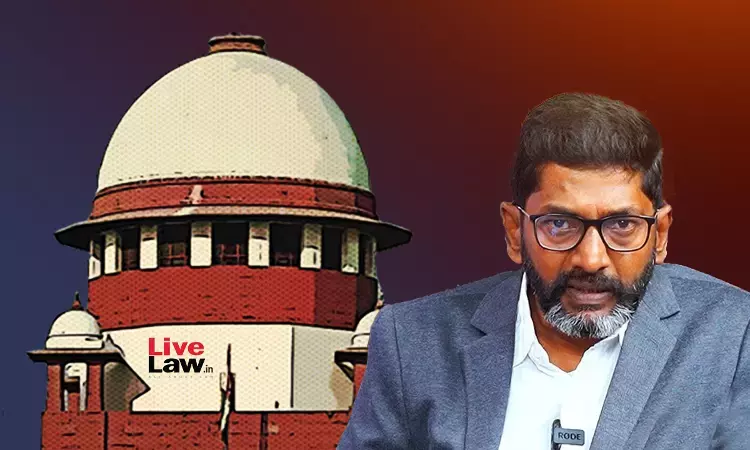
The Supreme Court today(January 20) refused to entertain a plea filed by YouTuber and Journalist Shankar @Savukku Shankar seeking to unseal his office in Chennai and also to direct the Tamil Nadu Police to return his devices seized during the investigation in connection with the allegations of assault and extortion by a film producer.The matter was heard by a bench comprising Justice...
This is a premium content
Available exclusively to
Our subscribers
Subscribe Premium 
INR 1099+GST
Your support helps us to bring you more content at
an affordable subscription scheme !!!
All payment options available
The Supreme Court today(January 20) refused to entertain a plea filed by YouTuber and Journalist Shankar @Savukku Shankar seeking to unseal his office in Chennai and also to direct the Tamil Nadu Police to return his devices seized during the investigation in connection with the allegations of assault and extortion by a film producer.
The matter was heard by a bench comprising Justice Dipankar Datta and Justice Satish Chandra Sharma.
At the outset, Justice Datta questioned: "Who is this gentleman? On Friday, we passed an order, and he is again before us!"
Justice Sharma also remarked that for every small inconvenience, the jurisdiction of this Court is being invoked.
Senior Advocate Balaji Srinivasan said, " The High Court, while granting me interim bail, finds that whole thing is orchestrated against me. What they do is, there is a man in whose restaurant drugs are found. They set him up to transfer Rs.90,000 to one of my employees, and they arrested him. In the same process, they seal my office, which they have no power. If I can place the bail order on record."
However, Justice Sharma said that the Court will not entertain the plea. "No, very sorry. You please go to the learned magistrate. If he does not pass an order, let the High Court look into it."
"Having granted the liberty by the High Court to approach the Judicial Magistrate concerned seeking appropriate relief, we are not inclined to interfere," the Court ordered.
When Srinivasan asked if the Court could direct that his application be decided expeditiously, Justice Datta questioned if this was the purpose for which the present plea was filed. Srinivasan replied that he thought he had a case.
Justice Sharma responded: "Please don't mind. You thought you had a case just because we had earlier interfered."
To this, Srinivasan responded that this plea was filed much earlier. Justice Datta told the advocate that in this order uploaded last Friday, the Court has included two Supreme Court judgments which talk about the scope of interference by the writ Court.
"Don't take it as if the writ Court is the panacea for every relief," Justice Datta added.
Shankar had filed three writ petitions before the Madras High Court seeking a mandamus against the State police unseal his office in Chennai and forbade the State Police from deploying police personnel outside his office; to return his electronic devices, cash, documents seized on December 13th and 17th pending final adjudication by the Supreme Court in writ petition concerning arbitrary seizure of media professionals' digital devices ; and defreeze his bank accounts.
By an order dated December 30, the Madras High Court gave the petitioner liberty to approach the Judicial Magistrate. The High Court took note of the fact that a report has been filed by the Investigating Officer before the Magistrate's Court in respect of the properties seized/sealed. The High Court said that in respect of the petitioner's grievance that certain properties are unrelated to the alleged crime, the petitioner can approach the Judicial Magistrate as per the property contemplated under Sections 105 to 107 of the Bharatiya Nagarik Suraksha Sanhita, 2023.
Shankar was granted interim bail for three months in December 2025 by the Madras High Court, which the Tamil Nadu police has challenged it. The High Court while granting bail had crititicised the State police for targeting Shankar.
The bail was granted in a petition filed by Shankar's mother seeking medical treatment and temporary bail. Shankar's mother submitted that one day before the arrest, on 12th December, one of the employees of Shankar's media company had received Rs 94,000/- through Gpay from an unknown person. While the employee was in the process of filing a complaint regarding the unauthorised transfer of money, the police abruptly came to Shankar's residence and arrested him. It was argued that the transfer was an orchestrated trap to falsely implicate Shankar and secure his arrest in a fabricated criminal case.
Case Details: SHANKAR @ SAVUKKU SHANKAR v THE INSPECTOR OF POLICE|SLP(Crl) No. 807-809/2026
Tags
Gursimran Kaur Bakshi
Gursimran is the Principal Correspondent with LiveLaw for the Supreme Court. She can be reached out at: simrankaurbakshi@livelaw.in

