



- Home
- /
- Top Stories
- /
- Supreme Court Refuses To Hear...
Supreme Court Refuses To Hear Contempt Pleas Alleging Violation Of 'Bulldozer' Judgment, Sends Matters To High Courts
Debby Jain
16 July 2026 1:38 PM IST
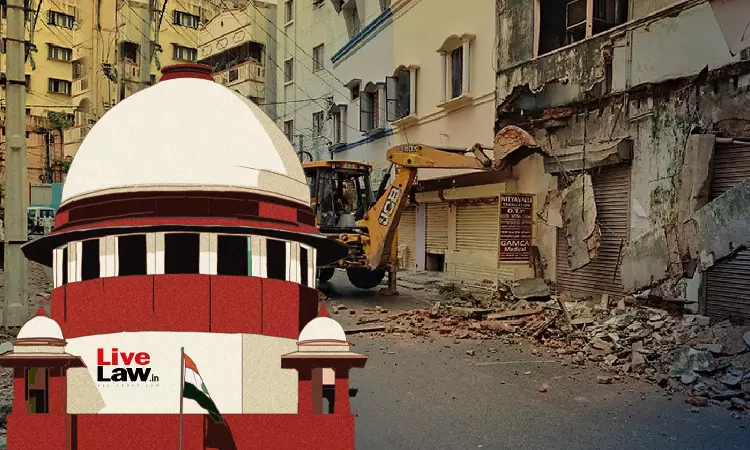
The Supreme Court on Thursday refused to entertain contempt petitions alleging that demolitions were carried out in violation of its landmark November 2024 judgment laying down safeguards against "bulldozer justice", saying such grievances should be raised before the concerned High Courts.A bench comprising Chief Justice of India Surya Kant, Justice Joymalya Bagchi and Justice V Mohana,...
This is a premium content
Available exclusively to
Our subscribers
Subscribe Premium 
INR 1099+GST
Your support helps us to bring you more content at
an affordable subscription scheme !!!
All payment options available
The Supreme Court on Thursday refused to entertain contempt petitions alleging that demolitions were carried out in violation of its landmark November 2024 judgment laying down safeguards against "bulldozer justice", saying such grievances should be raised before the concerned High Courts.
A bench comprising Chief Justice of India Surya Kant, Justice Joymalya Bagchi and Justice V Mohana, observing that there will be different factual disputes involved in each case, took the view that the Supreme Court cannot go on adjudicating each claim on facts.
The bench therefore passed an order relegating all the contempt petitions to the respective High Courts, leaving open all the issues. The Court had previously issued notice to the authorities in some of the contempt petitions.
Senior Advocate Huzefa Ahmadi, appearing in a contempt petition alleging illegal razing down of certain mosques in Somnath, submitted that the Court should interfere in cases of "egregious violations" which are patently evident from affidavits. Ahmadi submitted that he can demonstrate the egregious violation of the Supreme Court directions within fifteen minutes, if given an opportunity.
Senior Advocate Chander Uday Singh, appearing in a contempt case arising from Maharashtra, submitted that many demolitions follow public declarations by local politicians to take "bulldozer action". Singh stated that the affidavit filed by the State itself would show that the process mandated by the Supreme Court was not followed in the particular matter. He submitted that there are many instances when such demolitions are clearly taken as a "punitive action", as evidenced by the swiftness of the action, and the celebratory declarations made by local politicians.
Senior Advocate Sanjay Hegde submitted that he was appearing for a petitioner whose fruit juice stall was demolished using a bulldozer, in which a TV anchor was sitting live-telecasting the process.
CJI Surya Kant however said that the November judgment itself had carved out certain exceptions, stating that the directions will not apply to buildings encroaching public spaces. So when the authorities invoke such exceptions as a defence, it becomes a factual dispute, which cannot be adjudicated in a contempt jurisdiction, the Chief Justice said.
Justice Bagchi, supplementing the CJI's view, said that the November 2024 judgment was issued to address the larger trend of demolishing homes of persons accused in crimes as a punitive action. However, the judgment was not a blanket protection to illegal constructions, Justice Bagchi added.
"This judgment came as the conscience of the court was shocked. The foundation of presumption of innocence was disregarded," Justice Bagchi said. At the same time, the Judge said that "bulldozers have to be used" against rampant illegal constructions. "Yes, bulldozers need to be used when the rule of law is throttled by comfortable corruption between authorities and illegal encroachers. But in the guise of implementing law, there should not be characterisation of individuals. It runs against basic tenets.... The question is whether a person had authorisation and procedure of law was followed?" Justice Bagchi said.
"Judgment cannot be read as a statute. Directions are hedged with a caveat. These are in the form of reiteration of what statutory rights are there....We read these along with para 94 (exceptions)", Justice Bagchi added.
Ahmadi, in response, submitted that his case pertained to a "targeted action" against a mosque. He said that the demolition was preceded by a letter written by a politician asking "how can we have Asia's largest mosque in this particular state?". Ahmadi asserted that the particular structure was not situated on any public land.
Justice Mohana then asked if the State was disputing these assertions, whether it was possible to decide them in a contempt matter. "All over India whatever happens, can everybody come directly to the Supreme Court?," Justice Mohana asked.
Senior Advocate Dr S Muralidhar submitted that his client had actually approached the Madhya Pradesh High Court, and the High Court refused to entertain it; therefore, he was forced to approach the Supreme Court. Muralidhar submitted that the High Court closed the matter saying the Collector had no notice of the Supreme Court's judgment. Hearing this, the bench proceeded to pass an order setting aside the High Court's order, and remanded the matter for fresh determination by the High Court.
Court's order in the other petitions
In the order dictated by the bench, the Court observed that the central issue in the contempt petitions was whether the petitioners' premises had been demolished in breach of the safeguards laid down by the Supreme Court. While the petitioners contended that the principles of natural justice were violated and demolition orders were passed contrary to law, the authorities maintained that due process had been followed and the demolitions were lawful.
Noting the conflicting stands, the Bench said the cases raised "multiple questions of fact" which could not appropriately be decided in contempt proceedings before the Supreme Court.
"We deem it appropriate to transfer the records of these proceedings to the concerned High Courts," the Court ordered, requesting the High Courts to call for relevant records and, if necessary, obtain evidence through the district courts to determine all factual issues.
The Bench clarified that it had expressed no opinion on the merits of the allegations. It further directed that the interim protection granted by the Supreme Court would continue during the pendency of the proceedings before the High Courts. However, the parties would be free to seek modification of the interim orders before the High Courts, which would decide such applications independently.
Click Here To Read/Download Order

Debby Jain
Debby Jain is a Correspondent with LiveLaw, covering the Supreme Court of India

