



- Home
- /
- Top Stories
- /
- Supreme Court Rejects Abu Salem's...
Supreme Court Rejects Abu Salem's Plea For Release On Claim Of Completing 25 Years' Imprisonment
Gursimran Kaur Bakshi
16 Feb 2026 12:23 PM IST
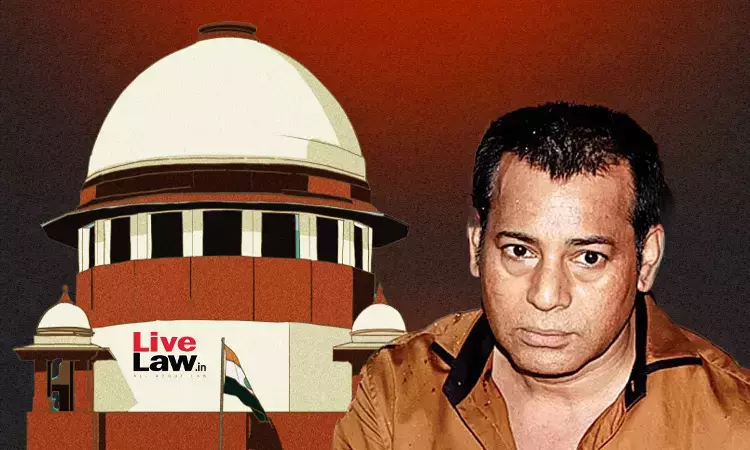
The Supreme Court today(February 16) dismissed an application filed by convicted terrorist Abu Salem, who had sought premature release in terms of an Extradition Treaty entered into between the Indian and Portuguese governments. Saleem was convicted under the Terrorist and Disruptive Activities (TADA) Act for the 1993 Bombay Blast case. The Court has, however, granted him liberty to approach...
This is a premium content
Available exclusively to
Our subscribers
Subscribe Premium 
INR 1099+GST
Your support helps us to bring you more content at
an affordable subscription scheme !!!
All payment options available
The Supreme Court today(February 16) dismissed an application filed by convicted terrorist Abu Salem, who had sought premature release in terms of an Extradition Treaty entered into between the Indian and Portuguese governments. Saleem was convicted under the Terrorist and Disruptive Activities (TADA) Act for the 1993 Bombay Blast case. The Court has, however, granted him liberty to approach the High Court.
Salem filed an application claiming the benefit of 3 yrs and 16 days jail-earned remission (for good conduct) in the computation of a 25-year jail sentence, upon completion of which he shall be eligible for pre-mature release. He cited the Supreme Court's decision of July 2002, which relied on the treaty with Portugal and held that Salem will have to be released on completion of 25 years in jail. However, the State of Maharashtra has maintained that Salem has not completed 25 years.
Earlier, a bench comprising Justices Vikram Nath and Sandeep Mehta had asked Salem to produce any rules prevailing in Maharashtra, as per which remission can be granted to someone convicted under the TADA.
Today, Senior Advocate Rishi Malhotra, for Abu Salem, produced Rule 4 of the Maharashtra Prisons (Remission System) Rules, 1962, which talks about different kinds of remission. Malhotra stated that he has come to the seeking ordinary and annual good conduct remission.
When Justice Mehta asked as to against which order he had come before the Court, Maholtra said that Salem approached the Bombay High Court with a plea for pre-mature release. It may be recalled that Salem approached the High Court seeking a direction for the authorities to specify a release date after completing 25 years. He contended that his right to life and liberty, as guaranteed under Article 21 of the Constitution of India, was being breached by the authorities since he was being kept in prison beyond the 25-year jail term as agreed by the Indian authorities while signing the treaty.
But the High Court in July 2025 prima facie observed that Salem had not completed 25 years, referring to the Supreme Court's order, which reckoned the date of Salem's arrest as October 12, 2005 and provided for premature release upon completion of 25 years sentence. It upheld the TADA Court's order, which had rejected his application for premature release.
"I have surpassed 10 months; it is the case of habeas corpus, illegal custody," Malhotra added. He clarified that if there is evidence that he has not completed 25 years, he will face the risk of completing the specified sentence.
Justice Mehta told him to move an application against the interim findings before the High Court. He added that this is certainly not the case of habeas corpus, but an appeal.
Malhotra then referred to the additional affidavit filed by the Inspector General of Prisons before the Bombay High Court. He submitted that the claim of the government that Salem has not completed 25 years is an "arithmetical error".
Before the High Court, the Inspector General of Prisons & Correctional Services had informed that, till March 31, 2025, Salem had only completed 19 years, 5 months and 18 days of his prison term.
Justice Nath said that whether the affidavit is correct or not will have to be considered by the High Court, and the Supreme Court can't be expected to bear the burden of the High Courts in pending cases.
"Mr Rishi Malhotra, learned senior counsel, after arguing for sometime states that this petition may be dismissed as withdrawn, leaving it open for the petitioner to go before the High Court for an early hearing and disposal of the pending matter. Petition is dismissed with liberty," the Court ordered.
When Malhotra pressed again that Salem is undergoing illegal custody for more than 10 months, Justice Nath reminded him that Salem was convicted under TADA.
"You have stayed for 25 years for not doing something good to the society. You have [been] convicted under TADA," Justice Nath orally remarked.
Background
In June 2017, a Special TADA Court had found Abu Salem and five others guilty of conspiring and carrying out a string of bomb blasts across Mumbai in 1993, which ended up killing 257 people. Abu Salem was convicted for offences punishable under Sections 120B, 302, 307, 326, 427, 435, 436, 201 and 212 of the IPC, Sections 3, 3(3), 5, 6 of the TADA Rapid Protection Act, and provisions of the Arms Act, Explosive Substances Act and the Prevention of Damage to Public Property Act.
The prosecution had submitted that the conspiracy was hatched in Dubai to avenge the demolition of Babri Masjid that took place on December 6, 1992. Salem transported and distributed arms and ammunition used in the blast. In September, 2017, a Mumbai court awarded life imprisonment to extradited Abu Salem.
On 13.12.2002, the Government of India had issued a Gazette Notification in exercise of the powers conferred by Sub-section (1) of Section 3 of the Extradition Act, 1962, directing that the provisions of the Extradition Act, other than Chapter-III, shall apply to the Portuguese Republic with effect from 13.12.2002.
By way of a letter dated 17.12.2002, the then Deputy Prime Minister-LK Advani on behalf of the Government of India assured the Government of Portugal that it will exercise its powers conferred by the Indian Laws to ensure that if extradited by Portugal for trial in India, Salem would not be visited by death penalty or imprisonment for a term beyond 25 years. After the request for the extradition of Abu Salem was considered and examined by the authorities in Portugal and by the Court of Appeals, Lisbon, Supreme Court of Justice, Portugal and Constitutional Court of Portugal, extradition of Abu Salem was granted in 8 criminal cases (3 cases prosecuted by CBI, 2 cases by Mumbai Police and 3 cases by Delhi Police).
Accordingly, Salem was extradited on 10.11.2005.
Case Title: ABU SALEM ABDUL QAYOOM ANSARI Versus THE STATE OF MAHARASHTRA AND ORS., Diary No. 60531-2025
Click Here To Read/Download Order
Tags
Gursimran Kaur Bakshi
Gursimran is the Principal Correspondent with LiveLaw for the Supreme Court. She can be reached out at: simrankaurbakshi@livelaw.in

