



Supreme Court Remands Several Land Acquisition Cases To Delhi High Court For Fresh Adjudication
Saima Anjum
18 Nov 2026 11:59 AM IST
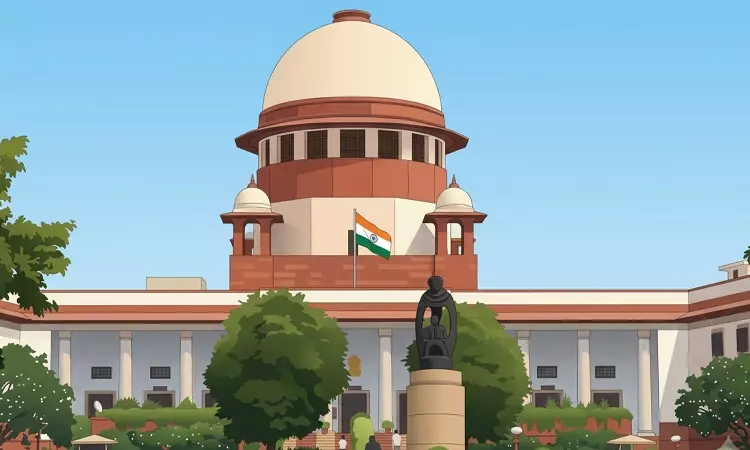
The Supreme Court has transferred a large batch of land acquisition matters to the Delhi High Court for fresh adjudication. The bench transferred the cases observing that it would not take up each case individually, because that would require a factual appreciation which would consume a lot of time.
A bench of Chief Justice of India Surya Kant, Justice Joymalya Bagchi, and Justice V Mohana transferred the matters invoking Article 142 of the Constitution. It revived the writ petitions and sent them to the High Court, requesting the Chief Justice of the Delhi High Court to assign a Division Bench that would hear the matters on a daily basis.
The matter relates to civil appeals, contempt petitions, miscellaneous applications, review petitions and curative petitions, concerning land in Delhi acquired by the Union government, the Delhi government, the Delhi Development Authority (DDA), the Delhi Metro Rail Corporation (DMRC), the Airport Authority of India (AAI), and other agencies. The bench noted that some acquisitions had been initiated as far back as in 1950. All the acquisitions took place before 01.01.2014, when the Right to Fair Compensation and Transparency in Land Acquisition, Rehabilitation and Resettlement Act, 2013 came into force, and were made under the Land Acquisition Act, 1894.


The dispute turns on Section 24(2) of the 2013 Act, which reads as under:
(2) Notwithstanding anything contained in sub-section (1), in case of land acquisition proceedings initiated under the Land Acquisition Act, 1894, where an award under the said section 11 has been made five years or more prior to the commencement of this Act but the physical possession of the land has not been taken or the compensation has not been paid the said proceedings shall be deemed to have lapsed and the appropriate Government, if it so chooses, shall initiate the proceedings of such land acquisition afresh in accordance with the provisions of this Act:
Provided that where an award has been made and compensation in respect of a majority of land holdings has not been deposited in the account of the beneficiaries, then, all beneficiaries specified in the notification for acquisition under section 4 of the said Land Acquisition Act, shall be entitled to compensation in accordance with the provisions of this Act.
In Pune Municipal Corporation v Harakchand Misirimal Solanki, it was held that an acquisition would lapse if either possession was not taken or compensation was not paid. Landowners relied on this to obtain declarations of lapse from the High Court.
In Indore Development Authority v Manoharlal, a Constitution Bench held that both conditions must be met for lapse, namely that compensation was not deposited and possession was not taken. This overruled Pune Municipal, which the bench observed as controversy that arose with regard to the orders passed by the High Court in the interregnum, meaning the period when the High Court relied on Pune Municipal.
The bench recalled that a Coordinate Bench had passed three judgments in May 2024. These were State (NCT of Delhi) v KL Rathi Steels Ltd, State (NCT of Delhi) v BSK Realtors LLP, and DDA v Tejpal. In Rathi Steels, it was held that once the Supreme Court has disposed of a Special Leave Petition (SLP) or appeal, a review petition based on a changed interpretation of law is not maintainable, and miscellaneous applications that effectively seek review are likewise not maintainable. BSK Realtors applied the doctrine of merger, holding that once leave is granted and the appeal is disposed of, the High Court order merges with the Supreme Court's order, and a later SLP against the same High Court order cannot be entertained. In Tejpal, the delay in filing SLPs was condoned in view of the critical public purpose of the acquisitions.
The bench observed that the present matters “indisputably fall within one or the other class of cases identified by this Court through the 2024 Judgments,” and that they remained pending because they were either not formally disposed of, or were filed afresh, or arose out of the 2024 judgments or later decisions after them.
With regards to deciding each case by itself, the bench observed as follows:
“One of the ways to deal with these residual cases would be for this Court to take each case up, one at a time, and dispose of them in accordance with the law laid down by the Constitution Bench and subsequent Coordinate Bench decisions of this Court. Such individual adjudication would, however, require appreciation of factual evidence and consume a lot of time of this Court. That apart, as this Court is the last forum available to the litigants, there would be no further opportunity of appeal to either side on such factual adjudication,” the bench observed.
It instead preferred remanding the matters and stated as under:
“A more appropriate method, in our considered opinion, would be to remand these matters to the High Court for adjudication upon examination of the record and the independent facts of each matter. This would not involve a return of the case for reconsideration of the original prayer in the Writ Petition filed before the High Court. Rather, the High Court would be required to exercise its plenary powers under Article 226 to determine the category within which each case falls and pass consequential orders in terms of the 2024 Judgments. This option would, clearly, be better suited to expeditiously and individually conclude the consideration of these cases.”
Further, the bench clarified that this would not reopen the original prayer in the writ petitions, and the High Court would use its Article 226 powers to determine the category within which each case falls and pass orders in terms of the judgments passed in May 2024.
It further stated that the High Court would not redetermine lapse under Manoharlal.
“For the remaining cases, where initial determination in terms of the 2024 Judgments is yet to take place, we may clarify that the purpose of remitting these cases would not be for the High Court to redetermine whether the acquisition can be deemed to have lapsed as per the principles in Manoharlal (supra).”
The bench laid out a sequence for the High Court. It must first consider whether the writ petitioners had locus standi to seek a declaration under Section 24(2) of the 2013 Act, “either on account of being a subsequent purchaser or on account of the title of the land being clouded.” If the petition lacks locus, the High Court must hold that the prayer cannot be granted.
Secondly, the High Court must identify the status of any previously disposed SLPs or civil appeals arising from the same writ petition, to determine whether the doctrine of merger has crystallised.
Thirdly, if the writ petition is maintainable, the petitioner has the necessary locus, and no appellate order has been passed by the Supreme Court, it must determine whether the acquisition has lapsed as per the law in force.
Finally, based on the above findings, “an appropriate direction safeguarding the Constitutional rights of the landowners as also the collective interest in the various projects undertaken by the government and its functionaries has to be issued.”
The Supreme Court invoked Article 142 and partly allowed the Civil Appeals in List A, set aside the impugned High Court judgments and orders, and revived the writ petitions for adjudication read with the May 2024 judgments.
The review petitions, miscellaneous applications and curative petitions in List B were dismissed in light of Rathi Steels. However, the bench restored the underlying writ petitions to their original file in the High Court, and granted permission to file the miscellaneous applications in List B.
The Registry was also directed to transfer the record of these cases to the High Court. Since no determination on merits was made, the bench ordered that “the interim relief, if any, granted by this Court, shall continue till the cases are finally disposed of by High Court.”
Further, the bench requested the Chief Justice of the Delhi High Court to assign the transferred matters to an appropriate Division Bench, and to ensure that “only these matters are assigned to the Division Bench till a majority of these cases are disposed of.” The Division Bench is requested to hear them day-to-day, after giving all parties a reasonable opportunity to make submissions and present the record, including any fresh and additional affidavits.
The matters not remanded include review petitions and applications seeking modification or recall of the May 2024 judgments or consequential orders. Nor were the contempt petitions filed by landowners over non-compliance with earlier orders upholding lapse.
The matters in List C, which comprises review, miscellaneous, curative and contempt petitions, will be listed before an appropriate bench of the Supreme Court.


