



- Home
- /
- Top Stories
- /
- 'Supreme Court & CJI Not Beyond...
'Supreme Court & CJI Not Beyond Legitimate Scrutiny In A Democracy': NALSAR Student Councils Condemns BCI Action
Debby Jain
15 Aug 2026 6:55 PM IST
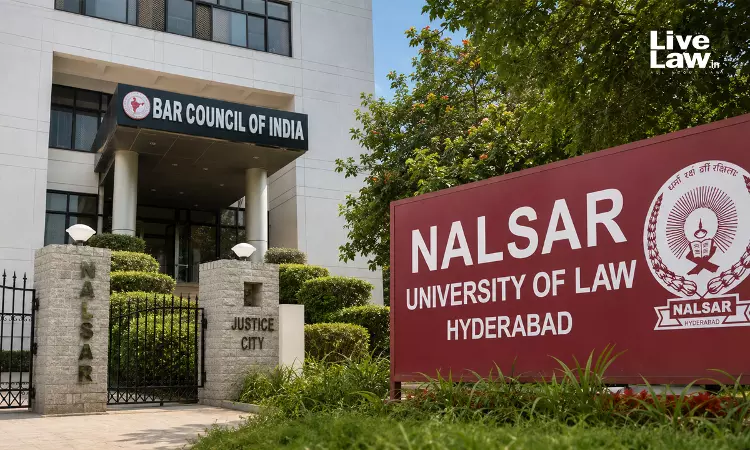
SC has said that every individual must respect other's right to dissent. The Chairperson seems to have forgotten the same: NALSAR Student Council.
The Student Bar Council of NALSAR University of Law has issued a statement condemning the letter issued by Bar Council of India Chairman Manan Kumar Mishra banning enrolment of the University's 2026 graduates over their internal protest against CJI Surya Kant being invited as a convocation guest.The Student Body says that Mishra's letter, as BCI head, did not align with statutory functions of...
This is a premium content
Available exclusively to
Our subscribers
Subscribe Premium 
INR 1099+GST
Your support helps us to bring you more content at
an affordable subscription scheme !!!
All payment options available
The Student Bar Council of NALSAR University of Law has issued a statement condemning the letter issued by Bar Council of India Chairman Manan Kumar Mishra banning enrolment of the University's 2026 graduates over their internal protest against CJI Surya Kant being invited as a convocation guest.
The Student Body says that Mishra's letter, as BCI head, did not align with statutory functions of the Bar Council and his action was "unbecoming of his post". It further states that the BCI's direction to the University Vice Chancellor for an "inquiry report" on those who expressed dissent against invite to the CJI constituted an "intrusive violation of privacy".
"The letter seeks to surveil the identities of virtually everyone involved in the alleged campaign, including (hold your breath) its initiators, drafters, organisers, coordinators, mobilisers, spokespersons, social-media administrators, office-bearers of student bodies, faculty, research scholars, alumni, and external participants. Section 49 of the Advocates Act, 1961 is merely a rule-making provision and cannot serve as an independent source of substantive power...asking for such details is an intrusive violation of privacy, considering that it involves revealing the identities of students, who may face potential long-term consequences."
The statement of the Student Council also objects to the language used in the BCI's first letter (barring enrolment), which included words like "groupism", "dirty politics" in the University and role of faculty in "misleading, misguiding and instigating students". It says that use of such language against legitimate dissent in a peaceful manner reeked of "malice". It is further stated that the allegations of students being "instigated" by faculty or "outsiders" is reflective of the "anti-national" narrative and denies students ownership of their own political views.
"By searching for the faculty member, alumnus, research scholar, or "outsider" who supposedly orchestrated the campaign, the letter denies students ownership of their own political views. It reflects the classic 'anti-national' narrative, in which dissent is not engaged with on its merits but is explained away as the work of external actors manipulating impressionable students in a patronising fashion. The post of Chairperson of BCI is the epitome of a statutory regulatory body. The current chairperson's actions are unbecoming of his post and the constitutional directives that he is expected to uphold. Even the communication on X from the BCI Chairperson did not withdraw the allegations made. We demand an apology from the BCI Chairperson for making such objectionable comments."
While the Student Body recognizes that the BCI Chairman's letter imposing a blanket ban on enrolment was subsequently withdrawn, it deems necessary a statement of condemnation in the backdrop of larger social realities of repression. It underlines that the BCI Chairperson's action cannot be divorced from the fact that he is a sitting Rajya Sabha member on BJP ticket and the exercise of identifying "outsiders" behind student dissent is all too familiar.
"No institution, including the Supreme Court and the CJI are beyond legitimate scrutiny in a constitutional democracy, and judicial accountability is not the antithesis of judicial independence but one of its essential safeguards...It is because dissent has so often been met with surveillance, intimidation, and disciplinary threats that this moment matters. The legal profession should resist the normalisation of fear, not participate in it. NALSAR is facing a defining choice: whether to acquiesce in the shrinking of democratic space or to affirm that universities are not extensions of the state, that regulators are not instruments for policing political opinion, and that constitutional freedoms do not become expendable when they are inconvenient."
The statement, written on the eve of Independence Day, also cites judicial precedents like Javed Ahmad Hajam v. State of Maharashtra (recognizing right to lawful dissent as part of Article 19(1)(a) of the Constitution), Anita Thakur v. Govt. of J&K (regarding political life and dissent) and Mazdoor Kisan Shakti Sanghatan v. Union of India (recognizing need to aid voice of the marginalized and poorly represented, rather than their suppression) to underline the importance and right of legitimate dissent.
Tags

Debby Jain
Debby Jain is a Correspondent with LiveLaw, covering the Supreme Court of India

