



Supreme Court Says It Will Examine Whether Delhi Police Applied Its Mind While Denotifying 'Jantar Mantar' As Protest Site; Issues Notice
Debby Jain & Amisha Shrivastava
15 Oct 2026 1:30 PM IST
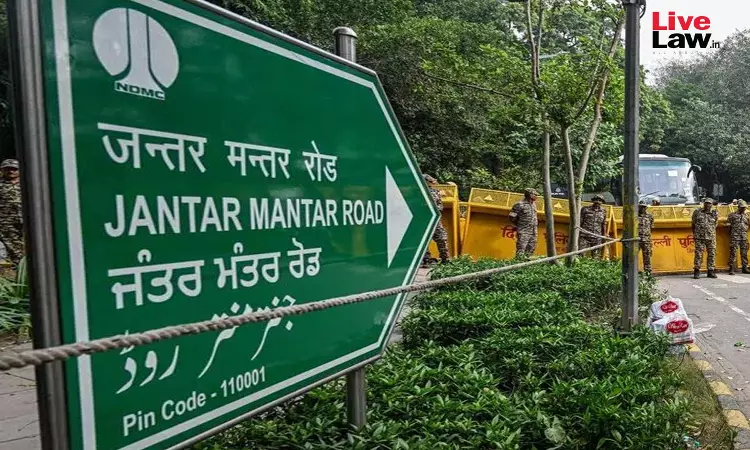
The Supreme Court today issued notice on a writ petition challenging the Standing Order dated October 11, whereby Jantar Mantar has been de-notified as a designated protest site and three alternative venues have been notified by the Delhi Police.
A bench of CJI Surya Kant and Justice Joymaya Bagchi orally observed that the Court will examine whether there had been an application of mind by the authority concerning the use and efficacy of the site.
During the hearing, Senior Advocate Gopal Sankaranarayanan sought restoration of the site's notification. He highlighted that the denotification has been stated to be in terms of a Supreme Court order.
Solicitor General Tushar Mehta responded that the Supreme Court's earlier decision was not the basis for the denotification. He said that a committee had been constituted, had submitted a report, and reasons had been recorded for the decision.


Senior Advocate Mukta Gupta argued that a protest site must be one where demonstrators can be heard.
Justice Bagchi observed that the issue also had to be understood from the perspective of technology. He referred to the argument that Jantar Mantar should not be shifted because of its proximity to government establishments and said that the Court would call upon the State to respond.
Background
The petition has been filed by advocate Swaty Singh, arguing that the relocation of protests to distant and outlying areas may render the fundamental right to peaceful assembly and freedom of expression ineffective.
It has been said that peaceful protests are not invariably capable of being planned in advance as a protest may arise in response to a sudden government decision, etc so the SOP to access new venues can't be left out.


