



- Home
- /
- Top Stories
- /
- Supreme Court Seeks Centre, BCI...
Supreme Court Seeks Centre, BCI Views On Plea Seeking National Registry For Advocates & Social Media Conduct Code
Amisha Shrivastava
18 Jun 2026 1:24 PM IST
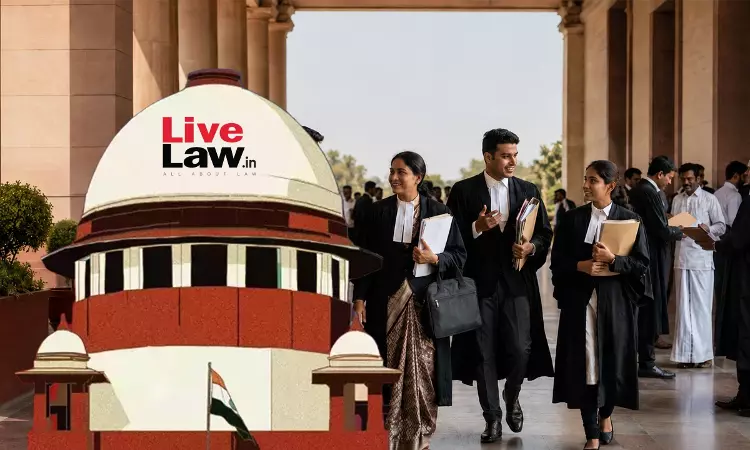
During the hearing, the CJI remarked that there was a need to strengthen the younger members of the Bar.
The Supreme Court on Thursday issued notice to the Union, Bar Council of India, the State Bar Councils and the University Grants Commission on a writ petition filed by the Bar Association of India (BAI) seeking a national advocate verification mechanism in order to weed out fake lawyers, and a social media code of conduct for lawyers.A bench comprising Chief Justice of India Surya Kant...
This is a premium content
Available exclusively to
Our subscribers
Subscribe Premium 
INR 1099+GST
Your support helps us to bring you more content at
an affordable subscription scheme !!!
All payment options available
The Supreme Court on Thursday issued notice to the Union, Bar Council of India, the State Bar Councils and the University Grants Commission on a writ petition filed by the Bar Association of India (BAI) seeking a national advocate verification mechanism in order to weed out fake lawyers, and a social media code of conduct for lawyers.
A bench comprising Chief Justice of India Surya Kant and Justice V Mohana heard the matter.
The petition seeks the creation of a National Digital Registry for the Legal Profession of India (NDRLP) to verify advocates and law degrees across the country, and also seeks formulation of a social media and digital conduct code for advocates.
During the hearing, Chief Justice of India stressed the need to strengthen young members of the Bar, observing that problems arising the legal profession could be addressed by ensuring that young lawyers have a secure space in the profession.
“The best way is to strengthen the young members of the Bar. Unless they are secured space in profession, unless they are really periodically trained, bring into the mainstream, given some space in the overcrowded courts, these problems will arise. So the first thing needed to be done is we must encourage the young lawyers and we must bring them on the front side… Our entire hope lies in the young member members and the future generation of the profession,” the Chief Justice observed
The remarks were made during discussion on the BAI's prayer for a digital code of conduct for advocates and concerns regarding the growing use of social media by legal professionals.
Referring to content by legal professionals circulating on digital platforms, the Chief Justice remarked that the Court had come across “nasty comments” which appeared to have no connection with the law, and the persons may not even be legal professionals.
“We will show you some of these samples, what kind of nasty comments, statements are being made and we are quite sure that they have nothing to do with law. They are all backdoor entry”, he said.
Responding, Advocate Prashant Kumar for BAI submitted that the issues of advocate verification and digital conduct were interconnected. He argued that while comments by common citizens stood on a different footing, statements made by advocates get sanctified in public mind as they carry professional credibility.
He submitted that the association was not seeking merely prohibitive measures, but a guidance on how advocates, particularly younger lawyers, could responsibly engage with social media.
The Chief Justice, however, emphasised that most advocates were responsible professionals who understood their ethical obligations, and the persons behaving badly on social media might not even be enrolled advocates.
“Advocates normally are very responsible. In particular they know law, they know their responsibility, they are professional. The first thing they learn is the professional ethics. So they will, they will not indulge. So those who are doing it, that is the something. And those are who defame the profession. Sometimes, they may not be really professionals, they may not be in fact, actually the member of the enrolled even advocates.”
He noted that several young lawyers' associations across High Courts and district courts were already engaging in constructive academic activities, organising lectures and discussions on legal subjects.
He said that these initiatives are a positive sign for the profession, the Chief Justice said they represented more than a mere ray of hope and reflected a confident future for the Bar.
“I know because I have been actively associated with them and I do encourage them. I know in many High Courts they are doing and even district courts also. And that is what the silver lining is there. That is what the not only ray of hope, rather a very confident scenario that is there.”
The Court also heard submissions of BAI's prayer for NDRLP, a centralised database intended to verify advocates and their qualifications.
At the outset, CJI Kant said that the proposal was an innovative idea which could be implemented with the help of technology.
However, he observed that any effective nationwide verification mechanism would ultimately require the participation of law universities they would have to be compelled to give details of law graduates.
Advocate Vipin Nair for the petitioner suggested that impleading all universities at the present stage could delay the exercise. The CJI agreed that the priority should be to first develop a workable model. The Court observed that a proper mechanism or module should be formulated before expanding the process to universities across the country.
Accepting the suggestion, the Court permitted the petitioner to place a supplementary policy paper on record setting out the proposed framework.
Advocate Kumar also sought details regarding the status of an earlier committee constituted to examine advocate verification. The Chief Justice said that the Court would first hear the concerned stakeholders and then consider the future course of action. He added that a fresh committee with a different composition might have to be considered.
“Otherwise, if they had done enough timely and effectively, this crisis would not have come,” he remarked.
The petition filed by the Bar Association of India seeks directions for establishment of a National Digital Registry for the Legal Profession of India, a centralised database containing details of all enrolled advocates, including a Unique National Advocate Identifier, real-time enrolment status verification, disciplinary records and QR-verifiable public profiles for advocates.
BAI has relied on recent observations made in proceedings before the Supreme Court concerning the genuineness of law degrees, as well as a statement by the Chairman of Bar Council of India that 35-40% of those practising before courts may be fake advocates.
The petition states that the present system of maintaining advocate rolls is fragmented across State Bar Councils and lacks a publicly verifiable national database.
It also seeks a direction to the Bar Council of India to frame a Social Media and Digital Conduct Code for advocates, establishing prohibitions on promotional conduct and misrepresentation using paid awards, prescribing a mandatory pre-enrolment online course in professional conduct as a condition of enrolment, and providing for graded consequences for breach.
Case no. – W.P.(C) No. 727/2026
Case Title – Bar Association of India & Anr. v. Union of India & Ors.
Tags

Amisha Shrivastava
Amisha Shrivastava is a Senior Correspondent with LiveLaw, covering the Supreme Court of India. She can be reached at amisha@livelaw.in

