



- Home
- /
- Top Stories
- /
- Supreme Court Seeks Union's...
Supreme Court Seeks Union's Response On Plea Challenging Muslim Inheritance Law As Discriminatory Against Women
Debby Jain
16 April 2026 3:40 PM IST
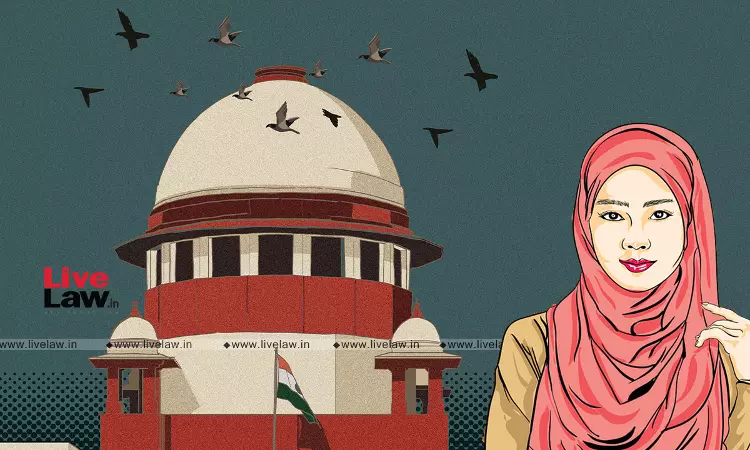
The Court also asked the petitioners to bring on record persons who are directly aggrieved.
The Supreme Court on Thursday (April 16) issued notice to the Union Government on a writ petition challenging Muslim personal law provisions as discriminatory against women.A bench comprising Chief Justice of India Surya Kant, Justice Joymalya Bagchi and Justice Vipul Pancholi was hearing a writ petition filed under Article 32 of the Constitution by Advocate Poulomi Pavani Shukla, along with...
This is a premium content
Available exclusively to
Our subscribers
Subscribe Premium 
INR 1099+GST
Your support helps us to bring you more content at
an affordable subscription scheme !!!
All payment options available
The Supreme Court on Thursday (April 16) issued notice to the Union Government on a writ petition challenging Muslim personal law provisions as discriminatory against women.
A bench comprising Chief Justice of India Surya Kant, Justice Joymalya Bagchi and Justice Vipul Pancholi was hearing a writ petition filed under Article 32 of the Constitution by Advocate Poulomi Pavani Shukla, along with an organisation Nyaya Naari Foundation, represented by Aisha Jawaid.
On March 10, when the petition was previously heard, the bench had expressed concerns about judicial interference, saying that it might create a vaccum regarding Muslim personal law, since the Indian Succession Act is not applicable to followers of the Islam faith. The bench had also orally commented that the enactment of a Uniform Civil Code can resolve the issue. The Court had then adjourned the matter, suggesting that the petition be amended to include suggestions as regards the relief.
Today, when the matter was taken, Advocate Prashant Bhushan, for the petitioners, responding to the Court's earlier concerns, stated that the Indian Succession Act can be applied if the Court was striking down the Shariat law provisions.
The Chief Justice then told Bhushan, "Someone will argue that it's a question of personal law."
Bhushan replied that personal law is not protected by Article 25 of the Constitution. "If it's discriminatory, it needs to be struck down. If it's struck down, the Indian Succession Act [can apply]. Only the Muslim succession law is not codified. Rules are so complicated that even lawyers find it difficult to discern. I often tell my Muslim friends not to oppose the Uniform Civil Code," Bhushan submitted.
CJI Surya Kant replied, "Uniform civil code is a constitutional ambition...it has nothing to do with religion." Justice Bagchi, while saying that the Special Marriage Act is one step towards uniformity qua marriage, asked if it was a matter for the Court to interfere or should it be left to the legislature. Bhushan replied that the Court can strike down discriminatory practices.
"Saying women will get half or even less than half compared to their male counterparts is discriminatory. This is a civil case and not an essential religious practice under Article 25," Bhushan said. He pointed out that even under testamentary succession, a Muslim cannot make a Will for more than 1/3rd of the property. Thus, Muslims cannot even make aWill for their self-acquired property as per their wish, the counsel appearing along with Bhushan added.
At this juncture, the bench said that it would be better if an aggrieved person approached the Court. Bhushan replied that the second petitioner organisation is represented by a Muslim woman, and that the Advocate-on-Record was a Muslim. He added that after the last hearing, statements were issued by several Muslim persons supporting the petition, and those statements have been produced as annexures. He stated that he can bring "any number of aggrieved persons" on record.
Bhushan also pointed out that the Supreme Court is already considering petitions filed by Muslim individuals seeking the application of the Indian Succession Act, instead of the Shariat Law.
"This is a very important constitutional issue which requires to be considered by this Court," Bhushan said. The bench agreed to issue notice, and tagged it along with the similar petitions.
The bench also asked Bhushan to bring on record some aggrieved persons. "Find out some actual sufferers, so that tomorrow an issue...", CJI said.
"We will certainly get a larger number of Muslim women who have been denied equal rights, and who are aggrieved," Bhushan said.
Bhushan acknowledged that it was a "sensitive matter." Justice Bagchi said that reformation should come from within the community. Bhushan replied that it cannot be completely left to custom.
"The answer is there in the Constitution," Justice Bagchi said, referring to the Uniform Civil Code. "But how much the society is ready is the question?" the Judge added.
Justice Bagchi further stated,"A scientific, rational, humanistic temper must be developed as encrafted in the fundamental duties." Bhushan then replied, "Unfortunately, we are going in the opposite direction."
Bhushan added that the fear of the Muslims was that "Uniform Civil Code will become de facto the Hindu Civil Code." However, even the Hindu civil code is also not uniform as it depends on the customs, he added. Bhushan said that the UCC must incorporate the most liberal elements which are not discriminatory.
The petitioners also referred to the similar matters pending in the Supreme Court - the case Sufiya PM v. Union of India, where an Ex-Muslim is seeking to be governed by the Indian Succession Act, and the matter Naushad K.K v. Union of India, where a practising Muslim seeks the option to be governed by the Indian Succession Act instead of the Shariat law.
The petition raised a constitutional challenge to provisions of the Muslim Personal Law (Shariat) Application Act, 1937, arguing that the enactment of the Uniform Civil Code of Uttarakhand, 2024 has created unequal civil rights among Muslims based solely on geographical residence.
The petition seeks several directions from the Supreme Court, including:
- A declaration that Section 2 of the Muslim Personal Law (Shariat) Application Act, 1937, insofar as it governs intestate succession and inheritance, is void under Articles 13, 14, 15 and 21 of the Constitution to the extent that it discriminates against Muslim women by denying them equal shares in inheritance.
- A declaration that the rules on intestate succession under the Shariat Act are not essential religious practices protected by Article 25 and, after the enactment of the Uttarakhand Uniform Civil Code, are subject to constitutional scrutiny under Part III of the Constitution.
- A declaration that the coexistence of the Uttarakhand UCC granting equal inheritance to Muslim women and the Shariat Act denying such equality elsewhere creates an unconstitutional geographical classification among women of the same faith, violating Articles 14 and 15.
- A direction that, until Parliament amends the law, Muslims across India should have uniform and gender-equal testamentary rights and that the one-third restriction on testamentary disposition should not operate to create unequal civil consequences between Muslims in Uttarakhand and those in the rest of India.
- A direction that Muslim women across India should have gender-equal inheritance rights, so that Muslim women outside Uttarakhand are not placed at a disadvantage compared to Muslim women in the State.
- A direction to the Union Government to amend the law of intestate succession, in exercise of powers under Articles 245–254 read with Entry 5 of List III of the Seventh Schedule, to ensure equal inheritance rights for Muslim women and equal testamentary rights for Muslims across India, consistent with constitutional guarantees of equality and dignity and the framework adopted in the Uttarakhand UCC.
Case: POULOMI PAVINI SHUKLA Vs UNION OF INDIA | D No. 67256/2025

Debby Jain
Debby Jain is a Correspondent with LiveLaw, covering the Supreme Court of India

