



- Home
- /
- Top Stories
- /
- Supreme Court Sets Aside Dismissal...
Supreme Court Sets Aside Dismissal Of Telangana Court Staff Over Forgery Charge, Orders Reinstatement
Gursimran Kaur Bakshi
11 Feb 2026 1:00 PM IST
Graver the charge, greater the need for care and circumspection in the disciplinary proceedings, the Court stated.
The Supreme Court today(February 11) passed an order for the reinstatement of a Subordinate Officer in the Court of Additional Senior Civil Judge, Karimnagar, who was dismissed from service on charges of forgery. Reinstatement must be with all consequential benefits, including all arrears of salary and ammoluments within three weeks.The appellant had submitted a medical certificate to...
This is a premium content
Available exclusively to
Our subscribers
Subscribe Premium 
INR 1099+GST
Your support helps us to bring you more content at
an affordable subscription scheme !!!
All payment options available
The Supreme Court today(February 11) passed an order for the reinstatement of a Subordinate Officer in the Court of Additional Senior Civil Judge, Karimnagar, who was dismissed from service on charges of forgery. Reinstatement must be with all consequential benefits, including all arrears of salary and ammoluments within three weeks.
The appellant had submitted a medical certificate to justify his unauthorised absence from service for a few days, but the doctor who had apparently issued it claimed it was fabricated. Upon departmental inquiry, the charges of misconduct and unbecoming of a government servant were proven, and the appellant was dismissed from service.
"For the reasons stated above, we set aside the impugned judgment of the High Court dated 12-02-2024 and the petition 40486 of 2021, and allow the appeal. Consequently, the order of dismissal from service dated 13-11-2018 and the order of the appellant authority dismissing the appeal dated 8-1-2021 will all stand set aside. The appellant shall be reinstated in service forthwith with all consequential benefits, including all arrears of salary and ammoluments since the non-employment was not due to the appellant's fault."
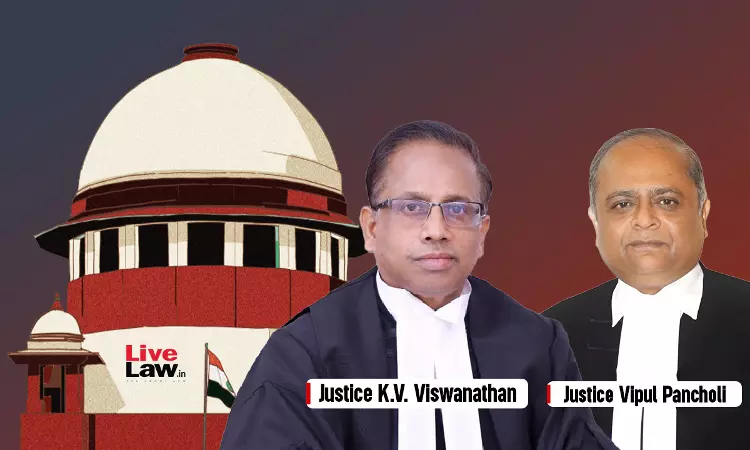
A bench comprising Justice KV Viswanathan and Justice Vipul M Pancholi passed the order.
The bench had called for the original files from the High Court and pursued the writings and signature of the medical certificate. It found that when a notice was sent to the doctor to appear before the Sessions Court with records of treatment he gave to the appellant, the Doctor had acknowledged the receipt by putting his signature, rubber stamp and date. The rubber stamp was found broadly similar to the one on the disputed medical certificate.
"What is however crucial is, the rubber stamp on Exhibit P7 is identical with the rubber stamp on the reverse of the copy of the notice dated 26-10-2017. What is also significant is that, the two undisputed signatures of Dr. Bommaraveni, one in Exhibit P9 and the other while acknowledging receipt of notice are themselves not identical, though broadly similar. The signature on the P7 medical certificate is not identical, though broadly similar to what is in the acknowledgement and what is on Exhibit P9. In this state of affairs, where nothing conclusive emerges one way or the other, prudence would dictate and common sense would command that the inquiry officer refer to the matter to a handwriting expert before recording a finding of fabrication of forgery. Failure to do so on facts constrains us to hold that the charge of forgery has not been proved."
Greater the charges, the stricter the compliance
The bench held that the charges against the appellant were grave in nature, the procedure had to be strictly complied with, and precaution and self-inspection should have been greater.
"Thereafter, highlighting the need for how investigations into the charges must be consistent with the requirement of the situation and how there must be fair play in action, where consequences could be loss of job and loss of livelihood, this court in Savoy Singh held as follows. It is important to comply with strict procedure, even though it is the preponderance of probability. This holding is extremely vital for the case at hand for the reason that, as was contended by the counsel by Sindhura, the penalty for a proved charge of forgery is mandatorily dismissed from service. Having failed to verify the disputed and undisputed signature, we find that the finding of the inquiry officer that Exhibit P7 was not genuine is perverse and based on no credible evidence."
The Court said that the main issue was not whether the case amounts an interference from the Court but whether the inquiry officer was right in accepting the word of the doctor that the appellant had submitted a fabricated medical certificate.
The question formulated was: "Then we say in this scenario, the real question that arises is whether the inquiry officer was justified in accepting the word of the doctor and rejecting outright the plea of the appellant to conclude that Exhibit P7(medical certificate) was not genuine, Exhibit P7 was not issued by PW2. Should the inquiry officer have verified the disputed writing in Exhibit P7 with the undisputed signature in Exhibit P9 and or whether the inquiry officer should have referred the matter to a handwriting expert? Greater the charge, greater the need for caution and circumspection. Even though it was a case of word against a word, the doctor admitted that the appellant consulted him."
The bench added that the doctor had even admitted that the letterhead on which the medical certificate was issued belonged to him. He had not even disputed about the rubber stamp nor that he had prescribed some tablets to the appellant.
"However, he does not remember the date and also stated that someone took away his blank letterhead and fabricated Exhibit P7 and he has not issued Exhibit P7 to the appellant at any point of time. The appellant not only suggested to the doctor that the handwriting was his, but he also confronted the doctor with Exhibit P9, a statement given by the doctor to the presiding judge on 28th, 10th, 2007 and suggested that the signature is of one and the same person. The appellant is a court attendant and PW2 is a medical practitioner."
Inquiry officer failed to verify whether the signature was Doctor's or not
The Court added that the inquiry office ought to have referred the matter to a handwriting expert since the disputed medical certificate was handwritten and the appellant had pointed out that the signature of the doctor was his in both the disputed and undisputed certificate which were called during the inquiry.
"When the doctor admits having treated the appellant, the least that was expected from the doctor is to provide the data on which he pleaded him to contradict the case of the appellant. However, the inquiry officer also verified the disputed and undisputed writings and if any doubt persisted, the matter ought to have been referred to the handwriting expert. We say so because Exhibit P7 is not a printed form certificate, but a fully handwritten certificate."
Background
As per the facts, the appellant was posted as an Office Subordinate in the Court of the Additional Senior Civil Judge, Karimnagar. The issue arose after he remained unauthorisedly absent from his duties from August 3, 2017, to August 7, 2017. Thereafter, as per the office memorandum, action was initiated against the appellant, and he was asked to explain his unauthorised absence.
Subsequently, the appellant submitted his explanation along with an application seeking leave on the grounds that he was suffering from a severe stomachache. Alongside the leave application, he submitted a medical certificate from Dr Bommaraveni Swamy Mudiraj, as per which, due to high fever, vomiting, and motions, he was admitted to the hospital during that period.
Pursuant to this, a notice was issued to Dr Mudiraj, requiring him to appear before the judge with a complete record of the treatment offered to the appellant. However, when the doctor appeared, he stated that the medical certificate was not issued by him. The doctor added that since he does not have a nursing home, the certificate appears to be fabricated.
Subsequent to this, a report was submitted that the appellant had fabricated the medical certificate to get away with the unauthorised absence. Again, an explanation was called for and in response to which, the appellant reiterated his illness and submitted that he is an illiterate person and can't forge/fabricate documents.
A departmental enquiry was initiated against the appellant, and charges of misconduct were levelled against him and were found to be proved under the Andhra Pradesh Civil Services (Classification, Control and Appeal) Rules. 1991. Consequently, he was dismissed from service on November 13, 2018. This was confirmed by the appellant authority in 2021.
The appellant challenged both orders before the Telangana High Court. But the High Court upheld the departmental enquiry, stating that it was held in accordance with the rules.
The appellant preferred a special leave petition before the Supreme Court. During the hearings, the Court had called for the original files of the disciplinary enquiry and other records.
Headnote
Departmental Inquiry — Proof of Misconduct — Fabrication of Medical Certificate — Graver the charge, greater the need for caution and circumspection — Findings of Inquiry Officer based on "word against word" without expert verification held perverse — Where a charge of forgery entails mandatory dismissal, fair play requires a thorough investigation consistent with principles of natural justice – Facts - The appellant, a Court Attender, was dismissed from service on charges of unauthorized absence and submitting a fabricated medical certificate. The Inquiry Officer relied on the statement of a Medical Practitioner (PW-2) who denied issuing the certificate, despite admitting the appellant consulted him and that the letterhead belonged to him - The High Court upheld the dismissal - Supreme Court Findings – i. Perversity in Findings: The Supreme Court held that the Inquiry Officer's conclusion was perverse as it was based on no credible evidence - noted that the rubber stamp on the disputed certificate was identical to the one used by the doctor on official notices; ii. Need for Handwriting Expert: Since the certificate was fully handwritten and the doctor's undisputed signatures varied, the Inquiry Officer should have referred the matter to a handwriting expert before recording a finding of forgery; iii. Standard of Proof for Grave Charges: When charges involve consequences like loss of livelihood, investigations must be consistent with the requirement of the situation and fair play. [Relied on Sawai Singh vs. State of Rajasthan (1986) 3 SCC 454; Paras 31-45]
Case Details: K. RAJAIAH v THE HIGH COURT FOR THE STATE OF TELANGANA|SLP(C) No. 11965/2024
Citation : 2026 LiveLaw (SC) 140
Click here to read the judgment
Gursimran Kaur Bakshi
Gursimran is the Principal Correspondent with LiveLaw for the Supreme Court. She can be reached out at: simrankaurbakshi@livelaw.in

