



- Home
- /
- Top Stories
- /
- '5-7 Yrs Punishment No Deterrant' :...
'5-7 Yrs Punishment No Deterrant' : Supreme Court Calls For Harsher Punishment In Acid Attack Cases & Making Illegal Sellers Liable
Debby Jain
4 May 2026 6:43 PM IST
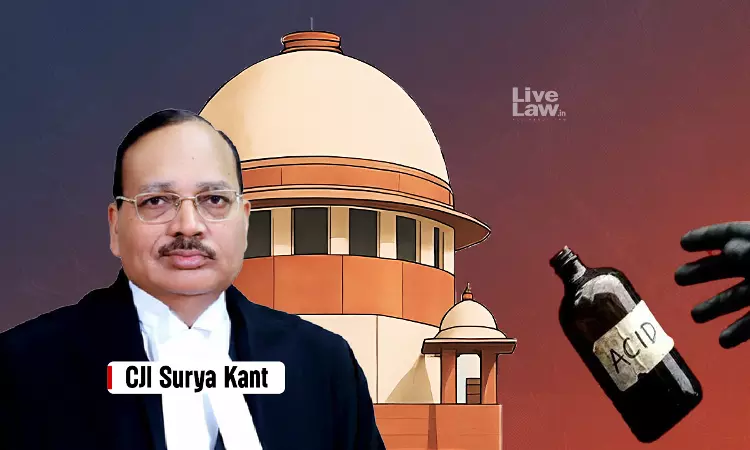
"Unless they [authorities] whip acid sellers, nothing will prevent [acid attacks]. Their criminal prosecution also very important" the CJI said.
In acid-attack survivor Shaheen Malik's case, CJI Surya Kant today expressed an inclination to take action against illegal sale of acid across the country. The CJI further opined that those who are selling acid illegally should be held accountable and made vicariously liable in acid attack cases.A bench of CJI Surya Kant and Justice Joymalya Bagchi was dealing with Shaheen Malik's...
This is a premium content
Available exclusively to
Our subscribers
Subscribe Premium 
INR 1099+GST
Your support helps us to bring you more content at
an affordable subscription scheme !!!
All payment options available
In acid-attack survivor Shaheen Malik's case, CJI Surya Kant today expressed an inclination to take action against illegal sale of acid across the country. The CJI further opined that those who are selling acid illegally should be held accountable and made vicariously liable in acid attack cases.
A bench of CJI Surya Kant and Justice Joymalya Bagchi was dealing with Shaheen Malik's petition seeking protection for victims who were forcibly administered acid or did not have external injuries on their body.
In a significant move, the Court extended the benefits under RPwD Act to such victims and ordered that the clarification shall be deemed to have retrospective effect from the date of coming into effect of the RPwD Act.
Listing the matter after 2 weeks, the Court further urged the Union to amend the relevant Schedule under the Act which excludes such victims from the ambit of provisions granting benefits.
During the hearing, the CJI voiced an earlier sentiment regarding inadequacy of the punishments prescribed in case of acid attacks. He lamented that even after the insertion of Section 326B in the IPC in 2013 (following the Nirbhaya gang rape case), which provided for minimum 5 and maximum 7 years of imprisonment, there had been no deterrent effect on criminals. Rather, within a period of 10 years, there had been an "alarming increase" in the number and brutality of acid-attack cases.
"Unfortunately, there has been no deterrent effect of the provision. The cases have increased, victims have multiplied. Rather, more brutal and more ruthless and barbaric attacks have been made. Now in 2023, it's absolutely Parliamentary prerogative that what should be the (quantum of) punishment, but don't you think that this punishment should been slightly harsher than what was there earlier? The alarming increase in cases is itself a serious issue of consideration that we should have probably brought a more robust mechanism to prevent this...", the CJI posed to SG Tushar Mehta.
He highlighted a need for considering two issues - one, adequate enhancement in punishments, and second, reversal of burden of proof. "Victim must immediately be absolved from the onus to prove. The onus must shift on the person who has been named", CJI said.
The SG on his part undertook to immediately bring the issues to the notice of the government. At one point, Sr Adv Mukul Rohatgi, for Shaheen Malik, recalled that 10-15 years ago, the Supreme Court had also taken up the issue of sale of acid and exclaimed that instead of buying a gun, someone can today easily buy a bottle of acid for Rs.50 and ruin another's life. "They are completely disfigured for life. Unable to carry on...", the senior counsel urged.
"That is another issue...today we don't want to address and pass an order. Definitely something requires to be done", CJI responded.
Notably, at one point, the CJI questioned as to why properties of the accused, including their shares in joint, coparcenary or parents' properties, cannot be attached to compensate the victims. "That share must immediately go to the victim. Let the parents also realize. Because it's [not] something that only children do..." he said.
However, Rohatgi claimed that in almost all cases, the victim is a woman targeted over some relationship. "If they can attach someone's asset in a PMLA case, they can certainly attach where one has virtually destroyed another's life at the age of 15, 20, 25", he said.
The SG informed that there is a provision in CrPC, which allows the Court at the end of a trial to compensate the victim in the way it deems fit. Rohatgi however countered that after a lapse of 10-15 years of trial, life of the victim is virtually gone.
At this point, the SG agreed with Rohatgi's contention that any compensation at such stage is "too little, too late".
Luthra, on the other hand, highlighted rules framed under the Poisons Act, contending that acid cannot be sold without a license. Stressing that the rules are inadequate, he urged the Court to consider the issue of how licenses are granted to acid sellers. In response, the CJI said that there should be a control order in place and further, sellers should be made vicariously liable for illegal sale.
"This offense has nothing to do with reformative principles. They need to be dealt with...so long as the law permits, our approach should be extremely harsh", he commented.
After the order was dictated, Shaheen Malik also addressed the bench. She alleged that rampant sale of acid is going on in India, especially Delhi. "Delhi mei acid khula bikk raha hai. Humne 2020 mei bhi survey kiya, Delhi HC mei approach kiya. HC ne fir keh diya ki govt ispe kuch karegi but implementation bilkul nahi hai. Abhi bhi humne poori Delhi mei survey kiya hai, acid khareeda hai. Poora record hai humare paas. Other state mei bhi kiya hai, lekin hum ye dekh rahi hain ki bilkul bhi implementation kahin bhi nahi hai. Asaani se, galiyon mei awaaz deke acid becha ja raha hai."
Listing the matter after 2 weeks, CJI Kant asked her to give suggestions on how to ban such sale of acid. "We will investigate it strictly. Unless you (authorities) will whip shopkeepers who are keeping it, nothing can prevent. And then on them also, the criminal prosecution framework, is very very important" he remarked.
Case Title : SHAHEEN MALIK v. UNION OF INDIA | W.P.(C) No. 1112/2025
Tags

Debby Jain
Debby Jain is a Correspondent with LiveLaw, covering the Supreme Court of India

