



- Home
- /
- Top Stories
- /
- Shiv Sena Case | Political Party's...
Shiv Sena Case | Political Party's Decision Must Prevail Over Legislative Party's Majority, Says Supreme Court In Hearing
Debby Jain
5 Aug 2026 7:55 PM IST
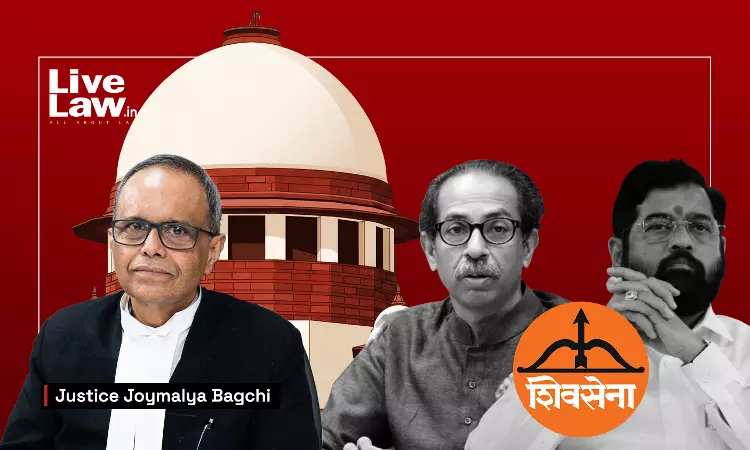
In the Shiv Sena dispute, the Supreme Court today orally said that as per existing law, a political party has subsisting control over a legislature party and any decision of the political party would prevail over the will of the majority of the legislature party.A bench of CJI Surya Kant, Justice Joymalya Bagchi and Justice V Mohana was hearing the plea filed by Uddhav Thackeray faction...
This is a premium content
Available exclusively to
Our subscribers
Subscribe Premium 
INR 1099+GST
Your support helps us to bring you more content at
an affordable subscription scheme !!!
All payment options available
In the Shiv Sena dispute, the Supreme Court today orally said that as per existing law, a political party has subsisting control over a legislature party and any decision of the political party would prevail over the will of the majority of the legislature party.
A bench of CJI Surya Kant, Justice Joymalya Bagchi and Justice V Mohana was hearing the plea filed by Uddhav Thackeray faction member Sunil Prabhu challenging the Maharashtra Speaker's refusal to disqualify MLAs of the Eknath Shinde faction under the 10th Schedule. Another petition, filed by Uddhav Thackeray, was also listed before the bench, which challenges the ECI decision that recognized the Eknath Shinde faction as the official Shiv Sena and allowed it the use of the 'bow and arrow' symbol.
During the hearing, Justice Bagchi observed :
"Law as it stands is Subash Desai. The control of the political party subsists over the legislature party. Any decision of the political party, validly demonstrated, must prevail over any will, even if of the majority of the legislature party."
The judge was recapitulating the legal position laid down in Subhash Desai v. Government of Maharashtra, where a Constitution Bench of the Court held that the Maharashtra Governor's decision to call a floor test after the Shiv Sena split was wrong, but Uddhav Thackeray could not be reinstated as he resigned before facing the floor test. In Subhash Desai, the Court had also held that a legislative party cannot act independent of the political party, and that legislative majority was irrelevant in determining which group was the real party.
Justice Bagchi opined that the ECI was wrong in considering whether there was majority in the legislature party. "It should be something to do with the political party", the judge remarked.
For context, the ECI's recognition of Shinde faction as the real Shiv Sena was based on the reasoning that they had legislative majority (i.e majority of MLAs were with Shinde). In 2024, the Speaker rejected the disqualification petitions by following the ECI's reasoning that Shinde group enjoyed legislative majority. Prior to that, in 2023, the Supreme Court had refused to stay the ECI decision, but permitted the Uddhav faction to retain the name "Shiv Sena (Uddhav Balasaheb Thackeray)" and the symbol "flaming torch" in terms of paragraph 133(IV) of the ECI order (during the pendency of the matter).
Uddhav faction's submissions
Today, Senior Advocate Kapil Sibal, appearing on behalf of the Uddhav Thackeray faction, made submissions in connection with the disqualification issue. He took the Court through a list of dates and contended inter-alia that:
- The ECI does not have jurisdiction to decide the validity of a party's constitution. Its decision, which refused to acknowledge the 2018 party Constitution on the purported ground that the Constitution was not on record, was erroneous. Besides, Article 11A of the constitution was highlighted before the ECI in 2013;
- Both parties acknowledge that they were appointed under the 2018 party constitution and neither party has challenged the said constitution. For as long as Eknath Shinde was a Cabinet Minister (while Uddhav Thackeray was Chief Minister), no issue was raised qua the 2013 or the 2018 party Constitutions;
- Uddhav Thackeray's status as leader of the party was never doubted by the respondents (including Eknath Shinde), or the ECI, or the Maharashtra Speaker. It was Uddhav Thackeray who, as Paksh Pramukh, appointed Eknath Shinde as Group Leader and Sunil Prabhu as Chief Whip. But in 2019, 31 MLAs "voluntarily gave up membership of the party" and resolved to declare Eknath Shinde as party leader and Bharat Gogawale as the Chief Whip. Notices were issued by Uddhav Thackeray while calling a meeting after the "anti-party" actions, to the effect that failure to attend would attract action under 10th Schedule, but the 31 MLAs did not attend the meeting. The MLAs' actions amounted to voluntarily giving up of membership, which is a ground for disqualification as per paragraph 2 of the 10th schedule.
- The 31 MLAs' defection was pre-meditated. They first went to Surat, then to Guwahati (in BJP-ruled stated). The MLAs' response was that they met at Surat by chance, but that could not have been a coincidence. The MLAs were in constant communication with the BJP and Eknath Shinde openly stated that they had the support of a big national party.
- After the MLAs' defection, Uddhav Thackeray convened a meeting, and it was resolved that Eknath Shinde be replaced by Ajay Chaudhri as Group Leader. The resolution was conveyed to the Deputy Speaker and he recognized it. However, the 31 MLAs passed a resolution recognizing Eknath Shinde as Group leader and Gogawale as Chief Whip, which was conveyed to the Speaker.
- The question before the ECI was not of the split of a 'political' party, but rather, a 'legislature' party. There was a split in the 'legislature party' and in terms of what was held in Subhash Desai, a faction of a legislature party cannot change the Group Leader or the Chief Whip.
- The 10th schedule no longer recognizes the concept of 'split'. The only defence is merger with another party, which has admittedly not happened in this case. A splinter legislative group cannot claim to be the real party.
- The issues have implications for the system of representative democracy. The defection of the 31 MLAs led to the toppling of the elected Maharashtra government, and eventually Eknath Shinde became Chief Minister.
In this regard, Sibal also spoke about the emerging trend of a legislature party merging with another political party. He submitted that when legislators contest on one party's ticket using its symbol, and then merge with another party and represent another symbol, the end result is that the electorate is not represented by the government it elected. This kind of manipulation and defection can change electoral verdicts and reduce the process of elections to a farce.
"Is it not fundamentally against the basic structure of the Constitution that the representative of a party suddenly moves to another party, forms coalition with it, topples the government and doesn't allow the disqualification proceedings to be decided until the next election?", Sibal asked.
- The whole matter suffered fait accompli, as no mandamus was issued to the Speaker. The Speaker responded to the notices only after the matter came before the Constitution Bench (in 2023). The 10th schedule is rendered otiose if the Speaker, an Election Tribunal, does not decide disqualification issues in time. Due to the delay occasioned, a government with no legal foundation served its term.
In response to Sibal's submissions, the bench made some crucial remarks. CJI Kant questioned whether there is any defined parameter in ECI's guidelines or the party Constitution on what constitutes majority of the political party. He also said that the meaning and limits of the term 'majority' reflect a gray area (which needs to be considered). Sibal replied that the Supreme Court's judgment in Sadiq Ali case has answered these issues by laying down tests to determine which faction has the majority.
Justice Bagchi queried if the election symbol belongs to the 'political' party. When Sibal replied that the symbol does belong to the political party, the judge said that the ECI was wrong in considering whether there was majority in the legislature party. "It should be something to do with the political party", the judge said.
The hearing will continue tomorrow at 2 pm.
Appearance: Senior Advocate Kapil Sibal and Devadatt Kamat (for Uddhav faction); Senior Advocates Neeraj Kishan Kaul and Maninder Singh (for respondents)
Case : Sunil Prabhu v. Eknath Shinde SLP(C) No. 1644-1662/2024 (and connected case)
Tags
Debby Jain
Debby Jain is a Correspondent with LiveLaw, covering the Supreme Court of India

