



- Home
- /
- Top Stories
- /
- Shiv Sena Dispute | If ECI...
Shiv Sena Dispute | If ECI Considers Events After Symbol Application, It Will Encourage Defections: Sibal Tells Supreme Court
Debby Jain
13 Aug 2026 9:34 PM IST
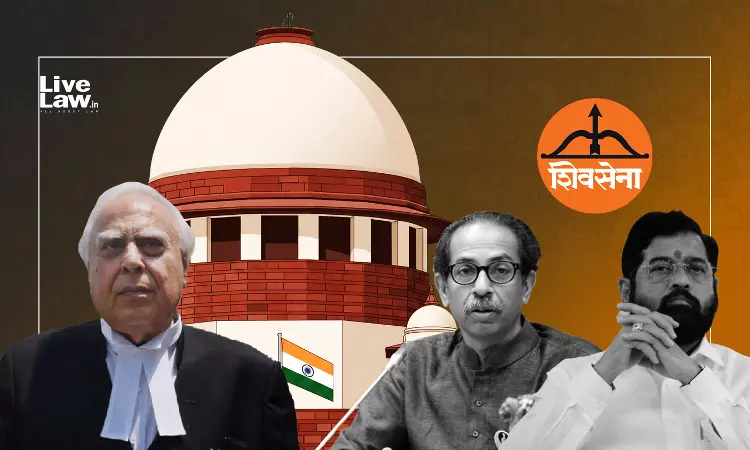
In the Shiv Sena matter, the Uddhav Thackeray faction today argued before Supreme Court that taking into account events after the splinter group has filed an application before the ECI claiming the party symbol can encourage defection and defeat the purpose of the anti-defection law (10th Schedule).Senior Advocate Kapil Sibal, for the Uddhav faction, recalled the Rajendra Singh Rana v....
This is a premium content
Available exclusively to
Our subscribers
Subscribe Premium 
INR 1099+GST
Your support helps us to bring you more content at
an affordable subscription scheme !!!
All payment options available
In the Shiv Sena matter, the Uddhav Thackeray faction today argued before Supreme Court that taking into account events after the splinter group has filed an application before the ECI claiming the party symbol can encourage defection and defeat the purpose of the anti-defection law (10th Schedule).
Senior Advocate Kapil Sibal, for the Uddhav faction, recalled the Rajendra Singh Rana v. Swami Prasad Maurya case pertaining to the 2003 split in the Bahujan Samaj Party. He pointed out that initially only 13 MLAs had defected to the Mulayam Singh Yadav-led Samajwadi Party. But as the then Speaker kept the disqualification petitions pending, more MLAs defected and finally when the number reached 37 (1/3rd majority), the Speaker passed an order recognizing the "split".
Ultimately, a Constitution Bench of the Supreme Court set aside the Speaker's decision and noted that the defection of the first 13 MLAs did not cross the majority threshold so as to be recognized as a split. Underlining the legal principle discernible from the case, Sibal said that nothing that happens after the first defecting action can be taken into account to recognize a split. "You can't have a 'snowballing of legislators' to make up the 1/3rd [majority]", Sibal quoted from the case.
"If you do that, you are interpreting the 10th Schedule against its intent. The purpose is to prevent the sin of defection, not to grant legitimacy to it. The relevant date is when you go to Speaker or ECI", he submitted. Sibal further contended that while subsequent events should not be taken into account for the issue of a 'split', they may be considered when one is dealing with the issue of disqualification.
"It's a very dangerous proposition of law to say that after the petition is filed under para 15[of the Election Symbols Order], subsequent events, not demonstrated on the day of the filing, will demonstrate whether the party claiming the symbol has a right to get the symbol because of subsequent events. Then you are allowing the use of political power, the use of the fruits of [that power] to garner support and therefore, in a sense, encouraging defection. You send somebody a notice under the Enforcement Directorate, you send somebody a CBI notice, he will immediately come to you. Whether he is a legislator or leader of the party. So, you can't interpret the constitution provisions to give encouragement to the very sin that anti-defection law tried to prevent" he argued.
A bench comprising Chief Justice Surya Kant, Justice Joymalya Bagchi and Justice V Mohana was hearing the petition filed by Uddhav Thackeray challenging the decision of the Election Commission of India that recognized the Eknath Shinde faction as the official Shiv Sena and allowed it the use of the 'bow and arrow' symbol. Another plea filed by Uddhav Thackeray faction member Sunil Prabhu challenging the Maharashtra Speaker's refusal to disqualify MLAs of the Eknath Shinde faction under the 10th Schedule was also listed before the bench.
Besides the aforesaid, Sibal referred to the Janata Dal case of 1994, where the ECI held that while applying the test of majority, the Commission has to see the relative majority of rival groups in both the legislative and organizational wings. He contended that the decision in that case was squarely applicable in favor of the Uddhav faction. Yet, the ECI relied on it to hold against the Uddhav faction. He further highlighted that test of majority has historically involved considering both the legislative and the organizational wings of parties.
On facts, he claimed that if all the legislators facing the disqualification proceedings had been disqualified on time, the Uddhav faction would have had majority in the legislative party as well.
Sibal also argued that under para 15 of the Election Symbols Order, ECI does not have jurisdiction to decide whether a party constitution is undemocratic or not. Even assuming the party constitution is undemocratic, he said, the only option with the Commission is to issue a notice for de-registration of the party. But under no circumstance is it empowered to benefit a rival faction by according it the party symbol, whilst ignoring the amended party constitution even though the rival faction head himself was appointed under the amended constitution.
The senior counsel further averred that ECI's power to de-register a party is limited to violation of the oath to the Constitution. It cannot de-register a party in the case of breach of constitutional provisions. Recalling a case where a plea was filed to de-register the BJP and freeze its lotus symbol, he pointed out ECI's stance that it cannot deregister a recognized political party in exercise of powers under Section 29A of the RP Act.
In response to Sibal's submissions on consideration of subsequent events, Justice Bagchi noted that while the disqualification issue comes to an end with the Assembly, the election symbol issue survives as long as the political party does. The judge further commented that the sin of defection is not akin to "corrupt practice" under the RP Act.
Subsequently, Sibal contended that the 5-judge bench's observation that the disqualification issue can be decided first by the ECI should be referred to a 7 judge bench. CJI Kant observed that the only concern is that such an issue must be decidedby an independent Tribunal.
Later, in response to Sibal's submission that the ultimate burden of preserving democracy lies with the court, Justice Bagchi remarked, "it [preserving democracy] is a collective responsibility".
Sibal will now be making submissions on the disqualification issue on Tuesday.
Appearance: Senior Advocate Kapil Sibal and Devadatt Kamat (for Uddhav faction); Senior Advocates Neeraj Kishan Kaul and Maninder Singh (for respondents)
Case : Sunil Prabhu v. Eknath Shinde SLP(C) No. 1644-1662/2024 (and connected case)
Tags
Debby Jain
Debby Jain is a Correspondent with LiveLaw, covering the Supreme Court of India

