



- Home
- /
- Top Stories
- /
- Gen Z Protests : Supreme Court...
Gen Z Protests : Supreme Court Expresses Intention To Quash FIRs Against Students, Says 'Question Of Their Future'
Debby Jain
18 Aug 2026 1:44 PM IST
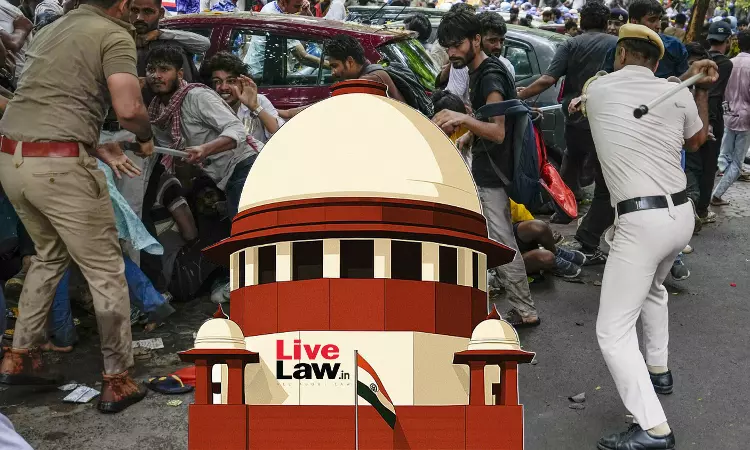
The Court also expressed the intention to form a committee headed by a former SC Judge to examine the issues relating to police force.
The Supreme Court on Tuesday expressed its intention to quash the FIRs registered against student protesters over the protests held in different parts of the country last month over issues such as exam paper leaks. The Court however clarified that cases against persons having a past history of grievous offences, who infiltrated the protests, will not be quashed.A bench comprising Chief...
This is a premium content
Available exclusively to
Our subscribers
Subscribe Premium 
INR 1099+GST
Your support helps us to bring you more content at
an affordable subscription scheme !!!
All payment options available
The Supreme Court on Tuesday expressed its intention to quash the FIRs registered against student protesters over the protests held in different parts of the country last month over issues such as exam paper leaks. The Court however clarified that cases against persons having a past history of grievous offences, who infiltrated the protests, will not be quashed.
A bench comprising Chief Justice of India Surya Kant, Justice Joymalya Bagchi and Justice V Mohana observed that it was a question of the future of thousands of students, and indicated that Article 142 powers could be invoked to quash the cases.
The CJI also reiterated the intention of the Court to constitute a high-powered committee to examine the issues related to the student protest violence, and indicated that the committee will comprise a former Supreme Court Judge, former High Court Judge and a former DGP. On the first day of the hearing of the petitions as well, the Court had expressed the plan to form a committee to monitor the investigation of allegations of police violence. The CJI revealed that the consent of a former CBI Director and a former DGP (not from any of the States involved in the present issue) has been obtained, and the bench will pass orders after considering all aspects. The CJI allowed the parties to give written suggestions regarding the mandate and scope of the committee.
Solicitor General of India Tushar Mehta submitted that except for 2873 individuals, who have grave cases involving grievous offences of murder, rape, abductions etc, the cases against others can be quashed. "FIRs against student protestors must be quashed. How to do... your lordships can decide. Anti-social elements who infiltrated have to be probed," the Solicitor General said. Advocate Vrinda Grover (appearing in plea against pellet guns) submitted that the States should supply the details of the FIRs so that they can be filtered.
Advocate Rizwan Ahmed, appearing for a petitioner opposing the withdrawal of cases against the protesters, insisted that the students should file affidavits expressing remorse. He submitted that as per the BNSS, there are only two categories of protests - lawful and unlawful, and since the July 20 Parliament march was unlawful, the participants cannot escape liability.
The CJI then responded, "Criminality has to be seen with the object and purpose for which students gathered there. Let's not forget their right under Art. 19 right. So long as you don't violate the law and raise your voice peacefully, those cases are completely distinguishable from cases of hardened criminals."
"Are they (students) seeking pardon or showing remorse? Your leniency would be termed in future as weakness of court..They may put an affidavit of remorse" Ahmed submitted. Justice Bagchi flatly stated that the Court will not make any such direction. "Not necessary," the Judge said.
Highlighting the Court's concerns over the future of students, the Chief Justice said, "It's a question of life and future of innocent students. Even if there is outcry...they have legitimate expectation from system."
Advocate Tanushree Bhalla raised the issue of online threats of rape/abduction and sexually offensive messages being received by women protesters. She submitted that social media accounts of certain women, who participated in the protests, have been taken down (thereby suppressing reporting), while their harassers are not facing any legal consequences. She alleged that the authorities have violated the Supreme Court's previous order barring the disclosure of digital data of protesters. She further sought directions for the State to disclose how many FIRs were registered on complaints of women protestors in this regard.
The CJI assured that the high-powered committee to be constituted by the Court will examine the issue.
Senior Advocate Shadan Farasat submitted that the disciplinary action however should be taken by police officers whose acts of molestation of women protesters have been documented in video evidence. Farasat argued that the State's action should not await the decision of the committee. Senior Advocate Gopal Sankaranarayanan also joined Farasat's request, and said that the Delhi police affidavit has admitted that officers in plainclothes and without nametags had used force against protesters. Senior Advocate N Hariharan and Advocate Vrida Grover also made similar submissions on behalf of the protesters. Senior Advocate Dr Menaka Guruswamy raised the issue over the use of facial recognition technology.
Delhi and Bihar police have filed counter-affidavits in the matter denying the use of excessive force against protesters.
Earlier, on August 3, the Court clarified that the States are at liberty to close or withdraw the FIRs, in accordance with law, against students over their participation in the student protests. The clarification pertained to a July 28 order, which had observed that the States can proceed with the investigation in the FIRs. The Court made the clarification after petitioners pointed out that the July 28 order can impede the withdrawal of FIRs, which was a commitment made by the Union to the Cockroach Janata Party leaders as a condition to end the protests.
Background
The Court was hearing a batch of petitions alleging excessive use of police force against students who participated in protests across the country from July 20 onwards over examination paper leaks and other alleged irregularities. The petitions concern incidents in Delhi as well as Assam, Bihar, West Bengal, Uttar Pradesh, Madhya Pradesh, Maharashtra and Kerala. Petitions have also been filed on behalf of injured police personnel and media persons.
At the previous hearing, the Court observed that the allegations prima facie made out a case for an independent and impartial investigation. The Court indicated that it may constitute a Special Investigation Team headed by a former Supreme Court judge and sought responses from the Union, Delhi Government and the States concerned. Solicitor General Tushar Mehta also accepted the Court's suggestion for an independent investigation under the monitoring of a retired judge appointed by the Court.
The Court directed the preservation of CCTV footage, drone footage, body-worn camera recordings, videography, wireless communication records and PCR logs relating to the protests. It also directed the authorities to preserve protesters' personal information and digital data and not disclose or publish such information for the time being.
While allowing the States and the Delhi Government to continue investigations into the FIRs registered over the protests, the Court directed that no coercive measures be taken against protesting students who have no criminal antecedents. It further directed all States to release children below 18 years detained or arrested in connection with the protests if they have no criminal antecedents, if necessary on execution of a simple bond by them or their family members.
Case : Shailendra Mani Tripathi v. Union of India & Ors., Diary No. 44078/2026 and connected cases
Tags
Debby Jain
Debby Jain is a Correspondent with LiveLaw, covering the Supreme Court of India

