



Landlord's Bona Fide Need Not Be Defeated By Subsequent Events Merely Because Of Long Pendency Of Eviction Case : Supreme Court
Saima Anjum
26 Nov 2026 1:34 PM IST
The Supreme Court has held that a tenant cannot rely on changes brought about by the prolonged pendency of eviction proceedings to defeat a landlord's otherwise established claim of bona fide requirement. It further added that the principle allowing courts to consider subsequent events is not meant to let the delay in adjudication become a ground for denying relief.
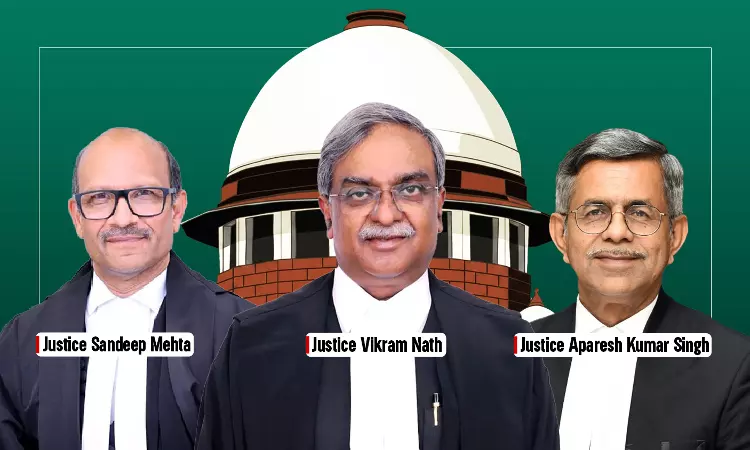
A bench of Justice Vikram Nath, Justice Sandeep Mehta, and Justice Aparesh Kumar Singh observed so while setting aside a Bombay High Court judgment that had interfered with concurrent eviction decrees. The High Court had held that the landlord's need was ended by subsequent events. However, the Supreme Court restored the decree of eviction.
The question before the bench was as under:
“Whether, in eviction proceedings, subsequent events can completely eclipse the landlord's reasonable and bona fide requirement?”
Background
In 2022, the appellant (a partnership firm) sued to evict the tenant from premises stating that the premises were required for the residential and medical needs of its partners and their families. The trial court passed the eviction order in 2014, and the Appellate Bench of the Court of Small Causes affirmed this in 2022.


However, in revision, the Bombay High Court set aside the decree, relying on Kedar Nath Agrawal v Dhanraji Devi and held that the requirement of one partner and his wife had ended with their deaths. It also held that the needs of the other partner's family and the second partner's son had been wholly satisfied, as they had acquired other premises and let out the second floor.
Aggrieved by the High Court's ruling, the partnership firm approached the Supreme Court.
The Supreme Court found the High Court's conclusion as unsustainable, both on facts and in law, noting that the suit was filed by the firm as landlord, and pleaded the needs of both partners and their families.
“The demise of Mangilal and his wife could have a bearing on the requirement attributable to them. However, it could not extinguish the entire claim of the appellant-firm without examining the independent requirement pleaded by the other partner,” the bench noted.
It added that how the partners would use the premises was not the issue before the court but the question was whether the partnership firm had established its reasonable and bona fide requirement, or not.
On Allegations Of Dissolution Of Firm:
The tenants sought to produce material under Order XLI Rule 27 of the Code of Civil Procedure, 1908 (CPC) to prove that the firm had been dissolved. On this, the Court referred to Section 47 of the Indian Partnership Act, 1932, which continues partners' authority for winding up and completing unfinished transactions, and observed as follows:
“The mere assertion that the firm stood dissolved could not, by itself, justify the conclusion that the pending eviction proceedings had lost their substratum. The applicability of Section 47 and the effect of the alleged availability of alternative accommodation were matters requiring due consideration.”
On Alternative Accommodation Acquired During Litigation:
The bench held that the tenants could not rely on arrangements the landlord's family made because of prolonged litigation and observed as follows:
“Once the appellant-firm had specifically pleaded that the tenanted premises were required for the benefit of its partners and their respective families, the subsequent arrangements made by them to secure alternative accommodation could not, by themselves, be permitted to defeat the claim for eviction. The respondents-tenants cannot rely upon such arrangements, brought about by the prolonged pendency of the proceedings, to contend that the original bona fide requirement no longer subsists.”
The Court questioned whether arrangements made out of necessity during pendency of litigation for over two decades can be used to deny relief, and answered as under:
“Such arrangements, by themselves, cannot be construed as extinguishing the original requirement. Rather, they may well be indicative of the hardship occasioned by the prolonged denial of possession.”
On Scope Of Kedar Nath Agrawal:
The Court observed that the High Court had misread Kedar Nath Agrawal as the principle in that case, “does not require courts, at every subsequent stage of litigation, to reassess the circumstances merely to examine whether the tenant can avoid eviction.” It also observed that the doctrine “is not intended to afford a tenant an opportunity to defeat an otherwise established claim by relying upon changes that are, in substance, a consequence of the very delay in adjudication.”
“We may clarify that the principle in Kedar Nath Agrawal (supra), permitting courts to take subsequent events into account before final adjudication, is not an inflexible rule requiring consideration of every intervening development. It is a judicially evolved principle intended to prevent multiplicity of proceedings, shorten litigation and enable courts to do complete justice between the parties. The circumstances identified therein are illustrative and must be applied with due regard to the nature of the subsequent event and its bearing on the original cause of action,” the bench clarified.
The Court referred to the circumstances listed in paragraph 16 of Kedar Nath Agrawal which reads as:
“A court of law may take into account subsequent events inter alia in the following circumstances:
(i) the relief claimed originally has by reason of subsequent change of circumstances become inappropriate; or
(ii) it is necessary to take notice of subsequent events in order to shorten litigation; or
(iii) it is necessary to do so in order to do complete justice between the parties.”
However, it clarified that the circumstances are illustrative and not unrestricted grounds.
“Any such event must be genuine and material, and must have a direct bearing on the original cause of action or the relief claimed. More importantly, a party cannot be permitted to take advantage of the mere passage of time or of arrangements necessitated by prolonged litigation to defeat an otherwise sustainable claim. The doctrine is intended to facilitate effective adjudication and enable the Court to mould relief, where necessary, and not to allow the very delay in adjudication to become a ground for denying the relief originally sought.”
On Landlord's Right:
The bench examined Section 16(1)(g) of the Maharashtra Rent Control Act, 1999 as applicable in the present case and noted that the words 'shall be entitled' make it clear that “once the Court is satisfied that the statutory requirement is established, the landlord's right to recover possession must be given effect to.” It added that the Act, “while affording protection to tenants against arbitrary eviction, does not intend to extinguish the legitimate proprietary interests of landlords.” It also held that the High Court failed to adequately consider the age and medical condition of the partners, both of whom had undergone surgery and been advised to avoid climbing stairs. It observed as follows:
“It would be wholly unjustified to expect the landlords to continue enduring such hardship and to climb additional floors to access their own property, when the very purpose of seeking eviction was to secure accommodation better suited to their age, health and residential requirements.”
The bench concluded that the requirement of the firm rested on the needs of both its partners and their respective families, and could not be confined solely to the requirement of one partner and his wife. The death of that partner and his wife could not extinguish the entire claim for eviction, particularly when the independent requirement of the other partner and his family remained to be considered.
It further held that the dissolution of the firm or the acquisition of alternative accommodation during prolonged litigation could not defeat the eviction claim, and that the effect of such events must be examined in light of the applicable statutory provisions and the circumstances in which they occurred.
Finally, it held that the principle laid down in Kedar Nath Agrawal does not warrant consideration of every subsequent event indiscriminately. Such an event must be genuine, material and have a direct bearing on the original cause of action or the relief claimed, and it cannot be used to defeat an otherwise sustainable claim merely on account of the passage of time.
Applying the aforesaid, the Supreme Court set aside the Bombay High Court judgment and restored the eviction order. However, considering the tenant's long-standing occupation, the Court allowed one year to vacate.
“However, having regard to the facts and circumstances of the case and the long-standing occupation of the subject premises by respondent No. 1, we grant them time until the expiry of one year from today to vacate and hand over peaceful possession of the premises to the appellant, subject to their filing an undertaking before this Court, within four weeks from today, that: -
i. they shall not create any third-party rights or part with possession of the subject premises;
ii. they shall clear all admitted rent arrears if any and also advance rent for the next one year within the aforesaid period of four weeks; and
iii. they shall hand over vacant and peaceful possession of the subject premises to the appellant upon expiry of the aforesaid period of one year.”
Appearances:
For Appellant: Mr. Vijay Kumar Arora, Sr. Adv.; Mr. Bharat Thakorlal Manubarwala, AOR
For Respondents: Ms. Vidhi Pankaj Thaker, AOR; Ms. Anshula Vijay Kumar Grover, AOR


