



- Home
- /
- Top Stories
- /
- Can TADA Convict Seek Remission?...
Can TADA Convict Seek Remission? Supreme Court To Consider In Abu Salem's Plea For Premature Release
Debby Jain
12 Jan 2026 6:10 PM IST
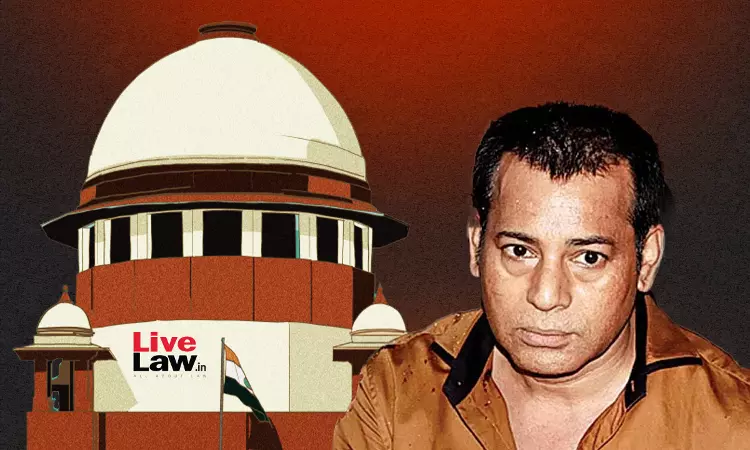
"Furnish Prison Rules of Maharashtra. Show us how 25 years sentence has been completed", Court told Salem.
The Supreme Court today asked terrorist Abu Salem, who seeks pre-mature release in terms of an Extradition Treaty entered between the Indian and Portugal governments, to produce Maharashtra State Rules to ascertain if it allows remission to a convict under the Terrorist and Disruptive Activities (TADA) Act.For context, Salem, who has been convicted in the 1993 Mumbai bomb blasts case, claims...
This is a premium content
Available exclusively to
Our subscribers
Subscribe Premium 
INR 1099+GST
Your support helps us to bring you more content at
an affordable subscription scheme !!!
All payment options available
The Supreme Court today asked terrorist Abu Salem, who seeks pre-mature release in terms of an Extradition Treaty entered between the Indian and Portugal governments, to produce Maharashtra State Rules to ascertain if it allows remission to a convict under the Terrorist and Disruptive Activities (TADA) Act.
For context, Salem, who has been convicted in the 1993 Mumbai bomb blasts case, claims the benefit of 3 yrs and 16 days jail-earned remission (for good conduct) in computation of a 25 year jail sentence, upon completion of which he shall be eligible for pre-mature release. He cites the Supreme Court's decision of July 2002, which relied on the treaty with Portugal and held that Salem will have to be released on completion of 25 years in jail.
A bench of Justices Vikram Nath and Sandeep Mehta heard the matter. It asked Salem to produce any rules prevailing in Maharashtra, as per which remission can be granted to someone convicted under the TADA.
"Let's see the prison rules of Maharashtra. Whether in a case where the accused is convicted for TADA, he would get a single day's remission or not?", said Justice Mehta.
"In both cases, your first date of arrest is somewhere in 2005. So show us how you have completed 25 years?", the judge added.
In the course of submissions, Senior Advocate Rishi Malhotra, for Abu Salem, pointed to the Extradition Treaty. The same was signed after the Indian government, on December 17, 2002, assured the Portugal government that since Salem was being extradited from their country for facing trial, he would not be handed over death sentence and his prison term would not go beyond 25 years. The senior counsel also contended that there are 2 types of remission, one being jail-earned remission, which has to be counted towards actual sentence.
Justice Mehta however disagreed and said, "Can't be. There are exceptions provided under the Rules which say - no remission".
"I am not on that at all. Even if it's 25 years actual, the law says that whatever you earn as a jail remission for good conduct, that has to be counted in your actual imprisonment", replied Malhotra.
Ultimately, the matter was adjourned, requiring that Salem furnish all the relevant rules, including the state prison rules.
To recap, initially, Salem approached the Bombay High Court with a plea for pre-mature release. He sought a direction for the authorities to specify a release date. It was argued that he had already completed 25 years of imprisonment after counting the remissions. Thus, as per the treaty signed between the Indian and the Portugal governments, he must be released.
He contended that his right to life and liberty as guaranteed under Article 21 of the Constitution of India was being breached by the authorities since he was being kept in prison beyond the 25 years jail term as agreed by the Indian authorities while signing the treaty.
Countering the same, the Maharashtra government claimed that Salem had not completed 25 years of sentence. In an affidavit filed by the Inspector General of Prisons & Correctional Services, the High Court was informed that till March 31, 2025, Salem had completed 19 years, 5 months and 18 days of his prison term.
"Abu Salem has a history which is not a palatable one at all. He has committed many offences in India. The Government of India gave a solemn sovereign assurance on December 17, 2002 through the then Deputy Prime Minister LK Advani, to the effect that the Government will exercise its powers conferred by the Indian laws to ensure that if extradited by Portugal for trial in India, the appellant would not be visited by death penalty or imprisonment for a term beyond 25 years," the affidavit stated.
The affidavit further mentioned that the proposal for Salem's release had been submitted to the Government for approval along with the opinion of the Advisory Board, concerned Court that had convicted the Prisoner, Police Report, the report of District Magistrate and with the recommendation by the Additional Director General of Police and Inspector General of Prisons.
In another affidavit filed by a Joint Secretary, Home Department, the State said that the proposal for premature release of Salem was under consideration of the Government and would be decided shortly.
In July, 2025, the High Court refused to grant Salem any interim relief, taking note of the 2022 decision. It observed that the Supreme Court judgment reckoned the date of Salem's arrest as October 12, 2005 and provided for pre-mature release upon completion of 25 years sentence. However, prima facie, it appeared that the period of 25 years remained to be completed, including the alleged pre-trial detention.
Background
In June 2017, a Special TADA Court had found Abu Salem and five others guilty of conspiring and carrying out a string of bomb blasts across Mumbai in 1993, which ended up killing 257 people. Abu Salem was convicted for offences punishable under Sections 120B, 302, 307, 326, 427, 435, 436, 201 and 212 of the IPC, Sections 3, 3(3), 5, 6 of the TADA Rapid Protection Act, and provisions of the Arms Act, Explosive Substances Act and the Prevention of Damage to Public Property Act.
The prosecution had submitted that the conspiracy was hatched in Dubai to avenge the demolition of Babri Masjid that took place on December 6, 1992. Salem transported and distributed arms and ammunitions used in the blast.
In September, 2017, a Mumbai court awarded life imprisonment to extradited Abu Salem.
On 13.12.2002, the Government of India had issued a Gazette Notification in exercise of the powers conferred by Sub-section (1) of Section 3 of the Extradition Act, 1962, directing that the provisions of the Extradition Act, other than Chapter-III, shall apply to the Portuguese Republic with effect from 13.12.2002.
By way of a letter dated 17.12.2002, the then Deputy Prime Minister-LK Advani on behalf of the Government of India assured the Government of Portugal that it will exercise its powers conferred by the Indian Laws to ensure that if extradited by Portugal for trial in India, Salem would not be visited by death penalty or imprisonment for a term beyond 25 years. After the request for the extradition of Abu Salem was considered and examined by the authorities in Portugal and by the Court of Appeals, Lisbon, Supreme Court of Justice, Portugal and Constitutional Court of Portugal, extradition of Abu Salem was granted in 8 criminal cases (3 cases prosecuted by CBI, 2 cases by Mumbai Police and 3 cases by Delhi Police).
Accordingly, Salem was extradited on 10.11.2005.
Case Title: ABU SALEM ABDUL QAYOOM ANSARI Versus THE STATE OF MAHARASHTRA AND ORS., Diary No. 60531-2025
Tags

Debby Jain
Debby Jain is a Correspondent with LiveLaw, covering the Supreme Court of India

