



- Home
- /
- Top Stories
- /
- Supreme Court Takes Note Of...
Supreme Court Takes Note Of Widespread River Pollution, Asks Rajasthan To Invoke Graver Offences Against Polluters
Amisha Shrivastava
24 July 2026 10:37 AM IST
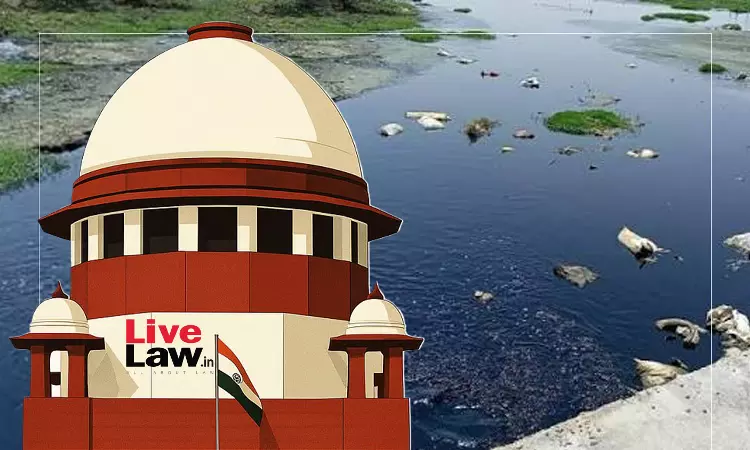
The Supreme Court recently sought Rajasthan Government's response to fresh reports alleging industrial pollution in different parts of the State, observing that the allegations, if found to be true, may point to a larger systemic failure in enforcement of environmental laws.The Court also asked the State to explain why prosecutions relating to illegal discharge of untreated industrial...
This is a premium content
Available exclusively to
Our subscribers
Subscribe Premium 
INR 1099+GST
Your support helps us to bring you more content at
an affordable subscription scheme !!!
All payment options available
The Supreme Court recently sought Rajasthan Government's response to fresh reports alleging industrial pollution in different parts of the State, observing that the allegations, if found to be true, may point to a larger systemic failure in enforcement of environmental laws.
The Court also asked the State to explain why prosecutions relating to illegal discharge of untreated industrial effluents had not invoked graver offences under the Bharatiya Nyaya Sanhita, 2023 and the Prevention of Damage to Public Property Act, 1984.
A bench of Justices Vikram Nath and Sandeep Mehta passed the directions while considering the Second Status Report of the High-Level Ecosystem Oversight Committee constituted to oversee restoration of the Jojari-Bandi-Luni river system and the Committee's comments on the first report filed by the Special Investigation Team (SIT).
During the hearing, the Court addressed Additional Solicitor General SV Raju, appearing for Rajasthan, and pointed out newspaper reports highlighting fresh environmental concerns in different parts of the State. One report alleged that the water of a pond near the Jojari river at Tanawada had turned pink due to industrial contamination, rendering it unfit for human consumption and livestock.
Another report alleged that around 2,500 industrial units were operating in the Sanganer-Dravyavati-Nevta region while only 143 possessed environmental clearances, resulting in untreated industrial waste being discharged into water bodies. A third report alleged that industrial effluents from the Sanganer-Sitapura industrial belt had travelled nearly 56 kilometres to the Morel Dam, contaminating water resources, damaging agricultural land and affecting several villages.
The Court noted that the allegations indicated contamination of water bodies across different regions of Rajasthan, possible discharge of untreated industrial effluents into rivers and reservoirs, adverse consequences for groundwater, agricultural land, wildlife and public health, and a prima facie failure of the regulatory authorities to effectively enforce environmental laws.
“The aforesaid newspaper reports prima facie disclose issues of environmental concern of a magnitude which cannot be ignored by this Court. The allegations, if found to be genuine, indicate contamination of water bodies across different regions of the State, possible discharge of untreated industrial effluents into rivers and reservoirs, adverse consequences for groundwater, agricultural lands, wildlife and public health, and a prima facie failure on the part of the concerned regulatory and administrative authorities to effectively enforce the statutory environmental framework and prevent such environmental degradation”, the Court stated.
The frequency of such reports from different geographical areas, the Court said, raised concern that the issue may not be confined to isolated instances but could reflect a larger systemic failure. It added, “Such allegations, therefore, warrant immediate examination by the competent authorities of the State of Rajasthan at the appropriate levels and a comprehensive response before this Court.”
Thus, the Court directed the State Government to file a comprehensive affidavit dealing with the issues emerging from the newspaper reports. The affidavit must disclose the factual position after due verification, the role of the concerned authorities, action already taken, responsibility fixed, if any, and the short-term as well as long-term measures proposed to address the environmental concerns and prevent recurrence.
The Court also questioned the manner in which environmental offences are being prosecuted. It directed the State Government to explain why prosecutions relating to illegal discharge of untreated effluents had not invoked Section 272 of the Bharatiya Nyaya Sanhita (malignant acts likely to spread infection of disease dangerous to life), Sections 326(a) and 326(c) (mischief by damaging irrigation works or public drainage), along with offences under the Prevention of Damage to Public Property Act, 1984.
Observing that illegal discharge of untreated effluents damages water bodies, government land, livelihoods and habitats and has wide-ranging consequences for human life, the Court opined that these offences were attracted and directed the State to invoke them in all pending and proposed prosecutions.
“Having taken note of the overall facts as available on record, we are of the firm opinion that the acts alleged are undoubtedly covered by the offences described above. Therefore, the State Government shall immediately initiate the process for invoking these offences in all pending as well as proposed prosecutions”, the Court stated.
The Court also directed the State to file a separate affidavit responding to every circumstance highlighted and recommendation made by the High-Level Committee in its Second Status Report and its comments on the SIT's first report.
The Second Status Report also flagged several issues requiring immediate attention. It raised concerns over the absence of proper demarcation of High Flood Line and buffer zones, resulting in industrial development and other activities within riverbeds and floodplains.
It also expressed concern over the proposed RIICO Industrial Area at Kakani and the Ambey Valley Industrial Park, pointing to prima facie irregularities and possible deviations from statutory requirements.
The Committee further recommended strengthening the Rajasthan River Basin and Water Resources Planning Authority by revisiting the existing statutory framework governing it.
The Committee additionally informed the Court that wildlife populations in villages around Melba, Dhawa and Jhanwar had declined because of contamination caused by effluent-laden water flowing through the Jojari river.
Accepting its recommendation, the Court directed the State to expedite transfer of identified parcels of land in Melba and Modathali villages to the Forest Department for development and preservation as forest and grassland ecosystems.
On the Common Effluent Treatment Plant (CETP) at Sangariya, the Court directed the Rajasthan State Pollution Control Board to prepare and implement a technical action plan for treatment and safe disposal of accumulated untreated effluent under the direct supervision of the High-Level Committee.
It clarified that no industrial operation of the CETP or its member industries could resume without prior permission of the Court and directed that the accumulated effluent be treated, as far as possible, before the next hearing to prevent further contamination during the monsoon.
The Court also directed that scientific testing of the effluents be conducted before and after treatment and clarified that the permission granted for treatment must not be used as a pretext for restarting industrial activity.
The Court also permitted industrial units claiming to fall within the “White Category” to approach the High-Level Committee. If, after physical inspection, the Committee finds that a unit is not discharging industrial effluents or contributing to pollution, it may order de-sealing of the premises and permit operations to resume subject to appropriate conditions, the Court said.
Making the Chief Secretary personally responsible for ensuring compliance with all previous and present directions, the Court directed the Chief Secretary to remain present through virtual mode on the next date of hearing. The matter will next be heard on August 4.
Background
The proceedings arise from a suo motu case initiated by the Supreme Court after a documentary uploaded on YouTube highlighted large-scale industrial pollution in the Jojari river affecting nearly two million residents.
In November 2025, the Court constituted a High-Level Ecosystem Oversight Committee headed by former Rajasthan High Court judge Justice Sangeet Lodha to prepare a comprehensive restoration and rejuvenation blueprint for the Jojari-Bandi-Luni river system.
In March this year, the Court expressed dissatisfaction over the State's failure to provide adequate logistical support to the Committee after it highlighted difficulties in carrying out the work entrusted to it.
Case: In Re: 2 Million Lives At Risk, Contamination In Jojari River, Rajasthan, Suo Motu Writ Petition (Civil) No. 8 of 2025
Tags

Amisha Shrivastava
Amisha Shrivastava is a Senior Correspondent with LiveLaw, covering the Supreme Court of India. She can be reached at amisha@livelaw.in

