



- Home
- /
- Top Stories
- /
- Supreme Court To Close Hate Speech...
Supreme Court To Close Hate Speech Matters; Reserves Order
Debby Jain
20 Jan 2026 1:41 PM IST
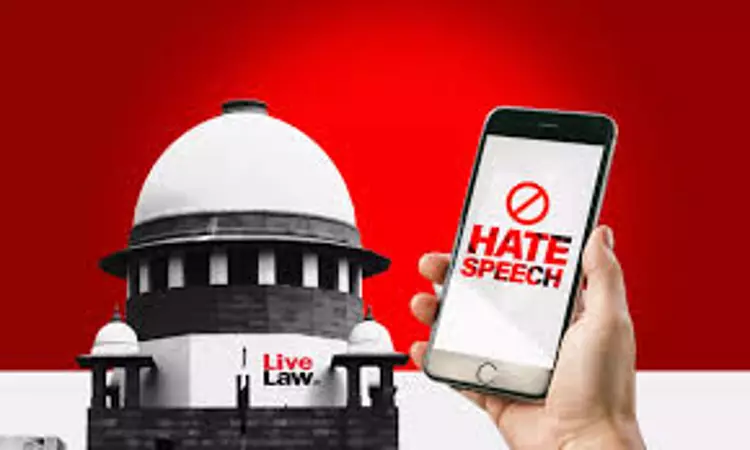
The Supreme Court on Tuesday reserved orders on a batch of writ petitions concerning the issue of hate speeches.A bench comprising Justice Vikram Nath and Justice Sandeep Mehta said that all the matters will be closed, reserving the right of the parties to pursue other remedies. The bench has decided to keep one matter(Kazeem Ahmad Sherwani Versus The State Of Uttar Pradesh And Ors) alive,...
This is a premium content
Available exclusively to
Our subscribers
Subscribe Premium 
INR 1099+GST
Your support helps us to bring you more content at
an affordable subscription scheme !!!
All payment options available
The Supreme Court on Tuesday reserved orders on a batch of writ petitions concerning the issue of hate speeches.
A bench comprising Justice Vikram Nath and Justice Sandeep Mehta said that all the matters will be closed, reserving the right of the parties to pursue other remedies. The bench has decided to keep one matter(Kazeem Ahmad Sherwani Versus The State Of Uttar Pradesh And Ors) alive, which relates to a 2021 alleged hate crime committed against a Muslim cleric in Noida, to ascertain the progress in trial and related steps.
Most of the petitions were filed in 2020, in the context of the 'Corona Jihad' slander campaign in social media, as well as the 'UPSC Jihad' show ran by Sudarshan TV. In 2020, the Court had passed orders to stop the telecast of the UPSC Jihad show.
Other petitions (Qurban Ali, Major General SG Vombatkere) were filed in the subsequent years with respect to the alleged hate speeches uttered during 'Dharam Sansad' events and religious gatherings. Among the batch were also PILs(Ashwini Upadhyaya) seeking legislation against hate speech. In 2023, the Court had passed a direction to all States/UTs that the police should suo motu register FIRs in respect of speeches promotion communal hatred and offending religious sentiments, without awaiting any formal complaint. Contempt petitions were also filed alleging non-compliance with the Court's directions.
Advocate Nizam Pasha, appearing for petitioner Qurban Ali, submitted that the problem was not inadequacy of law but the reluctance of enforcement agencies, particularly when the alleged offenders were connected to the ruling establishment.
He pointed out that hate speech events were often advertised in advance, and when the Court intervened earlier, incidents did not take place. According to him, the same “usual suspects” delivered hate speeches across different States, with multiple FIRs registered but no effective follow-up such as arrests, allowing repetition of offences.
Pasha also referred to an application seeking the takedown of an AI-generated video allegedly posted on social media by the BJP's Assam unit, which purportedly depicted apprehension of Muslims taking over the State if the party lost elections. He argued that there was a clear link between hate speeches and subsequent hate crimes, with speeches often calling for the very acts that later occurred.
Emphasising the Court's earlier directions, Pasha submitted that States had failed to act despite clear orders mandating suo motu FIRs, and that the Court had warned of contempt action against police officials for non-compliance. Simple measures like videographing events and ensuring preventive policing, he said, had earlier proved effective.
Senior Advocate Siddharth Aggarwal - appearing for CPI(M) leader Brinda Karat who has challenged the Delhi High Court's rejection of her plea seeking FIR against BJP leader Kapil Sharma, Anurag Thakur, etc., for alleged hate speeches -submitted that although his matter arose out of a hate speech issue, it raised a distinct legal question. He stated that a Magistrate had refused to direct registration of an FIR on the ground that prior sanction was required, a view later upheld by the High Court.
Aggarwal argued that sanction is required only at the stage of taking cognisance, not for registration of an FIR. He submitted that the reference in the Manju Surana case is pending on this issue. Justice Vikram Nath asked him to submit a brief note on the issue.
Senior Advocate MR Shamshad, appearing for Jamiat Ulema-i-Hind, stated that apart from general hate speech, there was a growing trend of targeting religious personalities, and complaints were routinely rejected by police on the erroneous ground of sanction.
Advocate Amit Pai, appearing for a political party, cited the example of alleged casteist remarks made by the Mayor of Guntur in September 2023, stating that despite attempts, no FIR was registered, reflecting complete non-compliance with the Court's directions.
Senior Advocate Sanjay Parekh, appearing for the People's Union for Civil Liberties (PUCL), recalled that the Court had earlier sought suggestions and indicated that it would follow the principles laid down in the Tehseen Poonawalla decision on mob lynching, though certain changes were required to address hate speech specifically.
Additional Solicitor General SV Raju submitted that there was compliance with the Court's directions. Referring to a contempt petition by Shaheen Abdullah, he stated that out of 16 incidents cited, FIRs had been registered in 10 cases, while in five others, no offence was made out.
Counsel for the News Broadcasters and Digital Association (NBDA) submitted that the media should also be heard, pointing out that the NBDA had framed guidelines on hate speech, which had been shared with the Court-appointed amicus curiae.
Senior Advocate Dama Seshadri Naidu, appearing for the Election Commission of India, stated that the ECI already had guidelines and enforcement mechanisms in place, and was not averse to strengthening them if the Court deemed it necessary.
Advocate Sharukh Alam, appearing in Kazeem Ahmad Sherwani, submitted that the petitioner, a Maulana, was targeted on account of his religious identity, and was stripped and assaulted. Denying that it was a hate crime, the counsel appearing for the State of Uttar Pradesh submitted that chargesheet has been filed in the case and trial was proceeding. The State's counsel further informed that departmental action has been taken against the erring officials. The bench said that it will keep this matter pending.
Alam submitted that hate speech should not be merely seen as a "law and order" problem, as it perpetuated discrimniation as well. Hence, it should be considered as a "constitutional tort", she urged, seeking the Court's consideration of the larger issue.
Referring to the controversy surrounding the “UPSC jihad” programme, Alam stated that although the show was toned down following Court intervention, similar content continued under a different name, raising broader concerns.
The counsel for petitioner Vishnu Gupta submitted that the plea sought SIT investigaiton against political persons like Owaisi and Udayanidhi Stalin for communal statements.
Senior Advocate Sanjay Hegde, the amicus curiae in the matter, after giving a brief context of the petitions, submitted that social media and mainstream media were amplifying hate since it gains viewer traction. "Is there some way these corporations can be reined in? If hate speech can be made unprofitable?" Hegde submitted. He referred to the orders passed by the Court in Tehseen Poonawalla and Amish Devgan cases relating to hate speeches.
After hearing all sides, the bench asked the parties to submit brief notes.
Case : Ashwini Kumar Upadhyaya v. Union of India W.P.(C) No. 943/2021 and connected cases.
Debby Jain
Debby Jain is a Correspondent with LiveLaw, covering the Supreme Court of India

