



- Home
- /
- Top Stories
- /
- Supreme Court To Examine If Closing...
Supreme Court To Examine If Closing Metro Services During Protests Is Proportionate
LIVELAW NEWS NETWORK
11 Sept 2026 12:09 PM IST
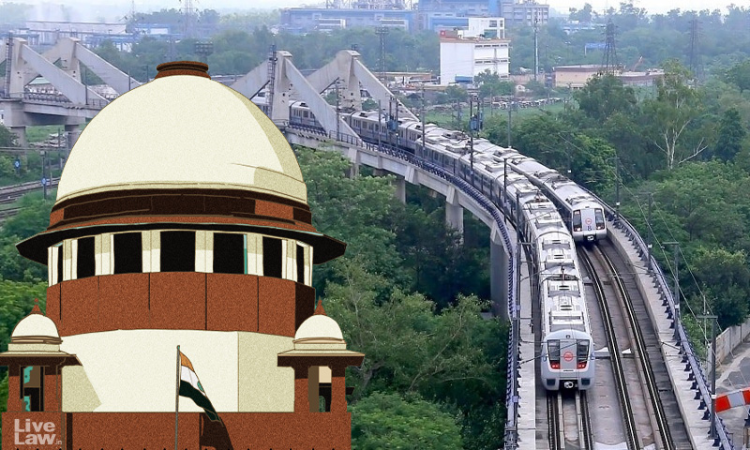
The Supreme Court has issued notice to the Union on a writ petition challenging the closure of 17 Delhi Metro stations during the July student protests as an illegal and disproportionate measure. The petitioner contended that there is no legal provision enabling the shutting down of a public utility to curb protests.The bench comprising Chief Justice of India Surya Kant, Justice Joymalya...
This is a premium content
Available exclusively to
Our subscribers
Subscribe Premium 
INR 1099+GST
Your support helps us to bring you more content at
an affordable subscription scheme !!!
All payment options available
The Supreme Court has issued notice to the Union on a writ petition challenging the closure of 17 Delhi Metro stations during the July student protests as an illegal and disproportionate measure. The petitioner contended that there is no legal provision enabling the shutting down of a public utility to curb protests.
The bench comprising Chief Justice of India Surya Kant, Justice Joymalya Bagchi and Justice V Mohana heard the matter yesterday along with other petitions concerning the student protests. The bench orally observed during the hearing that although Courts ordinarily defer to the executive on law-and-order measures, judicial scrutiny may be warranted when the exercise of such discretion becomes disproportionate. Responses were also sought from the Delhi Police, NCTD Government and the Delhi Metro Rail Corporation.
Appearing for the petitioner, Advocate Sanjiv Narang argued that the issue was not about the rights of protesters, but about the constitutional standards governing the shutting down of a public utility and restrictions imposed on the public.
The petitioner contended that the closure violated the doctrine of proportionality and the requirement that restrictions on constitutional rights must adopt the least restrictive or least invasive measure. He relied on the principles of proportionality evolved by the Supreme Court in the Anuradha Bhasin case and In Re: Ramlila Maidan Incident.
It was also argued that there was no specific statutory provision authorising the closure of Metro stations in such circumstances.
"There is no particular statute under which these orders were passed. In fact, no order itself was passed. There were only posts on X communicating the decision to the public. Most of the public don't know what are the posts on X.com," counsel submitted. He added that there was no specific reason stated for the shutting down, except a generic statement that it was done due to security reasons.
The counsel referred to the Metro Railways (Operation and Maintenance) Act and argued that there was no provision empowering authorities to shut down Metro stations on account of protests.
"The police can regulate a protest, but they cannot issue orders directing a public utility to be shut down," counsel submitted, while seeking directions for a standard operating procedure governing the closure of Metro stations during protests.
Justice Bagchi, however, noted that regulation of movement in the context of law and order is ordinarily undertaken through directions issued by police authorities under the relevant police laws. The Bench questioned whether the measures in question would fall within the State's law-and-order powers.
Justice Bagchi observed that courts have traditionally shown deference to executive authorities when it comes to decisions concerning law and order.
"Standard Operating Procedures in such cases is actually a mirage. When it comes to such questions, courts have deferred to the executive authority. It is only when it becomes disproportionate that courts step in," the Judge remarked.
The Court said it would therefore have to examine how the executive discretion to shut down the Metro stations was exercised in the particular circumstances.
"So we will have to examine the way in which the discretion is being exercised," Justice Bagchi said.
The Supreme Court thereafter issued notice on the plea.
Case : Sparsh Kant Nayak v. Union of India and Ors | W.P.(C) No. 1066/2026


