



- Home
- /
- Top Stories
- /
- Supreme Court To Examine TN Power...
Supreme Court To Examine TN Power DisCom's Challenge Against Electricity Rule Mandating That Tariff Should Reflect Cost
Amisha Shrivastava
19 Feb 2026 9:04 PM IST
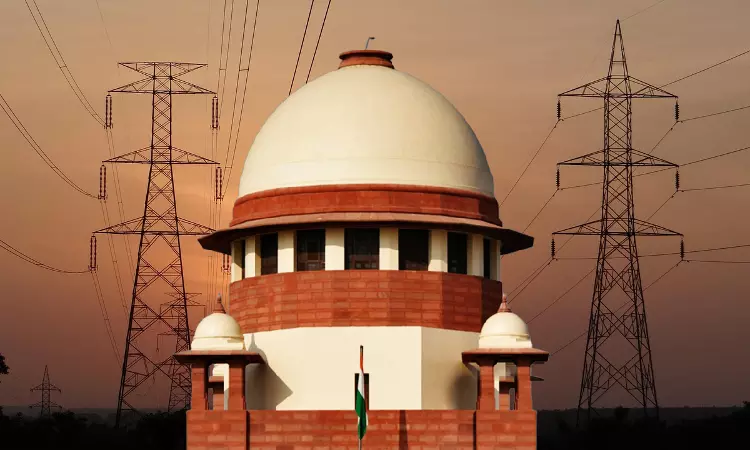
The plea is challenging Rule 23 of the Electricity (Amendment) Rules, 2024.
The Supreme Court today issued notice on a writ petition filed by Tamil Nadu Power Distribution Corporation Limited challenging Rule 23 of the Electricity (Amendment) Rules, 2024.A bench of Chief Justice of India Surya Kant, Justice Joymalya Bagchi and Justice Vipul Pancholi questioned State of Tamil Nadu's policy of absorbing electricity distribution losses.The Court asked counsel for...
This is a premium content
Available exclusively to
Our subscribers
Subscribe Premium 
INR 1099+GST
Your support helps us to bring you more content at
an affordable subscription scheme !!!
All payment options available
The Supreme Court today issued notice on a writ petition filed by Tamil Nadu Power Distribution Corporation Limited challenging Rule 23 of the Electricity (Amendment) Rules, 2024.
A bench of Chief Justice of India Surya Kant, Justice Joymalya Bagchi and Justice Vipul Pancholi questioned State of Tamil Nadu's policy of absorbing electricity distribution losses.
The Court asked counsel for the parties to assist it in understanding the fiscal policy of other states regarding losses incurred in power distribution. “We are issuing notice. We would like you to help us in understanding that what is the fiscal policy of other states about this power distribution”, the Court said.
The petition challenges Rule 23, which provides that tariff shall be cost-reflective and that the gap between the approved Annual Revenue Requirement of the distribution licensee and the estimated annual revenue from approved tariff shall not exceed 3% of that ARR. It further mandates that such gap, along with the carrying costs at the base rate of Late Payment Surcharge, be liquidated within a fixed time frame – three years for new gaps and seven years for existing gaps.
The petition contends that application of Rule 23 would result in a steep tariff increase and burden the public exchequer. The petition contends that applying the base rate of Late Payment Surcharge would substantially increase this liability and force tariff hikes. The plea argues that the Rule imposes a uniform cap and liquidation framework without accounting for the distinction between privately owned distribution licensees and State-owned utilities operating under welfare obligations.
Senior Advocate Gopal Subramanium, appearing for the petitioner, submitted that in Tamil Nadu, the State government has undertaken to absorb the financial losses of the distribution utility.
The bench questioned the fiscal implications of States absorbing the losses while continuing to implement large-scale welfare schemes.
Justice Bagchi pointed out that unless the concession falls within subsidy under Section 65 of the Electricity Act, 2003, which has to be granted in advance, there is no scope to depart from the scheme laid down in the earlier BSES Rajdhani judgment. He observed that if a State intends to grant subsidy, it must provide it in advance so that the Electricity Regulatory Commission can factor it into the approved revenue requirement.
“So if you wish as a state to give some subsidy, you have to give in advance and that can be considered in the subsequent tariff regime, so the people who suffer because of the tuning up of the tariff will get the rebate in the subsequent tariff fixed by the Commission” he highlighted.
He criticized the state policy, observing, “If you had a planned outlay, financial planned outlay, you should have given the subsidy in advance that these are my public utility, I am giving X subsidy. Then the Commissioner would be fully aware this is a subsidy. So the generating company cannot claim a shortfall, because their approval revenue requirement has gone down to that extent. But you don't do it. But in the midst of the tariff, you suddenly give them a largesse.”
He said that if subsidy is not provided in advance but granted later, it may create arbitrariness in fiscal administration and interfere with the statutory scheme of tariff determination.
“What we are really concerned, and this Article 32 petition really throws up this issue, is planned expenditure versus non planned expenditure… Suddenly, what you decide, I will give free electricity to a particular section of community. And that wholesome desire is definitely not unwelcome. But the manner in which that desire is being enforced creates a sense of arbitrariness in the fiscal administration and laws which are within your domain you can control, but agencies which are regulated by statute, like the Electricity Commission and the price of electricity, how can we interfere there? Just because the state suddenly has decided to open its purse a bit more”, he said.
The CJI said that the consumers should pay for the costs incurred in generating and supplying energy. “Whatever you are incurring the expenditure in generating and supplying that electricity, please ask them to pay that much only, so that people also have a sense of some savings and discipline in their life.”
Questioning the fiscal mechanism, the Chief Justice asked, “This money, which you say today the state will spend from where the state will get? Is it not the other taxpayers' money?... Let the government file an affidavit before us that from where they are going to divert these funds.”
The Chief Justice clarified that the Court does not intend to interfere in welfare policy but is concerned that states are running in deficit. He said, “See, we also don't want to intermingle…what should be the format of the welfare scheme, how it should be implemented, this is all political wisdom for elected government to decide. But our worry is that the states are running in deficit and still giving all this kind of…from where that money is coming? Ultimately, whether it's Tamil Nadu, whether it's Punjab, whether it is Haryana, whether it is North East, or Rajasthan or any state you name, they will have to have some kind of a mechanism. Say for example, 25% of the revenue you collect in the year, why it should not be completely dedicated only for development, development of the state?”
During the hearing, the bench also expressed concerns about 'freebie culture'. While the bench said that it cannot direct a State instrumentality to indulge in profiteering while providing an essential service, it disapproved of the grant of subsidised services even to persons who can pay. The fundamental principle is that a person should pay for the service, the bench said.
'Why Cash Transfer Schemes Just Before Elections?' Supreme Court Slams 'Freebies' Culture, Says Nation Building Hampered
Details of the petition
In its writ petition, TNPDCL has sought a declaration that Rule 23 is unconstitutional and violative of Article 14 of the Constitution and a consequential direction quashing the provision
What Rule 23 Provides
Rule 23 mandates that the gap between the approved Annual Revenue Requirement and the estimated annual revenue from approved tariff shall not exceed 3 percent of the ARR. It further requires that such gap, along with carrying costs calculated at the base rate of Late Payment Surcharge under the Electricity Late Payment Surcharge and Related Matters Rules 2022, be liquidated in a maximum of three equal yearly instalments. For regulatory assets existing on the date of notification of the Amendment Rules, the liquidation period is capped at seven equal yearly instalments
TNPDCL argues that this framework imposes a rigid and inflexible mechanism for liquidation of what are termed regulatory assets, without accounting for the origin, context or public welfare obligations of State owned distribution utilities
Challenge Based on Arbitrariness and Retrospectivity
The petition contends that the Rule is manifestly arbitrary as it mandates application of the base rate under the Late Payment Surcharge Rules, which TNPDCL describes as penal in nature, for calculating carrying costs on regulatory assets
It further challenges the third proviso to Rule 23 on the ground that it operates retrospectively by requiring liquidation, with carrying costs, of regulatory assets that existed prior to the notification of the Amendment Rules. TNPDCL argues that Section 176 of the Electricity Act, 2003 does not empower the Union Government to frame subordinate legislation with retrospective effect
The petition argues that delegated legislation cannot operate retrospectively in the absence of express statutory authorisation and asserts that the Rule ventures beyond the scope of the parent Act
Encroachment on Regulatory Commission Powers
TNPDCL has also argued that Rule 23 encroaches upon the statutory powers of State Electricity Regulatory Commissions under Sections 61, 62 and 63 of the Electricity Act to determine tariff. The petition states that the mandatory cap of 3 percent and strict timelines for liquidation erode the discretion of SERCs to balance consumer interest, financial viability of utilities and State policy directives under Section 108
It contends that the Union Government, through the impugned Rule, is effectively issuing binding directions to SERCs and State utilities, which is not contemplated under the Act
Financial Impact on Tamil Nadu
According to the petition, the Tamil Nadu Electricity Regulatory Commission has determined a cumulative revenue gap up to FY 2021 to 2022 at approximately Rs 83,000 crore. Following restructuring of TANGEDCO into separate generation and distribution entities, 71 percent of this liability, amounting to about Rs 59,038 crore, has been allocated to TNPDCL
The utility states that applying the Late Payment Surcharge base rate for carrying costs would inflate this figure by an additional Rs 11,601 crore, taking the total to around Rs 70,639 crore
It submits that mandatory liquidation within seven years would lead to an exponential tariff shock, with an estimated increase of around 50 percent in tariff, placing a disproportionate burden on consumers and the State exchequer
Context of Supreme Court Directions
The petition notes that in August 2025, the Supreme Court in BSES Rajdhani Power Ltd vs Union of India issued directions regarding liquidation of regulatory assets and referred to Rule 23 as a guiding principle. Subsequently, in October 2025, the Court modified its directions to align with the seven year timeline under Rule 23. TNPDCL states that APTEL has since directed State Commissions, including the Tamil Nadu Commission, to factor in carrying costs as per Rule 23
Stating that the issue has pan India implications and affects ongoing proceedings before APTEL under Section 121 of the Act, TNPDCL has urged the Supreme Court to examine the constitutional validity of Rule 23.
The petition was drawn by Advcoates Richardson Wilson and Apoorv Malhotra, and settled by Senior Advocate P Wilson. The petition was filed through AoR T Harish Kumar.
Case no. – W.P.(C) No. 158/2026
Case Title – Tamil Nadu Power Distribution Corporation Limited v. Union of India
Tags

Amisha Shrivastava
Amisha Shrivastava is a Senior Correspondent with LiveLaw, covering the Supreme Court of India. She can be reached at amisha@livelaw.in

