



- Home
- /
- Top Stories
- /
- UGC Equity Regulations 2026 Can...
UGC Equity Regulations 2026 Can Divide Society; India's Unity Must Be Reflected In Educational Institutions : Supreme Court
Debby Jain
29 Jan 2026 3:40 PM IST
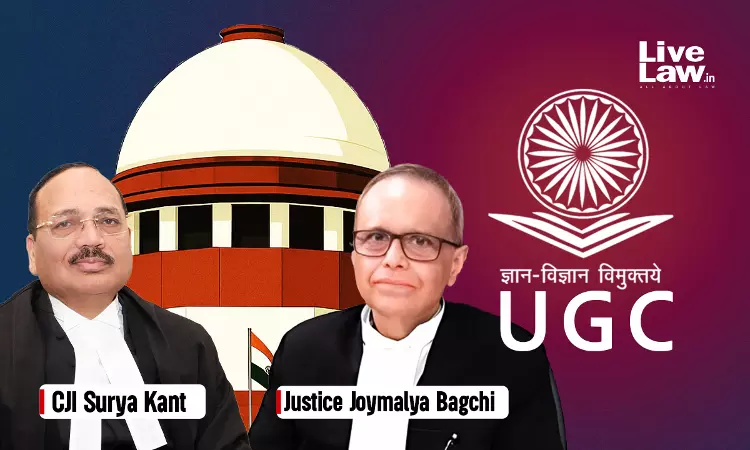
"Are we going backwards from whatever we gained in terms of achieving a casteless society?" asked the CJI.
While keeping in abeyance the University Grants Commission (Promotion of Equity in Higher Education Institutions) Regulations, 2026, the Supreme Court today expressed that the Regulations can have a very dangerous impact and divide society.A bench of CJI Surya Kant and Justice Joymalya Bagchi heard the matter. It called for the Union's response, noting that there are 4-5 questions...
This is a premium content
Available exclusively to
Our subscribers
Subscribe Premium 
INR 1099+GST
Your support helps us to bring you more content at
an affordable subscription scheme !!!
All payment options available
While keeping in abeyance the University Grants Commission (Promotion of Equity in Higher Education Institutions) Regulations, 2026, the Supreme Court today expressed that the Regulations can have a very dangerous impact and divide society.
A bench of CJI Surya Kant and Justice Joymalya Bagchi heard the matter. It called for the Union's response, noting that there are 4-5 questions involved insofar as constitutionality and validity of the Regulations are concerned.
When Senior Advocate Indira Jaising (who appears for petitioners in the 2019 PIL which led to notification of the UGC's 2026 Regulations) opposed the stay of the Regulations without proper chance of hearing to the other side, the CJI said,
"No, no, no. We will hear you. There are 4-5 questions which arise for consideration. Otherwise, this will have very sweeping consequences. It will divide the society, it will lead to very dangerous impact."
The CJI also commented that prima facie, the language of the Regulations exhibited complete vagueness and is capable of misuse. Justice Bagchi, on the other hand, emphasized the principle of non-regression and questioned why there should be a "regression" in the protective framework put in place by the wider, all-inclusive 2012 Regulations.
"Unity of India must be reflected in the educational institutions" said Justice Bagchi. "Are we going backwards from whatever we gained in terms of achieving a casteless society?" remarked the CJI.
Assailing the Regulations, some counsels pointed to the exclusion of provisions against ragging. One of the counsels posed a hypothetical that if a senior belonging to a reserved community indulges in ragging of a fresher belonging to general category, the fresher may not be able to resist or complain, as there can be a cross-case of caste discrimination from the senior's side. As such, the fresher may land up behind bars in his very first month of college.
In response, the CJI questioned if in such a scenario, the Regulations provide for redressal of the junior's ragging complaint. The counsel responded that the Regulations do not even define ragging. Taking note, the CJI expressed that ragging is one of the worst issues prevailing in educational institutions.
Before parting, the CJI also warned against politicization of the issue and pondered remodulation of the Regulations by an expert committee comprising an eminent jurist and persons "who understand social value and ailments that the society is facing".
Case Title:
(1) MRITUNJAY TIWARI Versus UNION OF INDIA AND ANR., W.P.(C) No. 101/2026
(2) VINEET JINDAL Versus THE UNION OF INDIA AND ANR., W.P.(C) No. 109/2026
(3) RAHUL DEWAN AND ORS. Versus UNION OF INDIA AND ANR., W.P.(C) No. 108/2026
Tags

Debby Jain
Debby Jain is a Correspondent with LiveLaw, covering the Supreme Court of India

