



- Home
- /
- Top Stories
- /
- Supreme Court Waives Prior Practice...
Supreme Court Waives Prior Practice Requirement For Civil Judge (Junior Division) Exams Till March 2027
Amisha Shrivastava
21 Aug 2026 11:52 AM IST
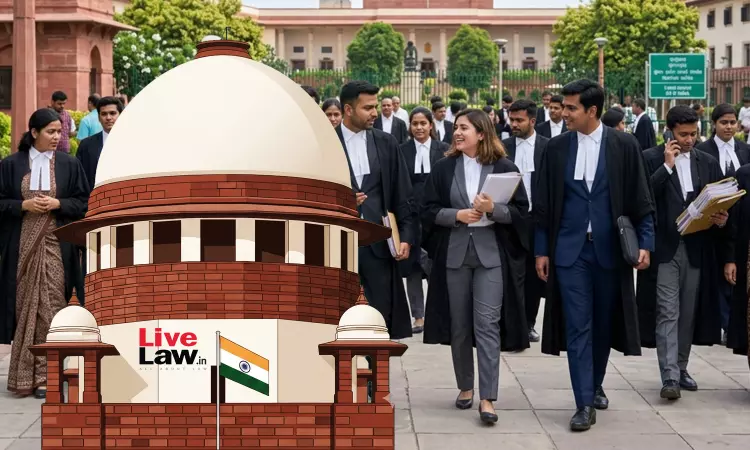
The Supreme Court has waived the three-year practice requirement for candidates applying for Civil Judge (Junior Division) examinations pursuant to recruitment notifications issued between May 20, 2025 and March 31, 2027.A bench of Chief Justice of India Surya Kant, Justice Augustine George Masih and Justice K Vinod Chandran (dissenting) said all law graduates would be eligible to apply...
This is a premium content
Available exclusively to
Our subscribers
Subscribe Premium 
INR 1099+GST
Your support helps us to bring you more content at
an affordable subscription scheme !!!
All payment options available
The Supreme Court has waived the three-year practice requirement for candidates applying for Civil Judge (Junior Division) examinations pursuant to recruitment notifications issued between May 20, 2025 and March 31, 2027.
A bench of Chief Justice of India Surya Kant, Justice Augustine George Masih and Justice K Vinod Chandran (dissenting) said all law graduates would be eligible to apply during this transitional period, notwithstanding the three-year practice requirement.
The Court said such candidates would be deemed to have completed one year of active practice for the purposes of their applications. They will not be required to furnish a separate certificate of practice for the deemed period.
“In light of the above discussions, we consider it appropriate to issue the following directions which would apply to all recruitment notifications, advertisements issued through the post of Civil Judge Junior Division in the transitional period, namely from the date the judgment was in May 25 pronounced and up to 31st March 2027. The directions are – all law graduates shall be eligible to apply notwithstanding the 3-year practice requirement. Having regard to the fact that more than one year has elapsed since the judgment under review was pronounced, such candidates shall, for the purposes of their applications, be deemed to have completed one year of active practice. There shall not be required to furnish a separate certificate of practice in report of the said deemed period”, the Court held.
Candidates selected pursuant to these recruitments will, however, be appointed initially as Trainee Judicial Officers. They will undergo one year of intensive training at the concerned State Judicial Academy, followed by one year of structured law clerkship. The clerkship will include six months under the supervision of the Principal District Judge, District and Sessions Judge or a member of the Higher Judicial Service, and six months under a sitting judge of the concerned High Court.
The Court said the training and clerkship periods will be treated as equivalent to two years of practice at the Bar for the purposes of the three-year requirement.
The direction has been issued as a transitional arrangement after the Court restored the three-year practice requirement in its May 20, 2025 judgment. The Court held that the sudden restoration of the requirement without a transitional arrangement had caused hardship to law graduates when had prepared for judicial examinations under the earlier regime.
“The sudden restoration of the requirements without any transitional arrangement has visited hardship upon law graduates who had prepared their professional lives on the basis of the regime that prevailed for over two decades”, the Court observed.
The Court has otherwise retained the requirement of prior practical exposure, but reduced the requirement to one year for recruitments after the transitional period. For recruitment notifications issued on or after April 1, 2027, candidates will have to possess at least one year of actual practice before appearing for the Civil Judge (Junior Division) examination. The selected candidates will have to undergo training for one year and clerkship for one year thereafter ( 6 months under District Judge and 6 months under High Court judge).
Headnote
Constitution of India, 1950 — Subordinate Judiciary — Judicial Service Rules — Recruitment to the post of Civil Judge (Junior Division) — Eligibility Criteria — Requirement of 3 years' practice at the Bar — Modification/Review of Judgment dated 20.05.2025 — Transitional Scheme vs. Post-Transitional Scheme - The Supreme Court had, vide its Judgment dated 20.05.2025 in All India Judges Association v. Union of India(Judgment under Review), restored the mandatory requirement of a minimum 3 years' practice at the Bar to be eligible to appear for the Civil Judge (Junior Division) examination - On review and clarification petitions, the Court examined the disproportionate impact and hardship caused to law graduates, women, and marginalized candidates due to the abrupt restoration of the 3-year practice rule - Held (per Surya Kant, CJI. and Augustine George Masih, J) - While the institutional necessity for prior exposure to court functioning before assuming judicial office is neither unreasonable nor displaced, the 3-year practice requirement cannot be applied in a manner that abruptly excludes candidates who arranged their careers under the pre-existing regime - The judgment under review stands modified to balance practical readiness with intellectual merit by prescribing a phased transitional model and a restructured post-transitional framework.
Key Holdings & Scheme Framed By Majority – i. Transitional Period (For advertisements/notifications issued after 20.05.2025 up to 31.03.2027) - Deemed Practice Exemption - All law graduates are eligible to apply without having to satisfy the 3-year actual bar practice requirement. Candidates are deemed to have completed one year of active practice, and no separate Certificate of Practice is required for this deemed period - Two-Year Training & Clerkship Model - Selected candidates shall be designated as "Trainee Judicial Officers"and must complete - Compulsory 1 year of intensive training at the State Judicial Academy (treated as equivalent to 1 year of practice at the Bar) with fixed emoluments equal to half the salary of a Judicial Magistrate First Class - Compulsory 1 year of structured Law Clerkship (6 months under a Principal District/District and Sessions Judge or Higher Judicial Service Member, and 6 months under a sitting High Court Judge), also treated as equivalent to 1 year of practice at the Bar - Confirmation: Trainee Judicial Officers shall be appointed to regular cadres carrying full pay scales only upon a satisfactory, reasoned evaluation report submitted by the supervising High Court Judge - ii. Post-Transitional Period (For advertisements/notifications issued on or after 01.04.2027) - 1-Year Actual Practice Mandatory: Candidates must possess at least 1 year of actual practice in the District Courts, verified through a Certificate of Practice showing recorded presence and participation in effective judicial proceedings - Subsequent Training: Selected candidates must undergo 1 year of institutional training at the State Judicial Academy, followed by 6 months of Law Clerkship in District Courts and 6 months of Law Clerkship under a sitting High Court Judge - iii. Higher Legal Education Not Countable as Practice - The duration spent pursuing higher legal education (LL.M., etc.) cannot be counted towards the mandatory practice requirement, as it does not foster the requisite familiarity with courtroom processes and practical court functioning - iv. Operation & Review of the Scheme - The scheme shall operate for five years, following which empirical data regarding its efficacy, recruitment quality, and officer performance shall be placed before the Supreme Court for reconsideration. [Relied on Re: Recruitment of Visually Impaired in Judicial Services, 2025 SCC OnLine SC 481; All India Judges Association v. Union of India (Judgment under Review / 6th AIJA Case), 2025 SCC OnLine SC 1184; Paras 58–80]
Dissenting Opinion (Per K. Vinod Chandran, J.) - No Ground for Review - There is no error apparent on the face of the record to warrant reviewing the well-considered judgment restoring the 3-year practice requirement - Impracticability of the Two Year Training Model - Requiring candidates to undergo two years of post-selection training/clerkship on half-pay prejudices recruits, creates unviable financial and administrative burdens on the exchequer, and leaves courts undermanned - making confirmation contingent on the subjective satisfaction of a High Court Judge creates arbitrary hurdles and results in disparate classes of recruits - Distinction from Civil Services - Judicial service cannot be equated with executive services like IAS/IPS; judicial officers exercise unhindered adjudicatory discretion from day one without hierarchical supervisory control over their judicial decisions - Courtroom practice is irreplaceable by pre-service training. [Paras 4-10]
Case no. – W.P.(C) No. 001110/2025
Citation : 2026 LiveLaw (SC) 841
Case Title – Bhumika Trust v. Union of India and connected cases
Tags

Amisha Shrivastava
Amisha Shrivastava is a Senior Correspondent with LiveLaw, covering the Supreme Court of India. She can be reached at amisha@livelaw.in

