



- Home
- /
- Top Stories
- /
- 'Surya Kumar Yadav Not Expected To...
'Surya Kumar Yadav Not Expected To Bowl Death Overs' : CJI Surya Kant Uses T20 Analogy, Stresses On Specialisation By Lawyers
LIVELAW NEWS NETWORK
2 March 2026 11:00 AM IST
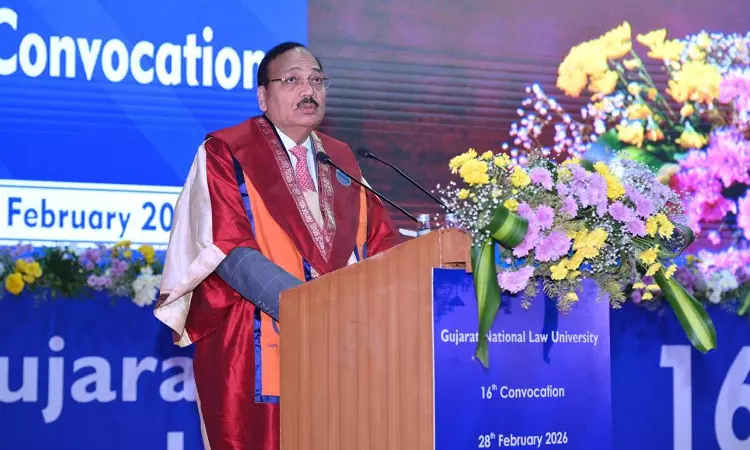
The profession does not reward those who attempt to do everything equally, CJI cautioned.
Chief Justice of India Justice Surya Kant on Friday emphasised the importance of professional specialisation for young advocates, observing that lawyers cannot excel in every aspect of the profession just as cricketers are not expected to perform all roles in a T20 match.Delivering the convocation address at the 16th Convocation Ceremony of Gujarat National Law University (GNLU), Gandhinagar...
This is a premium content
Available exclusively to
Our subscribers
Subscribe Premium 
INR 1099+GST
Your support helps us to bring you more content at
an affordable subscription scheme !!!
All payment options available
Chief Justice of India Justice Surya Kant on Friday emphasised the importance of professional specialisation for young advocates, observing that lawyers cannot excel in every aspect of the profession just as cricketers are not expected to perform all roles in a T20 match.
Delivering the convocation address at the 16th Convocation Ceremony of Gujarat National Law University (GNLU), Gandhinagar on February 28, the Chief Justice illustrated the point with a cricket analogy, stating that successful teams are built around clarity of roles and individual strengths.
Referring to T20 cricket, he remarked that no one expects Surya Kumar Yadav to bowl the death overs or Jasprit Bumrah to anchor a batting chase. Lawyers, similarly, must gradually identify the areas where their abilities lie and build their professional identities around those strengths, he said.
Justice Surya Kant observed that the legal profession rarely rewards those who attempt to do everything equally. According to him, lawyers who eventually become distinguished are those who recognise, often quietly and over time, where their thinking finds its natural discipline.
My dear graduates, where you belong in this profession is a question worth confronting early, because it rarely rewards those who attempt everything equally. Some of you might be cricket enthusiasts, and if you have been catching the T20 World Cup between hearings, you may have noticed something relevant here. The teams that succeed are not built on the assumption that every player must excel at everything. No one expects Suryakumar Yadav to bowl the death overs, or Bumrah to anchor a chase. They are trusted to do precisely what they do best, and the team is built around that clarity. The same principle, I would suggest, applies to your profession.
The CJI said that the distinguished lawyers did not reach the position by attempting everything equally. "They got there by recognising, often quietly and over time, where their thinking found its natural discipline," he said.
"This is not a question that resolves itself in the first year, or even the third. But it is worth asking early and returning to often, because the lawyers who seem most at ease with themselves are, almost without exception, those who somewhere along the way stopped performing and started practising," he added.
Addressing the graduates, the Chief Justice said that early years of legal practice often reveal the gap between academic learning and professional realities. While textbooks provide doctrinal understanding, actual practice demands discipline, responsibility and the ability to function under practical constraints, he said, describing the transition as the difference between “learning the map and navigating the territory.”
He noted that much of a lawyer's work remains unseen and uncelebrated, with research, drafting and strategic discussions often taking place without public recognition. Effort in the legal profession, he said, frequently precedes recognition by years.
Justice Surya Kant also stressed the importance of probity and professional credibility, stating that public trust in the legal profession depends on the integrity and consistency of those who practise law. Every professional choice made by a lawyer, he said, contributes either to strengthening or weakening confidence in the justice system.
He further expressed hope that legal education in India would increasingly adopt an apprenticeship-oriented approach, enabling students to learn not only about the law but within the profession through sustained engagement with its disciplines and responsibilities.
Concluding his address, the Chief Justice invoked the ancient injunction from the Taittiriya Upanishad, “Satyam Vada, Dharmam Chara” (Speak truth, Walk in righteousness), observing that these principles continue to define the ethical foundations of the legal profession. He told the graduates that the profession does not demand extraordinary achievements every day but requires reliability in difficult moments, which ultimately shapes the lawyer one becomes.


